In eight years, Gund Catalyst Awards have issued over $1.8 million in startup funds, supporting 28 innovative projects and over 140 UVM scholars. These projects have generated over $40 million in external funds and inspired real-world action.
In 2025, the Gund Institute launched the Gund Impact Awards, which aim to move solutions-oriented research to real-world action. Impact projects apply and scale solutions to environmental challenges based on demonstrated proof of concept and collaboration between UVM researchers and external partners.
Apply for Gund Catalyst Awards
Details
Gund Catalyst Awards increase collaborative research at UVM, while advancing our mission: to mobilize scholars and decision-makers to understand and solve critical, interconnected environmental challenges.
Successful projects will propose cutting-edge research, forge new interdisciplinary research partnerships, foster innovation, and envision a pathway toward real-world impact.
Awards can range from $10,000 to $50,000
The Gund Institute intends to fund two or more projects, with at least one related to biodiversity
Proposal deadline: October 14, 2026
Eligibility and Requirements
The Principal Investigator (PI) on each proposal must be a Gund Fellow.
Each proposal can have up to one Co-PI, who can be another Gund Fellow, any Gund Affiliate, or any UVM faculty member. Anyone can participate as a Collaborator.
For full requirements, see the Request for Proposals (RFP).
How to Apply
Proposals will be accepted through the InfoReady Review Portal until 11:59 pm EDT on October 14, 2026.
Required files to upload include:
Proposal narrative (see RFP for instructions)
Budget (use template provided in InfoReady)
Collaborators list (use template provided in InfoReady)
2-page CVs for PI, Co-PI (if applicable) and each investigator
Completed signature page (template in InfoReady) indicating support from the Chair and Dean
See full details and instructions in InfoReady.
Support Gund Catalyst Awards
Funded Research
Explore our research by clicking on the PDF or scroll through awards by year.
See summary of previous research awards (PDF)Learn More About Gund's Catalyst Awards
2025
How Land Conversion in the Brazilian Cerrado Affects Childhood Health
Land Use Change and Early Childhood Health Outcomes: A Brazil Case Study
Dates Active: October 2024-Current
Project Leads: Kelsey Gleason (PI), Gillian Galford (Co-PI)
UVM Team: Mojtaba Zeraatpisheh (postdoc), Ariane de Alemeida Rodrigues (postdoc), Uyoyoghene Adeyemo (Ph.D. student), Lara de Macedo Monteiro (Ph.D. student), Hannah Turner (research specialist), Nick Preschel (undergraduate research assistant)
External Collaborators: Ludmilla Rattis, Amazon Environmental Research Institute (IPAM); Daniel Veriera, EMBRAPA
Summary: Researchers are investigating if and how land use changes in Brazil’s Cerrado, South America’s largest savanna and second largest biome after the Amazon, are impacting children’s health, specifically incidences of diarrheal disease and chronic malnutrition. Using remote data, spatial analysis, and machine learning tools, the researchers will combine environmental, socioeconomic, and geospatial data to show how land use is changing in the region and affecting children’s health.
Products:
Presentation at the 2025 American Geophysical Union conference: “Using Machine Learning to Explore Socioeconomic and Environmental Influences on Diarrheal Disease in the Brazilian Cerrado”
Media:
April 28, 2025: Gund Institute Names 2025 Catalyst Award Winners, UVM News
February 17, 2026: From Classroom to Conference: UVM Junior Presents at National Scientific Meeting, UVM News
Understanding How Flooding Affects Vermont’s Soils
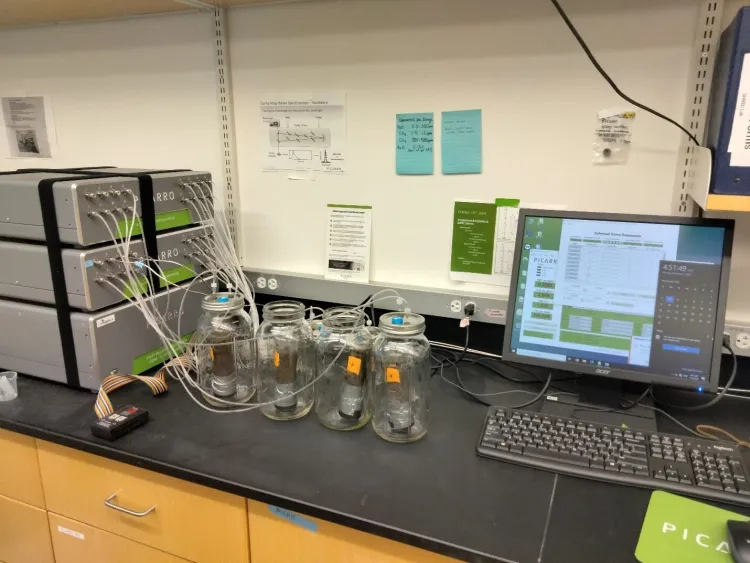
Understanding and addressing the impacts of flooding on greenhouse gas emissions, nutrient loss, and microbial community dynamics in agricultural soils
Dates Active: 2025-Current
Project Leads: Matthew Scarborough (PI), Heather Darby (Co-PI)
UVM Team: Carol Adair, Lindsey Ruhl, Agustina Montedonico Beiro
External Collaborators: None
Summary: As flooding becomes more common and extreme in Vermont, farmers are increasingly dealing with water-saturated fields. Using soil cores collected from the Borderview Research Farm in Alburg, Vermont, researchers are investigating how flooding affects soil nutrients, the soil microbiome, and the release of greenhouse gas emissions from soils. Researchers are also testing how soils treated with biochar and manure fare when flooded.
Media:
April 28, 2025: Gund Institute Names 2025 Catalyst Award Winners, UVM News
2024
Behavior and Environmental Behaviors, Value and Identity
“Starting with behavior” to understand links between pro-environmental behavior, values, and identity
Dates Active: February 2024-Current
Project Leads: Rachelle Gould (PI), Trisha Shrum (Co-PI)
UVM Team: Tabea Hoffmann (postdoc)
External Collaborators: Thomas Dietz, University of Michigan, Gund Global Affiliate, Co-Investigator; Cecily Maller, RMIT University, Australia, Co-Investigator
Summary: This project challenges the assumption that people act sustainably because they already hold strong environmental values. Instead, the researchers will test the idea that the reverse may also be true: engaging in environmentally friendly behaviors can shape people’s values and sense of identity. Through multiple experiments, the study will examine whether doing things like eating a few meatless meals or picking up trash leads individuals to care more about the environment. The goal is to better understand how behavior, values, and identity interact—which can offer new strategies for meaningful sustainability changes.
Assorted Outcomes:
Anticipated proposal to the Russell Sage Foundation Core Research Grants in Behavioral Science and Decision-making in Context
Media:
February 6, 2024: Gund Institute Names 2024 Catalyst Award Winners, UVM News
2023
Low-Cost Watershed Pollution Sensors
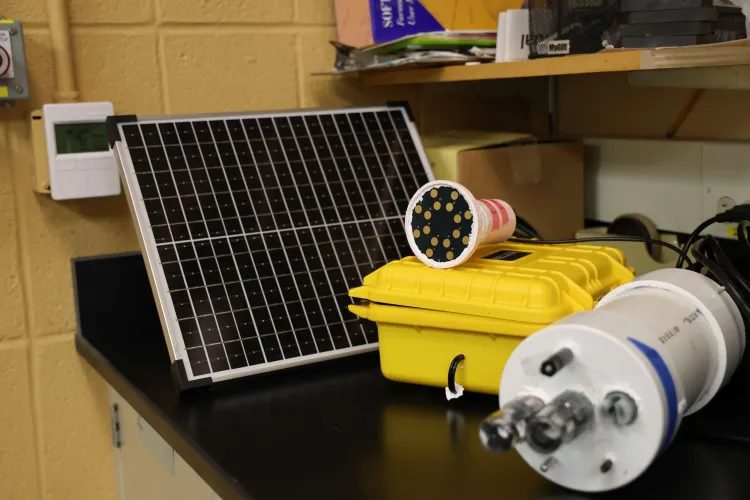
Low-cost and high frequency quantification of watershed nutrient loss in warming winters
Dates Active: January 2024-April 2026
Project Leads: Carol Adair (PI), Appala Raju Badireddy (Co-PI)
UVM Team: Andrew Schroth (CAS), Tian Xia (CEMS), Cooperative Institute for Research to Operations in Hydrology (CIROH)
External Collaborators: Lake Champlain Basin Program
Summary: Under a warming climate, places like Vermont are seeing more winter thaws and rain-on-snow events, which affect nutrient runoff in forests. This nutrient loss is not typically accounted for in forest soil research. Existing equipment to measure these nutrient fluxes is very expensive, can be damaged when left out for extended periods in winter conditions, and requires monitoring, which forces researchers to check icy field sites in difficult winter conditions. Under this project, the researchers designed new, small water nutrient sensors that can withstand winter conditions, be deployed across large sections of forest, and collect and transmit data; importantly, the new sensors are inexpensive and simple to produce and deploy. The team tested these sensors’ accuracy by ground-truthing them against other measurements of nutrients taken at the same field locations.
Assorted Outcomes:
This project produced groundwater nutrient sensors that are simple and inexpensive to make, easy to deploy in the field, and capable of collecting and transmitting data without the need for repeated battery replacement and other winter field maintenance.
Grants resulting from this work include two Vermont Space Consortium/NASA grants as well as grants from the National Science Foundation; NOAA/National Weather Service/U.S. Department of Commerce; and the Lake Champlain Basin Program.
Presentations of the work included the following seminars: graduate and department seminars in Civil and Environmental Engineering; a Vermont Water Center webinar; and a University of Maryland Center for Environmental Science seminar. Professional conference presentations include two at American Geophysical Union and one at the Sustainable Nanotechnology Organization.
Media:
January 19, 2023: Gund Institute Names 2023 Catalyst Award Winners, UVM News
July 6, 2026: ALCHEMIST's Modern-Day Magic, UVM News
July 22, 2026: The 90-Second Scientist: Environmental Engineer Raju Badireddy, Gund Institute YouTube
Co-creating Water Science Education in Jackson, MS
Intersections between the climate crises, environmental racism, and STEM education: co-creating culturally relevant teacher education in Jackson, MS
Dates Active: March 2023-August 2024
Project Leads: Julia Perdrial (PI), Leon Walls (co-PI)
UVM Team: Professors Regina Toolin (UVM College of Education and Social Services) and Donna Rizzo (UVM College of Engineering and Mathematical Sciences); and Gund Graduate Fellow Mandy Nix (UVM Rubenstein School of Environment and Natural Resources)
External Collaborators: Professors Deidre Wheaton, Chandar Lewis, and Jacquelin Jackson (all of Jackson State University/JSU)
Summary: The researchers sought opportunities to partner with educators in Jackson, MS following a water crisis that had affected predominantly Black neighborhoods, creating disruption and unknown effects on children and their learning. The team planned to co-create water science education with teachers and community members that is grounded in the local societal and historical context. The team organized listening sessions with Jackson teachers and community members, then helped to create networks among formal and informal science educators and water science experts in Jackson. Finally, the team created a new science curriculum for future teachers in a JSU undergraduate class.
Assorted Outcomes:
Networks established among Jackson elementary science teachers and community water and science experts and informal educators
New approach to JSU undergraduate science education course
Media:
January 19, 2023: Gund Institute Names 2023 Catalyst Award Winners, UVM News
April 20, 2026: Education After Emergency: UVM, JSU Researchers Co-Create Education Approach Following Jackson Water Crisis, UVM News
2022
Assessing Soil Health with Coffee Farmers in Mexico and Guatemala
Towards a regional vision for agroecological soil management in the coffee landscapes of Mesoamerica
Dates Active: 2022-2024
Project Leads: Ernesto Mendez (PI), Joshua Faulker (Co-PI)
UVM Team: Andrew Gerlicz (Ph.D. student)
External Collaborators: Alejandra Guzman Luna, Universidad Veracruzana, Mareli Dominguez Gomez and Rosa Lopez Valentin with CESMACH Coffee Coop, and Hanory Lopez, Julio Lopez and Cesar del Valle with ASOBAGRI Coffee Coop, as well as farmers from both coops.
Summary: This project worked with organic coffee producers in Mexico and Guatemala to investigate and promote soil health to protect crop yields, livelihoods, and the environment. It employed a Participatory Action Research approach to explore the efficiencies and challenges of soil management and seek consensus on practices for maintaining healthy soils. With local experts and producers, the team co-created a soil health assessment that makes soil data collection and analysis more accessible and established a baseline for soil health that can be used to launch future research.
Assorted Outcomes
- Spurred additional research led by UVM’s Andrew Gerlicz with the ASOBAGRI farmers’ cooperative and Catholic Relief Services in Guatemala to experiment with the use of different species of cover crops in recently re-planted coffee plots is ongoing
- ASOBAGRI and CESMACH coffee cooperatives redoubled their efforts to promote the fabrication and use of organic fertilizers by their farmers
- Famers who participated received individualized results of the soil analyses (both the soil test results as well as the analyses that our research teams conducted at the cooperative offices)
- Findings were also presented to cooperative leadership and technical staff
Products:
- Presentation at the 2023 Ecological Society of America conference
Media:
- February 4, 2022: Gund Institute Announces 2022 Catalyst Award Winners, UVM News
Expanding Renewable Energy in Remote Alaska
Integrated community microgrids transitions and energy sovereignty in remote communities in Alaska
Dates Active: 2022-2025
Project Leads: Bindu Panikkar (PI), Mads Almassalkhi (Co-PI)
UVM Team: Jayashree Yadav (post-doc), Asim Zia (College of Agriculture and Life Sciences)
External Collaborators: Sonya Ahamed, Michigan Technological University; David Breecker, RIT Energy Sovereignty Institute; Diane Hirshberg, Institute of Social and Economic Research, University of Alaska, Anchorage; Gwen Holdmann, Alaska Center for Energy and Power, University of Alaska, Fairbanks; Maribeth Murray, Arctic Institute of North America, University of Calgary; Greg Poelzer, Community Appropriate Sustainable Energy Security Project, University of Saskatchewan; Erin Whitney, Alaska Center for Energy and Power, University of Alaska Fairbanks; Nathan Williams, RIT Energy Sovereignty Institute
Summary: For this project, the UVM team partnered with municipal and tribal leaders, local utilities and private firms, and later, University of Alaska researchers, to help the Arctic village of Shungnak lower energy costs by introducing renewable energy to the grid. Located in Alaska’s remote Northwest Arctic Borough (NAB), Shungnak and other nearby communities face transportation challenges and high costs to obtain the diesel fuel that powers the generators they rely on for energy. The NAB made a year’s worth of community energy data available and helped the team create a series of electrical one-line diagrams and power system models to determine how renewable energy and electrical heat-pump systems could be used to reduce the community’s dependence on far-away fossil fuels and lower energy costs for the community. Their work indicated that Alaska’s unique subsidy structure and the available solar-and-battery hybrid system could support air-source heat pumps that accomplish both goals.
Assorted Outcomes:
- Additional funding provided by the Sloan Foundation, Department of Energy and the Northwest Arctic Borough Alaska.
- Recipient of Gund Impact Award. The researchers plan to expand the project both in scope and geographic scale.
- Presented research at Institute for Policy Integrity, New York School of Law; West Virginia University College of Law Just Energy Transitions conference; Energy Steering Committee Meeting, Northwest Arctic Borough; Applied Energy Symposium MIT; New Energy Summit Panel Discussion; Gund Slam, Gund Coffee Talk
- Local energy utility purchased transformers under a federal grant to accommodate the new heat pumps installed in households in the region
Products:
- Jayashree Yadav, Ingemar Mathiasson, Bindu Panikkar, Mads Almassalkhi. Community-centric multi-criteria assessment framework for energy transition in Arctic microgrids. Sustainable Energy, Grids and Networks. (2026). https://doi.org/10.1016/j.segan.2026.102165.
- J. R. Yadav, I. Mathiasson, B. Panikkar and M. Almassalkhi. Electricity Rate Analysis for Remote Alaskan Microgrid Communities: Impact of Renewable Energy Integration and Electrification. 2026 IEEE Green Technologies Conference (GreenTech), Boulder, CO, USA. (2026). 10.1109/GreenTech68285.2026.11471585
Media:
- February 4, 2022: Gund Institute Announces 2022 Catalyst Award Winners, UVM News
- October 25, 2025: Solar in Alaska? UVM Researchers Aim to Lower Energy Costs in Northern U.S., UVM News
- July 30, 2026, Gund Institute Awards $300,000 to Bring Clean, Reliable Energy to Remote Alaska Communities, UVM News
2021
Hands-on Science Curriculum in Winnoski, VT
Ecological Design and K‑12 Students of Color: An Inquiry-Based Science Approach
Dates Active: 2021–2022
Project Leads: Eric Roy (PI), Leon Walls (Co-PI)
UVM Team: Tricia Brown
External Collaborators: Nancy Keller, Andrew Wild, Anja Mosehauer, Gina Krol (middle school teachers, Winooski School District)
Summary: This project explored how inquiry‑based ecological design can strengthen science learning among middle school students of color in Vermont’s most diverse school district. Researchers partnered with Winooski School District (WSD) teachers to develop hands‑on curricula integrating ecological design, food systems, water quality, and sustainability into 6th‑ and 7/8th‑grade classrooms.
Assorted Outcomes: The project produced two new inquiry‑based ecological design curricula aligned with the Next Generation Science Standards. Four Winooski Middle School teachers participated in summer curriculum design workshops and received year‑long intermittent training to support implementation. The Catalyst project also contributed to a successful U.S. EPA grant that launched a follow‑up initiative on food‑waste co‑digestion and anaerobic digestion with WSD 6th‑grade teachers as well as a grant from the Lake Champlain Basin Program, which included a K-12 outreach component at Winooski Middle School.
Products
Presentation at the American Ecological Engineering Society Conference
Using Culturally Responsive Project-Based Learning to Teach Core Skills, by WSD 6th‑grade teachers Nancy Keller and Andrew Wild
Media
November 2021: Coverage in the Winooski School District Newsletter
January 19, 2021: Gund Institute Launches Four Catalyst Projects, UVM News
Crop Diversity and Nutrition Security in Sub‑Saharan Africa
Crop Diversity and Food and Nutrition Security Outcomes across Spatial Scales in Sub‑Saharan Africa
Dates Active: 2021–2022
Project Leads: Daniel Tobin (PI), Emily Belarmino (Co-PI)
UVM Team: Meredith Niles (formerly a professor in Nutrition and Food Sciences, UVM), Travis Reynolds (College of Agriculture and Life Sciences)
External Collaborators: Kristal Jones, National Socio-Environmental Synthesis Center (SESYNC), U. Maryland, Brian Thiede, Agricultural Economics, Sociology, & Education, The Pennsylvania State University, Gloria Otieno, Biodversity International, Uganda, Atalel Wubalem Nadew, Bahir Dar University, Ethiopia
Summary: This project examined how smallholder farmers in sub-Saharan Africa could strengthen their food and nutrition security through crop diversification, improved market access, or a combination of both. Past research produced mixed findings because studies often focused on single countries or limited datasets. To address this challenge the team integrated five large, publicly available datasets into a single multi‑country database. This allowed researchers to analyze relationships among crop diversity, climate conditions, market access, and household nutrition outcomes across diverse regions and over time. By linking multiple data sources, the research generated new insights to inform agricultural development, nutrition interventions, and policies that support resilient farming communities.
Assorted Outcomes: The project produced a comprehensive integrated dataset combining household demographics, crop diversity measures, nutrition indicators, and climate data from sources including USAID DHS, MapSPAM, CHIRPS/CHIRTS, GeNUS, and LSMS. The team also developed new analytical tools and indices to support future research on crop diversity and dietary outcomes. This dataset is now available for use by African researchers and policymakers, supporting region‑specific analyses and decision‑making.
Products
Isbell, C., Tobin, D., Thiede, B.C., et al. The association between crop diversity and children’s dietary diversity: multi‑scalar and cross‑national comparisons. Food Security 16, 883–897 (2024). https://doi.org/10.1007/s12571-024-01458-9
Morrissey, K., Reynolds, T., Tobin, D., et al. Market engagement, crop diversity, dietary diversity, and food security: evidence from small‑scale agricultural households in Uganda. Food Security 16, 133–147 (2024). https://doi.org/10.1007/s12571-023-01411-2
Curtin, I. J., Tobin, D., & Reynolds, T. (2024). Do Wealth and Market Access Explain Inconsistent Relationships between Crop Diversity and Dietary Diversity? Evidence from 10 Sub-Saharan African Countries. Sustainability, 16(3), 1040. https://doi.org/10.3390/su16031040
Media
January 19, 2021: Gund Institute Launches Four Catalyst Projects, UVM News
Consumer Demand and Markets for Hemp
Hemp as a Contributor to Rural Resilience and Sustainability
Dates Active: 2021-2022
Project Leads: Jane Kolodinsky (PI), Jeff Buzas (Co-PI)
UVM Team: Amanda Falkner (graduate researcher), Steven Kostell, Hannah LaCasse (graduate researcher), Eric Roy, Trisha Shrum, Eric Bishop von Wettberg
External Collaborators: Hemp growers, processors and business owners from Kentucky, Colorado and Vermont. Ellen Kahler, Vermont Sustainble Jobs Fund. Tyler Mark and Yuqing Zheng, University of Kentucky
Summary: This project explored the consumer demand and market trends shaping the emerging U.S. hemp industry. The research team analyzed both revealed‑preference (scanner data) and stated‑preference (choice experiments) information to understand how consumers value hemp-based foods, fiber products, and CBD items. The project pursued four objectives: build a national dataset of supermarket hemp product sales (2012–2020), estimate willingness-to-pay for CBD product attributes, strengthen major federal grant proposals, and share insights with policymakers and stakeholders.
Assorted Outcomes: This project produced a new multi-year dataset of all supermarkert hemp product sales in the U.S. The Catalyst project also helped build a multi‑university research coalition. Team members delivered information to USDA leadership, state agriculture agencies, and stakeholder groups. This project received additional funding from UVM's College of Agriculture and Life Sciences, the Fulbright Foundation and the USDA.
Products:
- Falkner, A. (2022). Hemp in the United States: An Analysis of Policy and Consumption. Master's Thesis.
- Lacasse, H., Kolodinsky, J., Reynolds, T., & Darby, H. (2022). Modeling Hemp as an Innovative Input. Agriculture and Human Values.
- Lacasse, H. & Kolodinsky, J. (2022). Consumer Trends and Consumption of Industrial Hemp-Based Products. Elsevier. PAges 367-381
- Lacasse, H. (2021). Examining Consumer Perceptions & Behaviors Toward Hemp-Based Products. UVM Thesis.
Media:
- January 19, 2021: Gund Institute Launches Four Catalyst Projects, UVM News
- January 9, 2023: A Vt. company plans to process industrial hemp. Their first challenge? Convincing farmers to grow it, Vermont Public
By the numbers
- $1.8M Awarded to 28 Catalyst Awards
- 305 Collaborators from 23 UVM departments and 100+ organizations
- 40:1 Return on investment from subsequent grants