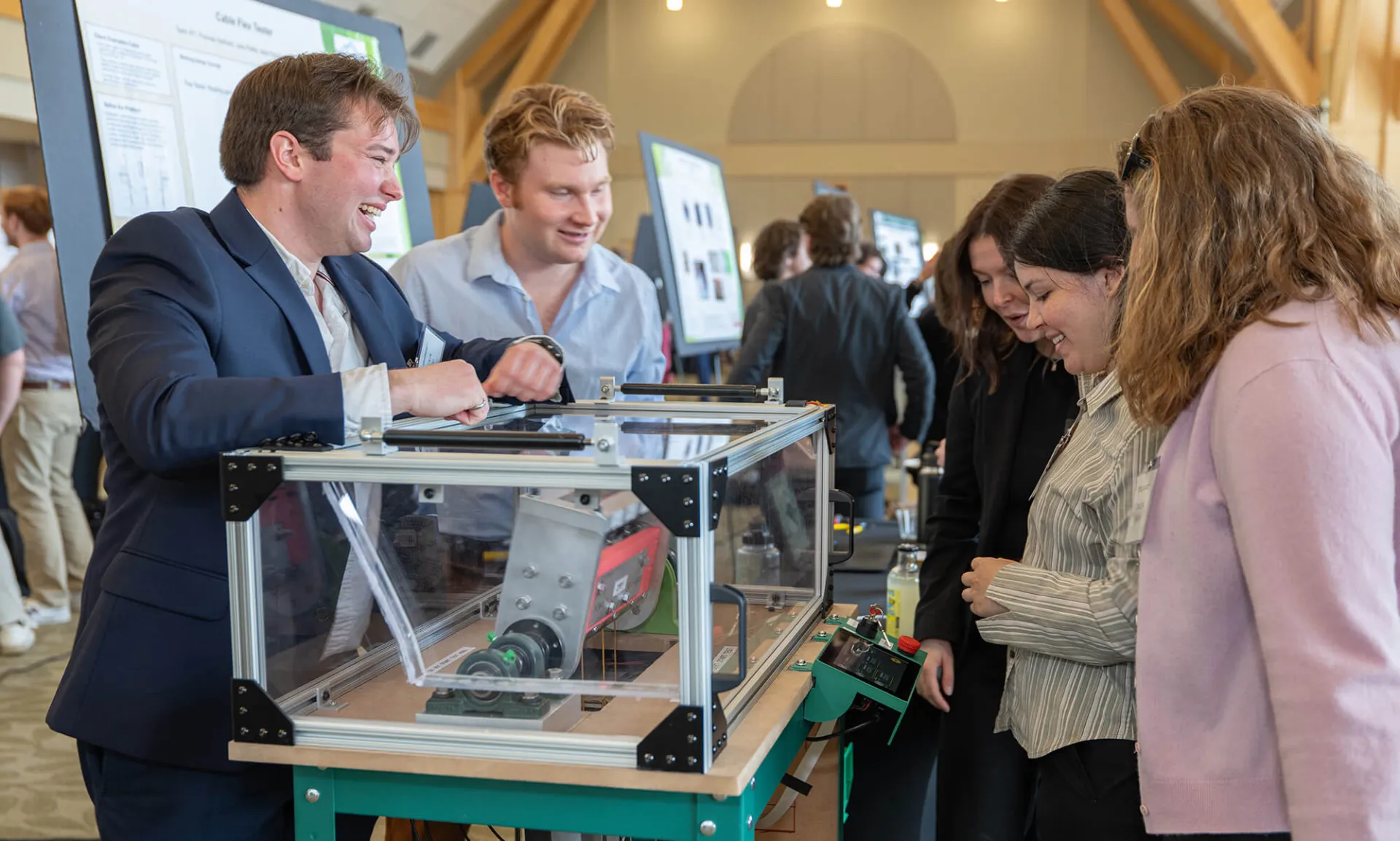
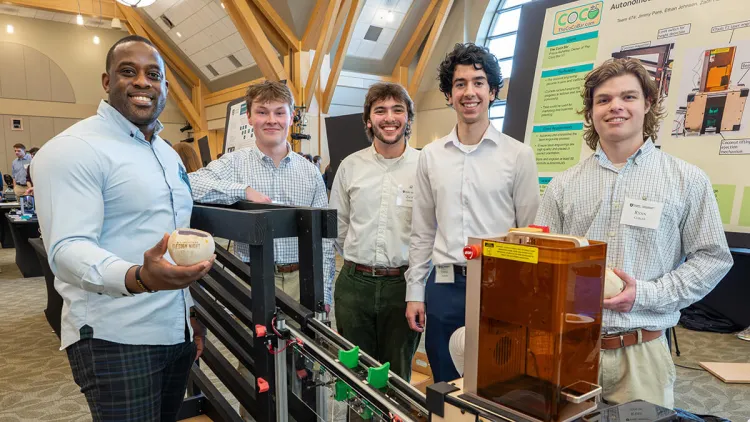
The top floor of the Davis Center was once again home to a phenomenal display of engineering prowess as over 130 students from Mechanical, Electrical, Biomedical, Civil, and Environmental Engineering shared their culminating year-end senior capstone projects this past Friday evening.
With the afternoon sun filling the Grand Maple ballroom in a warm light, a large crowd of students, faculty, staff, and visitors navigated through a maze of tables that filled the space with a diverse and impressive display of functioning prototypes and informative presentations that guided the viewer through the creative solutions each team had developed for the unique engineering challenge assigned to them.
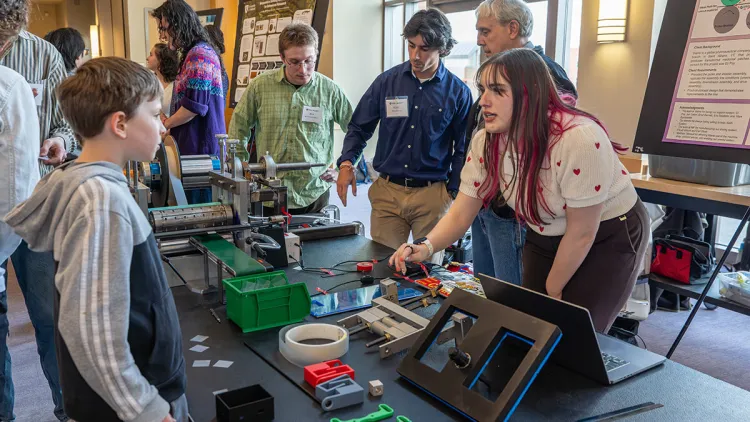
A core component of the interdisciplinary and hands-on curriculum in the College of Engineering and Mathematical Sciences are the real-world engineering design projects that seniors in these programs tackle as the culminating “capstone” experience of their undergraduate journey at UVM.
Each unique engineering discipline was represented in separate groupings defined by their respective capstone course. Twenty-four teams comprised of mechanical and electrical engineering seniors shared their prototype designs developed for the Senior Experience in Engineering Design (SEED) program. In the nearby Livak Lounge, ten teams of civil and environmental students presented their capstone projects alongside five teams from the biomedical engineering program.
2026 Design Night Program (PDF).
Senior Experience in Engineering Design (SEED)
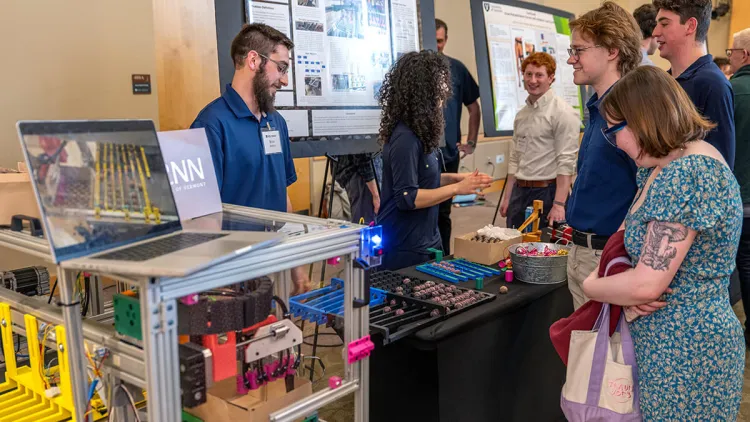
Co-led by professors Keith Epstein and Keith Doyle, the SEED program features groupings of senior Mechanical Engineering and Electrical Engineering students who are organized into teams early in the fall semester following a pitch session from sponsoring tech companies, non-profits, faculty, and UVM departments.
Based on the nature of the challenge and the students' skills and backgrounds, teams are formed and paired with each problem. Epstein, Doyle, and a corps of faculty mentors then guide the students through the engineering design process to address the complex, multidisciplinary challenges brought forth by the sponsors.
Over the course of their final year, the students collaborate to understand the challenge, design a solution, and build a functioning prototype—with each student usually specializing in a specific aspect for which their skills and interests are a good match.
Here is a sampling of the diverse and sometimes unexpected SEED projects that were on display at this year's Engineering Design Night:
- Adapting a head-mounted camera for use by toddlers in laboratory and home environments to record audio and video from the child’s perspective for use in language development research. Sponsored by the UVM College of Nursing and Health Sciences’ Department of Communication Sciences and Disorders
- A complex and multi-step project to design a fully automated system to sort, pick, and pack decorated truffles into boxes; replacing the current manual and ergonomically challenging process. Sponsored by Birnn Chocolates of Vermont.
- A remote-controlled industrial ice chopper designed to clear building entryways and sidewalks by breaking up to 1 inch of ice and help alleviate safety hazards for the campus community and save labor and time. Sponsored by UVM Custodial Services.
- A machine engineered to automate the custom laser engraving of promotional coconuts and replace a time-consuming manual process. Sponsored by The CoCo Bar.
- The design and development of a new Bidirectional GaN (Gallium Nitride) device and a half bridge circuit on a test chip which will then be manufactured by locally before being returned to the students for testing and measurements. Sponsored by GlobalFoundries.
- An cable flex testing apparatus to meet industry standards for measuring durability of electrical cables under extreme conditions.
Civil and Environmental Engineering (CEnvE) Senior Capstone Design
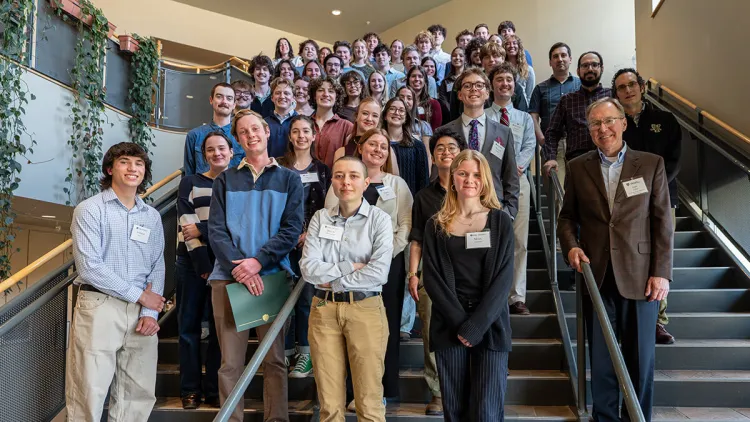
Under the guidance of course instructors John E. Lens and CEE course teaching assistants Silas Decker and Tanmoy Dutta, civil and environmental engineering students are teamed up for their semester-long senior capstone design experience. This course features service-learning projects where students work with local communities, towns, and non-profits on their Civil and/or Environmental engineering-related needs.
Working in teams over a semester, the students address complex and multidisciplinary projects that originate as problems or needs statements submitted by their sponsor. For each project, the students investigate the client’s needs, consider multiple design alternatives, and ultimately arrive at a recommended solution based on costs and social and environmental impacts.
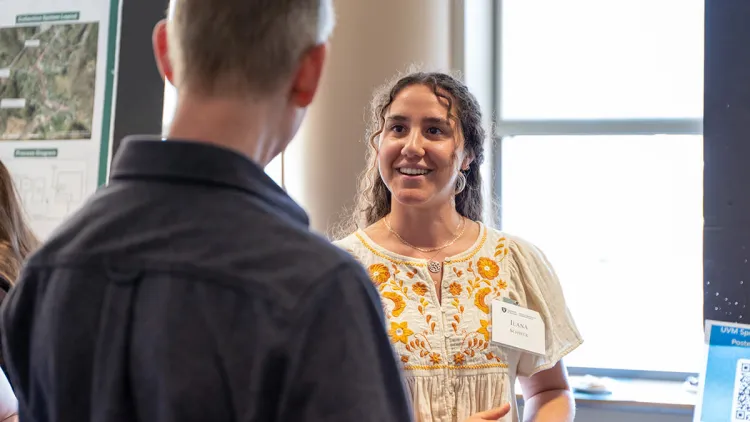
Some of the projects presented by CEE teams during the 2026 Engineering Design Night:
- Design rehabilitation or replacement for an 86-year-old steel/concrete bridge for the Town of Jamaica, VT.
- Design a solution for stormwater runoff mitigation with phosphorous removal for the Town of Shelburne, VT.
- Design improvements for capacity and pedestrian/cyclist deficiencies at the intersection of Pearl, Colchester, and Prospect roads in Burlington, VT
- Design septage treatment and capacity improvements for the Town of Canaan, VT
- Design greenhouse gas reduction for the University of Vermont’s James M Jeffords Hall.
Biomedical Engineering (BME) Capstone Design
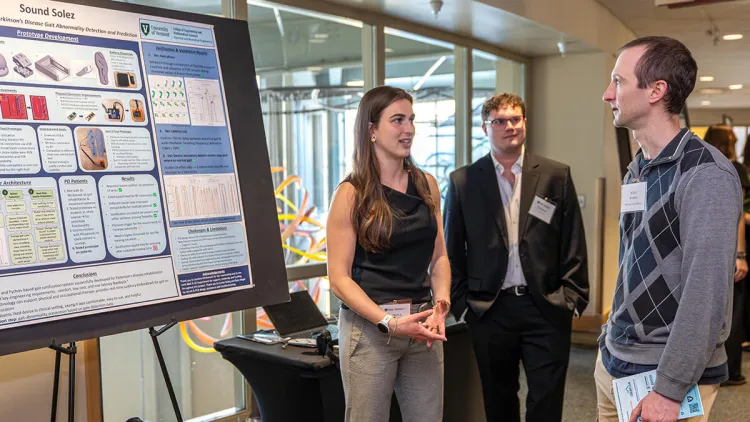
Uniquely situated between the Larner College of Medicine, UVM Medical Center, and UVM’s state-of-the-art STEM complex, UVM’s BME program provides a senior capstone project learning experience where students can engage in interdisciplinary research, collaboration, and instruction focused on a biomedical engineering challenge.
Led by the Director of the Center for Biomedical Engineering (CBI), Yuri Hudak, and mentored by UVM and Larner faculty, this spring’s cohort of BME students faced design and engineering challenges unique to their discipline.
Projects presented by BME teams during the 2026 Engineering Design Night:
- A novel device for simultaneous carpal tunnel release and electrocauterization.
- Advancing improved ventricular tachycardia ablation through novel electrode design.
- An insole device for improving research and treatment for patients with Parkinson’s disease by alerting them sonically to changes in their gait.
- A modular health clinic for improved access to care in rural Vermont.
- Advancing cardiac research through an improved cardiac tissue bioreactor.
2026 Engineering Design Night Slideshow
Feel free to visit the public online gallery of the event if you would like to download any of the images shared here.