Hands-On, Real-World Experience
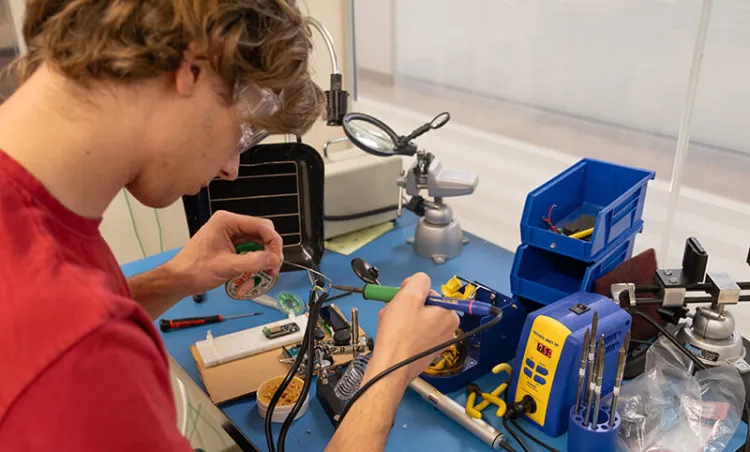
Seniors in Mechanical and Electrical Engineering programs work in teams to address complex and multidisciplinary problems. SEED projects originate as problem statements from companies, non-profits, faculty, or students. The projects are supported by the local engineering community and engineering faculty at UVM.
Sponsor Projects
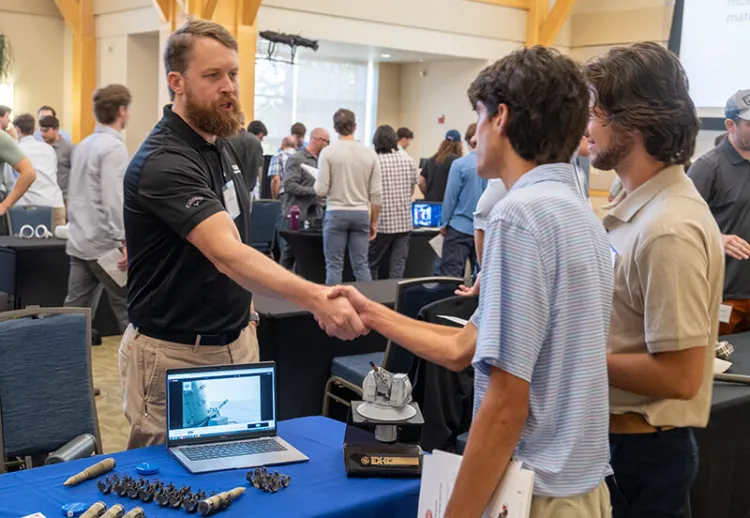
From a company's perspective, a SEED project offers the opportunity to work directly with senior engineering students, take a fresh look at a long-standing problem, or explore new ideas for their company. Students are eager to engage in engineering practice as preparation for work in industry and to apply the theory they have been learning in school. Course material related to design project fundamentals and the involvement of industry contacts adds to the student’s education and strengthens links between industry and Engineering at UVM.
Download SEED information package (PDF)
Design Night
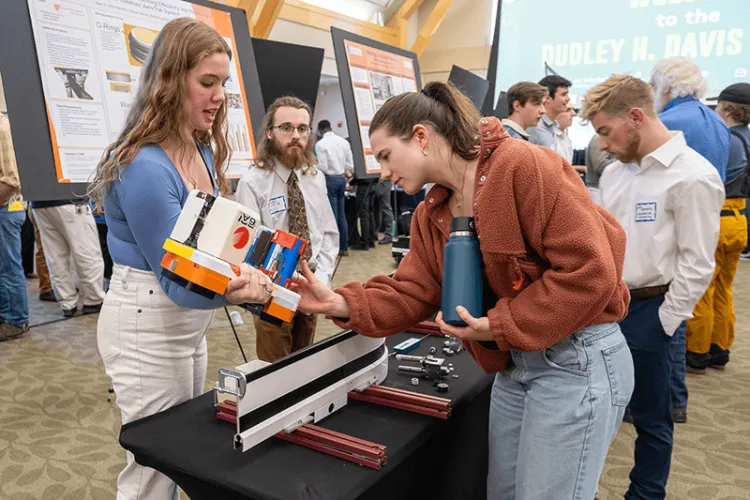
Each spring, students in the Senior Experience in Engineering Design (SEED) and the Civil and Environmental Engineering (CEnvE) Senior Capstone Design courses share their projects during the annual Engineering Design Night — the culminating event for their work over the course of the past academic year.
Frequently Asked Questions
Why participate in a SEED Project?
There are many reasons to submit a project and participate in SEED depending on your perspective.
Engineering Company:
- SEED projects offer the opportunity to work directly with seniors who are likely to be candidates for entry-level engineering positions when they graduate.
- The company gets to take a long-standing problem off the back burner for minimal cost.
- The company can look into a new idea or concept that may be too risky to use existing engineer resources to develop.
- Engineers often consider the mentoring role a welcome addition to their more typical duties.
Non-Engineering Company or Non-Profits:
- SEED projects offer the opportunity to solve a problem for your company that you may not be able to afford using traditional engineering firms.
- The company can look into a new idea, concept or product they don’t currently have the skills to design and build.
Students:
- SEED projects offer the opportunity to go after a new or old idea in an area you have a deep interest.
- The student gets to see the design process from both the sponsor and the engineering perspective.
- The student gets an opportunity to work directly with the SEED instructor to steer their project toward their definition of success.
Faculty:
- SEED projects offer an opportunity to work with undergraduate students who share a passion for your area of research in small groups.
- The students can move forward engineering related research with a finite and well-defined deliverables at the end of the spring semester.
- Projects can be designed to support non-engineering related research.
Charitable Donor:
- Directly fund projects that otherwise would not move forward due to funding gaps.
- An opportunity to donate to the engineering program and see tangible results via a demonstrable project over the course of an academic year.
- Supports innovation in an area of interest.
What makes a good SEED Project?
- Frame the project as a problem to be solved, not how it will be solved.
- The benefits of solving the problem need to be clear and important to you.
- You understand and clearly communicate the specific functionality that you need.
- You articulate the quality of the functionality. So not just do X, but do X quickly or do X reliably, etc.
- You clearly communicate the high-level qualities of the solution. (i.e., low cost, easy to use, accurate, durable, etc.)
- The project has a physical component that students can build and test.
- The project allows for prototyping with successive full or partial iterations of the product.
- Solving all or most of the problem is achievable by a team of roughly 4 students working 8-12 hours per week for two 13-week semesters.
- The estimated cost of the project fits within the expected budget.
- Multidiscipline projects are preferred. We serve 75% ME and 25% EE students. All EE projects are hard to fit into the program. All ME projects can work.
How do I submit a project for consideration?
If you are interested in sponsoring a SEED project, you can submit your project idea directly via the following link, Project Submittal. This link will bring you to our project management software EduSourced used for the course. A user login is required to submit and track all projects. If you have submitted projects in the past, you should use the same account to submit additional projects. Submitting a project does not hold you accountable to sponsor the project nor does it guarantee acceptance into the SEED program.
If you have specific questions about the program or want to discuss a project idea prior to submittal, contact the SEED program director via seed@uvm.edu.
What is the project submission timeline and priority?
Projects can be submitted at any time, and must be submitted at least two weeks prior to the start of the Fall semester. Early submission is appreciated, as it helps us plan effectively. We often have more projects submitted than we have students available to work on projects. To gather and define projects earlier, we give priority to projects based on project accepted date and sponsorship level. Projects with Priority 1 will be assigned to students first. Projects with Priority 2 will be assigned to students second. Projects with Priority 3 will be assigned to students last.
Priority 1: Submitted prior to June 1 or Program/Innovation Sponsor
Priority 2: Submitted prior to July 1, Team Sponsor, or returning Startup Sponsors
Priority 3: Submitted later or all other sponsorship levels.
How does a submitted project get accepted in the SEED program?
All projects submitted via the project management software are reviewed by the SEED program director. The director will work with the sponsor to verify that the scope, complexity, and budget are appropriate for the course and the students' skill level. Once details have been agreed upon, the sponsor and UVM sign a Letter of Understanding (LOU). The LOU is a non-binding agreement that outlines the expectations of both the sponsor and UVM for the duration of the course. At this point, the project is considered Accepted and awaits selection by students. During the first week of each Fall Semester, students rank the projects in order of interest. Students are assigned to projects based on their interest level and the project priority levels as defined in the next section.
What are the sponsor's responsibilities?
The sponsor agrees to assign a liaison to the project who will attend a SEED Project Pitch Event to pitch the project to prospective students in the fall. The liaison is required to periodically and promptly supply information to students when needed. They are asked to review and approve the proposed budget, deliverables, and support communication between UVM and the sponsor. The liaison will be encouraged to attend two separate design reviews through the semesters, either at UVM or the sponsor's location. In addition, we ask them to attend the UVM Design Night event at the end of the spring semester to support their design team and the other SEED projects.
We ask sponsors to recognize that these are students who are learning the engineering design process. They are asked to meet the needs of the sponsor and the course, which do not always align perfectly. We appreciate your willingness to allow for some flexibility in this process, making the learning process as rich as possible.
What does sponsoring a SEED project cost?
The cost of a SEED project consists of two parts: a sponsorship fee and material costs. The sponsorship fee is directly used to run the program, including, but not limited to special tools, safety training and equipment, lab supplies, machine shop resources, 3D printing, course administration, etc. This fee allows the program to provide students with the resources and flexibility they need to complete a successful project.
The second cost of the program is the material costs. These costs are very dependent on the type of project you sponsor. We ask all project sponsors to be prepared to spend at least $1,500 on material costs over the course of the project. The students are presented the budget at the beginning of the course and will work within those limits. If additional funding is needed, the SEED instructor will work with the sponsor to determine the need and the source of additional funds.
Project sponsorship levels are as follows:
- Non-Profit: no sponsorship fee, $1,500 for material costs
- Student: no sponsorship fee, $1,500 for material costs
- Startup Company (approx. 1 - 10 employees): $3,000 sponsorship, includes up to $1,500 for material costs
- Team Sponsor (approx. 11 - 100 employees): $6,000 sponsorship, includes up to $3,000 for material costs
- Program Sponsor (approx. 100+ employees): $12,000 sponsorship, includes up to $6,000 for material costs
- Innovation Sponsor: Charitable donation, 20% sponsorship, and 80% for material costs
What happens during the year?
Project Management:
The SEED program uses the SCRUM framework for project management. Each semester is broken into 3 or 4 Sprints. Each Sprint is planned and has a goal that is demonstrated to the sponsor with a physical Increment. The teams review these increments with the sponsors for feedback on progress and to adjust the design if needed.
During the fall semester, the students will:
- Create team roles and learn how to work as a team.
- Understand and revise the problem statement as necessary
- Perform a search of existing patents, products, literature, etc.
- Investigate the design space and select a preliminary design concept (or two)
- Create several prototype iterations for evaluation
- Perform critical analyses for the design
- Create a list of Engineering Specifications
- Present a Preliminary Design Review
During the spring semester the students will:
- Continue to design, build and test their project
- Perform a Failure Modes Effects Analysis of their project
- Demonstrate their working project
- Create a poster and present their project at Design Night
- Present a Final Design Review
- Generate and deliver a Final Design Report, Technical Documentation Package, and working project
How is intellectual property handled?
UVM has a standard Non-Disclosure Agreement (NDA) that can be signed by all students in the event you are concerned about disclosing confidential information. In addition, we have a standard form where students will assign all invention rights to the sponsor if a patent is developed as part of the course. The students still earn the right to have their names on the patent, but the rights to the patent will belong to the sponsor. UVM can also use your company-supplied NDA, but requires sufficient time for a review by our internal counsel before making a project active.
What resources are available to SEED teams?
Students in the SEED program will use the SEED Lab for most of their project development. The new lab is designed to promote group collaboration and provide the basic needs of most teams. Features include:
- Locked cabinets to secure each team's project
- Large computer screens for group collaboration and presentations
- Fume hood
- Part vending for standard fasteners and other common parts
- Basic electrical equipment such as power supplies, oscilloscopes, function generator etc.
- Basic hand tools
- Soldering station
- Multiprocessor Virtual Machines for simulations
Machine Shop
- Water jet
- 3-axis CNC milling machine
- Lathes
- Milling machines
- Drill press
- Horizontal and vertical bandsaws
- Welding
- Other tools
The Fab Lab
- 3D Printing
- Laser cutting machine
- 1-layer Printed Circuit Board Manufacturing
- Sewing machine
- Solder reflow oven
UVM Woodshop
- Table saw
- Router
- Bandsaw
- Lathe
- Jigsaw
- Belt sanders
- Drill press
Teaching Labs
- Tensile strength tester
- Vibration table
- Wind Tunnel
- SEED students can obtain access to the teaching labs used for various courses here in CEMS. A comprehensive list of lab equipment can be found by visiting the teaching labs website.