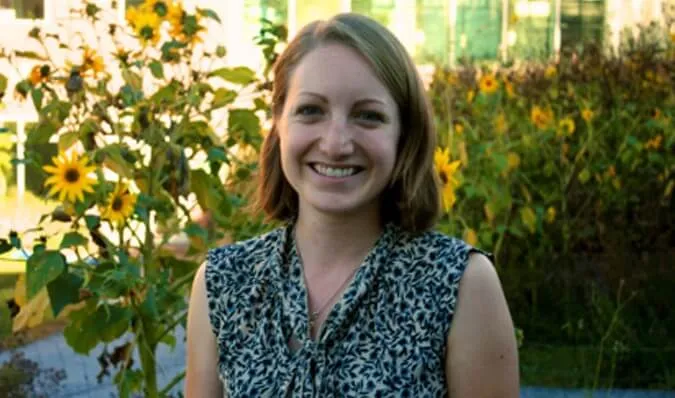
In our ongoing series highlighting Gund Institute for Environment alumni, this month, we hear from former University of Vermont Ph.D. student Phoebe Spencer. The environmental economist graduated in 2017 with a degree in natural resources from the Rubenstein School of Environment and Natural Resources and was first Ph.D. graduate of Economics for the Anthropocene. After graduation, the Gund Graduate Fellow quickly landed a job at the World Bank in Washington, D.C, working to address the impacts of poverty and natural resource depletion, from air pollution to deforestation. We caught up with Spencer, who is still at the World Bank, ahead of her upcoming GundxChange.
This interview has been lightly edited for clarity.
You landed a role at the World Bank two months after graduating with your Ph.D. in 2017. What has your work at the World Bank looked like?
I started as a short-term consultant in 2017, working on an analysis of how poverty and different environmental factors coincided worldwide using geospatial data. That work led to a project on forecasting food insecurity and my role pivoted toward looking at environment and conflict linkages from there, working to understand environmental pressures on food security and on forced displacement. When I was accepted into the World Bank’s Young Professionals Program in 2020, I was given a chance to continue my work on conflict and nature with the goal of improving conflict sensitivity in environmental projects. For the past five years, I’ve also worked intensively on lending projects in the environment sector across the Middle East and North Africa. Through those projects, I’ve worked on topics including improving the sustainability of fishing in Yemen, implementing the Montreal Protocol in Jordan, and working with industries to comply with national environmental laws in Lebanon.
Can you share what a typical day might look like at the World Bank?
The majority of my work is based in the Middle East, so my days often start early, meeting with clients from different government agencies and international partners, or with colleagues based in in the region. Most of my day is spent keeping projects moving forward. I guide economic analyses, troubleshoot project challenges, review documents and studies, and write reports (including Defueling Conflict: Notes from the Field, which just came out in December). When I travel for work, I visit project sites and meet with government officials and other organizations that work on similar issues. I really enjoy working together with governments and communities to solve different environmental challenges, often in places I might otherwise not have a chance to visit.
How did your time at the Gund influence how you've approached your job?
Beyond learning concrete skills that I use all the time (ecosystem service valuation, data analysis), my time at the Gund helped me consider the bigger picture when approaching a task. Nothing we do is in isolation, there are trade-offs and externalities related to natural resources, communities, the economy, everything, and we have to consider that when designing and implementing projects.
What advice would you offer to current or future graduate students or postdocs?
Apply your skills in real-world contexts as soon as possible and always look for new learning opportunities. Apply for an internship with an organization that excites you, take a class that sounds interesting even if it’s outside your comfort zone, or volunteer with a local group. An atelier class I took on calculating the Genuine Progress Indicator for Vermont made me so interested in ecological economics that I ended up changing my whole dissertation topic. It’s ok for your interests, opinions, and perspectives to change (it’s often a good thing). Seek out opportunities to work with people with backgrounds different to your own, study a foreign language, and travel if you can.
Spencer will give a GundxChange on Friday, March 6 from 12-1 p.m. in Farrell Hall, room 006. Learn more here.