Research shows spending time in nature makes us happier and healthier. Natural systems also provide essential benefits like clean air and water, nourishing food, carbon storage, trillions in economic benefits and so much more. What if these benefits were not only recognized by the federal government, but centered in U.S. policy?
Researchers, policy leaders, and the public will gather this week at the University of Vermont to imagine that future and create a playbook for making that happen.
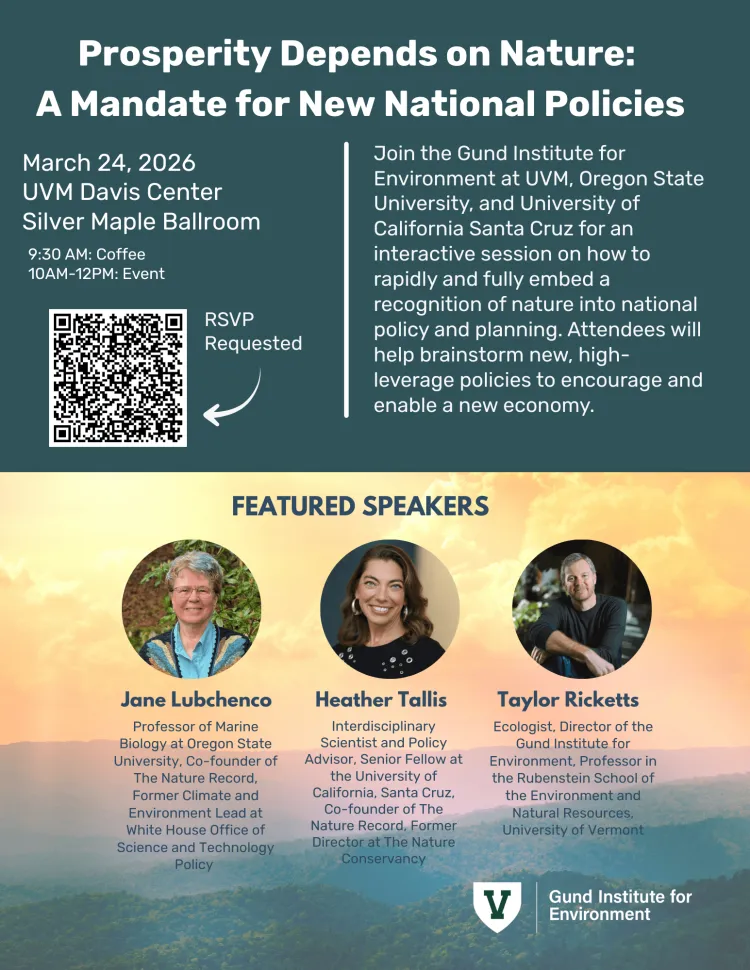
“Prosperity Depends on Nature: A Mandate for New National Policies” is the brainchild of Heather Tallis, a senior fellow at the Center for Coastal Climate Resilience at the University of California, Santa Cruz and Jane Lubchenco, distinguished professor at Oregon State University. Both researchers bring, among other things, experience at White House Office of Science of Technology Policy during the Biden administration where they worked on similar efforts.
Moderated by Taylor Ricketts, a professor at the Rubenstein School of Environment and Natural Resources and director of the Gund Institute for Environment, findings from the multi-day event will feed into an evidence-based policy playbook, expected in late 2026.
Ahead of the event, we sat down with Tallis and Lubchenco to learn more about where this idea originated and why it matters.
This interview has been lighted edited for clarity.
Let’s start with the background here: Where did this idea come from?
Jane: I'm an ecologist, and I have worked on how important nature is in our lives for most of my professional career. I focus on ocean ecosystems. Recently, much of the thinking about nature has focused on protecting 30% of the lands and waters by 2030. We know that protected areas are critically important but simply doing that will not stem the loss of nature, the loss of biodiversity, because what happens in the other 70% is critically important. And while Heather and I served in the White House, in the Office of Science and Technology Policy during the Biden administration, we initiated several activities to help incorporate nature into decision making across the federal government. And so, we saw both the opportunities and the challenges of doing that and think that there is much greater opportunity than has been realized.
Heather: Jane captured it well. I'm trained as a biogeochemist and so see all the interconnections among systems, and I have spent most of my career focused on helping people see clearly how tightly connected we are to nature and trying to find straightforward and powerful ways to change policy and economic activity to reflect those connections. A lot of what Jane and I worked on together in the White House started to move more into that realm than conventional conservation and environmental policy often does, but there's still so much, dramatically more, that needs to shift to have an actual transition in the economy to something that's going to behave differently. I think we saw that a lot firsthand, and now there's a lot of disruption in the system, with climate change, losses in nature and in the political system that I think gives us an opportunity to be bolder and be more ambitious in what we imagine could shift in the policy sphere and really create a different connection with the economy.
Jane: We know that most of the economy depends on nature, but most people don't get those connections. We know that human health, both mental health and physical health, is strongly influenced by nature, and I think a lot of people began to appreciate that during the pandemic, when they were spending more and more time outside, and realized that was really their happy place. And we know that nature is critically important to climate solutions, to national security, and to equity. And so, you can look at those connections through a number of different lenses, and you keep coming back to the same thing: Nature is at the center, and yet many of our policies and practices don't reflect that scientific knowledge. So that's the opportunity.
Let’s talk about the format. Following the public event on Tuesday, policy leaders and scientists from across the country will gather at UVM for a few days to continue this work. What are the goals?
Heather: We're aiming to have this be the start of continuing conversations, first aiming towards putting out a nature and national policy playbook for the U.S. by the end of this year. We’re focusing here on the U.S., taking advantage of the federal moment. It may expand to what could be useful for other countries as well as obviously, the U.S. isn't the only country that needs to transition.
Jane: We also know that a lot of businesses are asking how nature relates to their activities and what they might do. They're interested. They've heard about nature-positive economies, but they don't quite know what that means or what to do with it. They're primed, but they don't know what’s next. And so that's another piece of this. These are ripe conversations that are happening globally. What Heather and I bring to the table are the experiences that we had and the programs that we started when we were in the White House. But we seek to listen to a much broader group of people through these round tables. We hope to hear from interested citizens as well as folks that have served in government at the state and federal levels. We're going to be doing a lot of brainstorming and exploring options, and it's going to be a lot of fun.
How would you characterize the ways in which nature has been traditionally represented in U.S. policy? How might this approach look different?
Jane: I think we've always assumed that nature would always be there. And it's sort of like the Joni Mitchell song lyric, “you don't know what you've got 'till it's gone.” One thing that we are seeing is increasing loss of nature and nature's benefits across many different freshwater, terrestrial, marine ecosystems, and that has real consequences for people and the things that we care about. I think there's increasing recognition that because the assumption has been it's always going to be there, we haven't taken the steps to really recognize its importance, and now it's past time to do that, but better late than never.
Heather: I think there are two other characteristics of past policy that really need to shift. One reflects another song: “Somewhere Over the Rainbow.” People think of nature as somewhere out there, separate from the economy and our lives and our health, not connected to and core to our lives. The other is that a lot of our current policy focuses on simply avoiding harm. That’s what most of our environmental policies ask us to do: Don’t make it worse, don’t mess it up. But, actually, we should be focusing on how can we improve nature. And there's a lot of cases where we can use economic activity to actually improve conditions for nature and ourselves. So those would be other, completely different framings of what a policy is trying to do that we hope to see a lot more of come out in the next couple days.
“Prosperity Depends on Nature: A Mandate for New National Policies” will be held Tuesday, March 24, 2026 from 10 a.m.-12 p.m. in the Davis Center Silver Maple Ballroom. Join us for coffee at 9:30 a.m. Find more information and RSVP here.