In just a few years, Artificial Intelligence, or AI, has taken the world by storm. A June 2025 survey from the Pew Research Center found nearly all Americans report having heard or read at least a little about AI. Half of American adults say they are concerned by the technology’s impact on daily life.
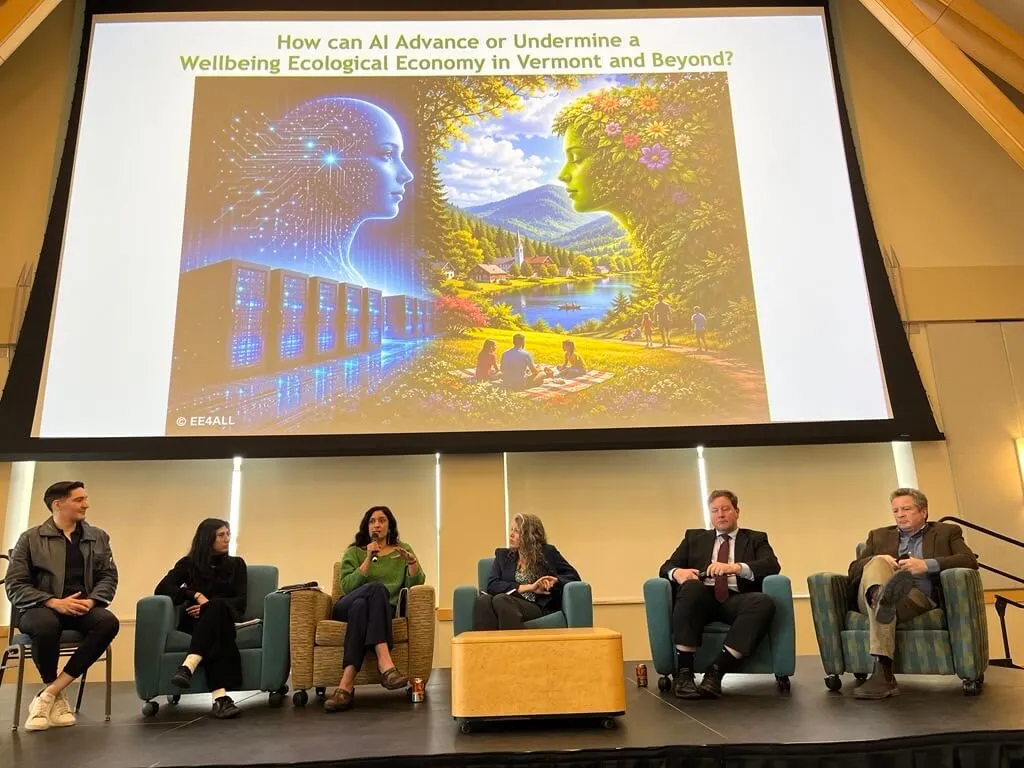
Last week, the University of Vermont chapter of Rethinking Economics hosted an Earth Day conversation exploring how AI could advance or undermine human well-being and our connection to the rest of nature. The group aims to foster diversity of economic thought and advocates for a well-being economy, or one that is resilient and regenerative, while recognizing the planet’s finite resources and sinks. That’s in contrast to our current economic paradigm, in which society has confused growth for an end goal, when it is only a means to our ultimate end goal of well-being.
“One of the goals of having a panel like this is to jumpstart collaboration among the UVM community through these kinds of discussions grounded in systems thinking led by the Gund and others to develop a better understanding of AI,” said event co-organizer Rigo Melgar, who recently successfully defended his dissertation and will receive his Ph.D. later this month.
UVM Chief Information Office Kellie Campbell shared how the university is thinking about AI, including through the convening of an AI task force. Then the panelists engaged in a 40-minute discussion, followed by questions from the audience.
“So, when you take the well-being economy frame for something like AI, you have to ask: can AI be used in a purposeful way that centers fairness, that centers justice, that centers sustainability?” said Jon Erickson, a professor in the Rubenstein School of Environment and Natural Resources and a Faculty Fellow at the Gund Institute for Environment. “And I think we all in the room … we're not sure. It's a very confusing time right now.”
Erickson, an ecological economist and collaborator with the Wellbeing Economy Alliance of Vermont, said tech companies posit AI can reduce the need for labor, but past technological innovations that have freed up time have led to more work, not less.
“With regard to AI, I love the idea of AI freeing my time to spend more time outdoors, spend more time with family, spend more time in community,” Erickson said. “But you can't do that by just fixing AI. You’ve got to work in our policy spaces. We have to ask: what do we do with labor saving?”
Trisha Shrum, an associate professor in the Community Development & Applied Economics department at UVM and Faculty Fellow at the Gund Institute, said AI can do things humans cannot in the same timeframe and that can be a powerful opportunity.
“But what I worry about the most is where AI can further undercut the connection between individuals and increase our dependence on digital spaces, decreasing our connections to one another,” she said.
To combat this, for example, higher education may need to redesign how it teaches students to produce undergraduates and graduates that can use AI while maintaining critical thinking skills.
Panelists also noted the extent of monopolization in the AI industry.
"From AI chips and cloud services to AI models, we see the same few companies at every level," said Rubaina Anjum, co-moderator of the panel and a PhD candidate in the Community Development & Applied Economics department as well as a Gund Graduate Fellow. "We’ve seen the push for AI to be integrated into everything in an effort to make it an essential technology. This will only lead to power being concentrated in the hands of a few tech billionaires."
From a policy perspective, Vermont State Treasurer Mike Pieciak noted that Vermont lawmakers are debating a bill that would temporarily ban AI data centers, which are huge consumers of both energy and water.
Vermont is piloting a “polluter pays” approach with fossil fuel companies for the damage their products have caused to the climate. Pieciak noted a similar approach could be taken with AI.
“If there are going to be side-on effects from energy consumption, if there will be side effects from these data centers, then we need to be thinking about that up front, rather than 60 years down the road, identifying all of the ways that it's impacted our environment and our communities, and then trying to hold them accountable on the back end,” he said.
Amanda Janoo, economic policy lead for the Wellbeing Economy Alliance and a democratic candidate for governor, said the public wants regulation of AI.
“And the fact that we're not seeing it is an illustration of a democratic deficit within our existing systems,” she said. “And so, it also provides us with an opportunity, I think, at the state level, to be able to be a leader in this.”
The organizers said they hope the panel is a gateway to future AI education events that Rethinking Economics UVM hopes to continue to co-sponsor with support from UVM’s AI Innovation Fund.
###
About the Gund Institute for Environment: The Gund Institute for Environment at the University of Vermont is a research center dedicated to understanding and tackling the world’s most critical environmental challenges. Driven by the belief that research should inspire action, the Institute takes a cross-sector approach to solving environmental issues with stakeholders from government, business, and broader society. The Institute focuses on five interconnected research themes: climate solutions, sustainable agriculture, health and well-being, equity and justice, and resilient communities. With 300 scholars in Vermont and across the world, the Institute brings together a network of internationally recognized researchers from diverse disciplines, including the natural and social sciences, business, health, technology, engineering, and the humanities.