Nestled among the steep western slopes of the Andes in the remote northwestern reaches of Ecuador lies one of the most ecologically pristine places in the world. Located at the intersection of two global biodiversity hotspots—the Tropical Andes and the coastal Tumbes–Chocó–Magdalena—northwest Ecuador is the most biologically rich cloud-forest landscape in the world.
It was during a stay in this tropical wilderness as part of an internship with the environmental and community advocacy organization, APT-Norte, that UVM mechanical engineering student Gabe Johnson happened on an idea that would bring together an interdisciplinary group of undergraduate engineering students on an independent and largely self-funded research project centered over 3,000 miles away from campus.

A Tradition of Advocacy
A rugged mountain-and-valley landscape, the Intag region is remarkable for its cloud forests—lush mountain forests that are frequently enveloped in mist. Rare globally, cloud forests comprise no more than 2.5% of all tropical forests worldwide. In terms of total global land cover, they occupy an even smaller fraction at less than 1% of the Earth's surface, yet they play a critical role in capturing and storing water.
As a result, the unique environment promotes one of the richest areas on Earth for plant and animal diversity. Scientists estimate that the Tropical Andes alone contain roughly 15–17% of the world's plant species and nearly 20% of its bird species.
In the early 1990s, the region drew attention for resources beyond biological ones when mining companies began exploring beneath the landscape for copper and other minerals, eventually discovering significant copper deposits in the Junín area of the Intag river valley in the province of Imbabura.
In response to this and ongoing environmental threats from deforestation, communities in the region banded together to form DECOIN (Defensa y Conservación Ecológica de Intag), one of the most influential grassroots environmental organizations in Ecuador. Since its inception, DECOIN has created dozens of environmental reserves, helping protect nearly 30,000 acres of forests and watersheds.
In 2016, however, a new challenge emerged when the Ecuadorian government began to promote industrial mining as a long-term economic strategy for the country. As a result, 24 mining concessions, covering roughly 85% of the Intag region, were awarded.
Less than two years later, residents throughout the Intag River Valley organized and created APT-Norte (La Asociación de Propietarios de Tierras Rurales del Norte del Ecuador), a collective legal and organizational voice for residents concerned about property rights, water security, environmental protection, and constitutional rights.

A Pivotal Internship
During his senior year, Johnson learned about an internship opportunity with APT-Norte from a friend in the Biology department. The executive director of APT-Norte, Peter Shear, is also a lecturer in UVM's Department of Geography and Geosciences and has offered study abroad courses in Ecuador, where he lives, since 2003. His course, The Politics of Land Use in Ecuador: Resource Wars, Alternative Social Models, and Agroecology, is centered around his work and experience in integrated rural development, environmental education, reforestation, agroecology, and conservation projects in Ecuador.
Originally from Breckenridge, Colorado, Johnson has been an avid traveler since his youth and was familiar with Ecuador, having visited the country with his family as a child.
“It turned out Peter was looking for interns to help his organization with water quality monitoring,” said Johnson. “I really had no idea what I was getting into, but I ended up just kind of falling in love with this incredibly serene and beautiful place in Northern Ecuador.”
“This project is a really unique opportunity for students who are passionate about protecting the natural world to apply their unique engineering skills on a challenging problem and directly see the way that you're helping these communities and making an impact on the global ecosystem by helping to preserve this rare cloud forest ecosystem.”
—Gabriel Johnson
Master's Student in Mechanical Engineering
Johnson worked with residents seeking to determine whether exploratory mining activity was affecting local water sources. With evidence documenting these activities, APT-Norte could demonstrate the harmful environmental impact and pursue legal recourse against the mining concessions.
While focused on environmental impacts, the water monitoring work in Ecuador kindled Johnson's acumen in mechanical engineering, and he began exploring ways he could continue to support the region’s communities after he departed.
Current water quality monitoring methods in the Intag Valley rely on manual data collection, which is time-consuming and occurs infrequently due to the area's remoteness. The lack of continuous data makes it challenging to track environmental changes effectively or gather adequate evidence for legal advocacy.
“I was focused on how I could use my background as an engineer to help the organization,” said Johnson. “Working in close coordination with APT-Norte, we developed the idea of designing a network of autonomous water quality monitoring stations— each with a sensor bundle that you can sit in a river and leave there for an extended period of time.
Upon his return to campus—now an accelerated master’s student in mechanical engineering—Johnson began brainstorming about the project, including the initial requirements for the remote water-quality monitoring stations. The field-deployable device would need to include multiple water-quality sensors, collect and store data, provide efficient power management to operate unassisted for at least a month at a time, and be affordable.
He quickly realized that the ambitious project would require an equally ambitious team.
Assembling the Team
With existing commitments to a NASA space grant-funded fluid dynamics research project he was working on with his professor, William Louisos, Johnson knew he would need to assemble an interdisciplinary team of students to develop a prototype device to be tested in Ecuador shortly after the end of the 2026 spring semester.
Through his friend, Cooper Petrie, a master’s student in environmental engineering and the former co-president of the UVM chapter of Engineers Without Borders (EWB), Johnson was introduced to the EWB club and learned about their success in organizing an ongoing project to bring clean water to a village school in Rwanda.
Johnson pitched the remote water-monitoring project to students gathered for an EWB chapter meeting in the fall of last year and soon recruited eight students representing a diverse mix of engineering interests.
The group began meeting weekly to strategize the development of a series of prototypes, with unique approaches to the physical mechanisms for collecting water and the required electrical systems to test the samples and store the data.
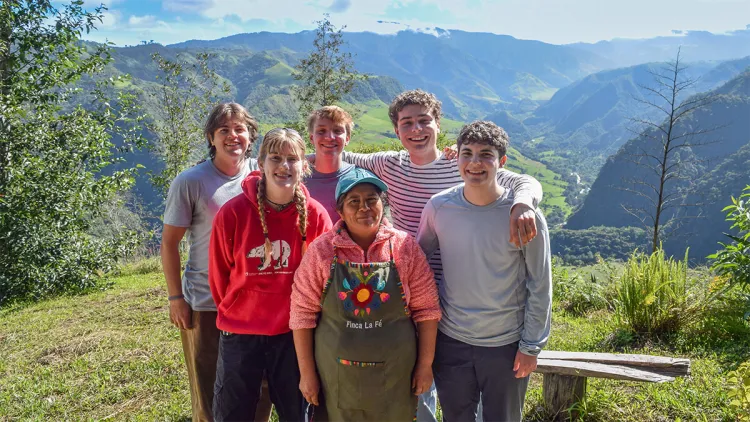
With the end of a busy fall semester, a smaller group of four dedicated students returned to advance the project following the intervening winter break: sophomores Henry Myatt (environmental engineering), Ginger Thralow (electrical engineering), and Finn Duncan (civil engineering), along with junior Finn Dabish (electrical engineering).
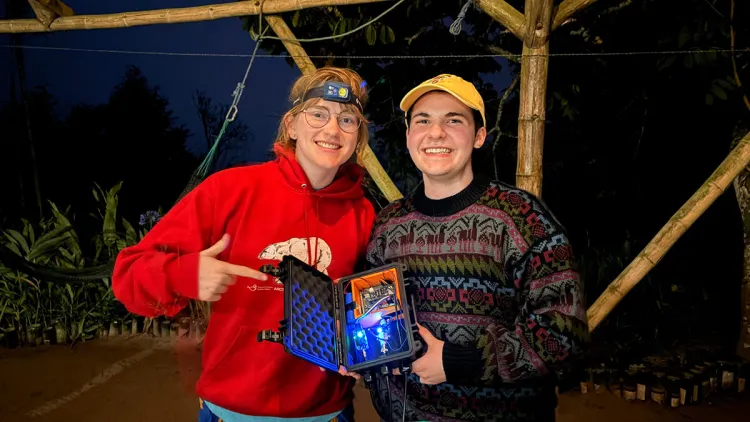
Each team member naturally migrated toward aspects of the project that aligned well with their experience and skill set. As electrical engineering majors, Thralow and Dabish worked together to develop the electronics package. At the same time, Duncan and Myatt took on deployment and logistical challenges, including the need for compact, waterproof housing and river-based sampling strategies.
Throughout the engineering design process, Johnson served as a mentor and advisor to the team and handled the logistics of funding appeals, group meetings, and international travel.
The Autonomous Water Monitoring Device
Central to the team’s design strategy was to develop a dependable and accurate system that APT Norte can operate, maintain, and troubleshoot independently, without relying on outside technical support. To facilitate this, the team decided to develop three prototypes to bring to Ecuador for field testing at the end of the semester.
To help cover the costs for the materials needed to fabricate the prototype stations, Johnson connected with Melissa Parr, the assistant director for undergraduate research at UVM’s Office of Fellowships, Opportunities, & Undergraduate Research (FOUR), whose program provides an array of research funding opportunities for undergraduate students across the university.
Since the research team consisted of four undergraduate students, Parr provided $2,000 in funding through individual research mini grants of $500 each. These popular grants are intended for research-related expenses and would help the team purchase the materials and supplies they needed to fabricate the devices, with funds left over that could be applied toward their travel expenses.

Despite having a clear conceptual plan for the water-monitoring devices, the student engineers needed to overcome several design hurdles along the way. One of the first challenges was developing a sensor array that would provide the most valuable data for APT Norte while considering both device calibration needs and power requirements.
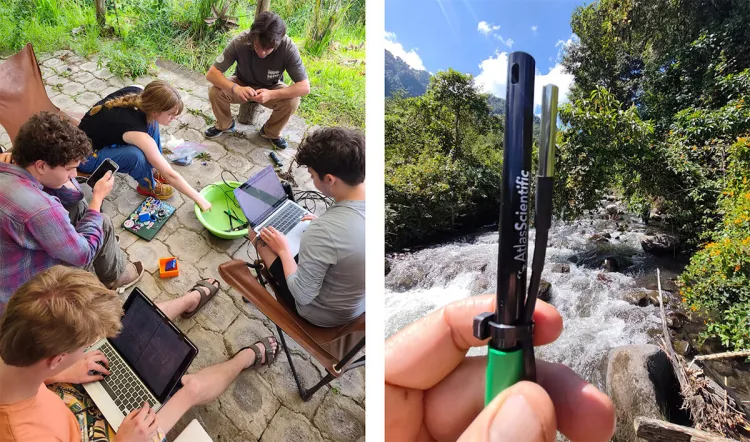
The team settled on a three-sensor approach, measuring for pH, conductivity, and temperature. While fluctuations in any one of these measured indicators are not necessarily a smoking gun, persistent changes in all these parameters can provide strong evidence that mining-related contamination may be entering a watershed.
- A sustained decrease in pH can indicate acidic runoff commonly found downstream from copper mineral extraction activities.
- Conductivity reflects the concentration of dissolved ions in water and is often one of the earliest indicators of contamination entering a stream.
- While an increase in temperature itself does not indicate mining contamination, it can help determine whether unusual pH or conductivity readings are associated with a new source of contamination entering the stream.
For the readings to be accurate, the students needed to design a calibration protocol in which liquids with known parameters are used to establish a baseline. Since this calibration needed to be done remotely in the field, the device required that the calibration tools be embedded in its design.
Thralow and Dabish introduced LED lights and switches to the device to facilitate field calibration. However, the more sophisticated circuitry required meant having the unique circuit board they designed printed by a vendor and shipped back to them in time to solder the components and test the electronics before their quickly approaching trip to Ecuador at the end of May.
“We were working back and forth between working on the project and preparing finals,” said Thralow, who eventually conceded that the focus needed to be on “studies over solder.” That left a scant two weeks between the end of exams and their trip to Ecuador to get the prototype device ready for testing in Ecuador.
Another ongoing, more obstinate challenge was powering the device for up to one month without being attended to. Initial plans called for testing not only battery-powered solutions but also hybrid approaches in which energy-generation components such as solar cells and micro-hydro turbines could help charge and sustain the batteries.
For the upcoming field tests, the team settled on using batteries alone, combined with an ESP32 microcontroller that features deep sleep capabilities. Using a carefully coordinated schedule of waking the device twice daily for roughly five minutes per session, the team determined the device would theoretically meet the desired lifespan before being replaced with a fresh battery during the collection of the microSD card, which stored the data.
Field Testing in Ecuador
During the last week of May, the five students traveled to Ecuador, flying into the capital, Quito, before making the 2-hour drive north. As they entered the Intag region, the lush landscape reminded team members of Vermont, only amplified to a wilder, steeper, and greener extreme.
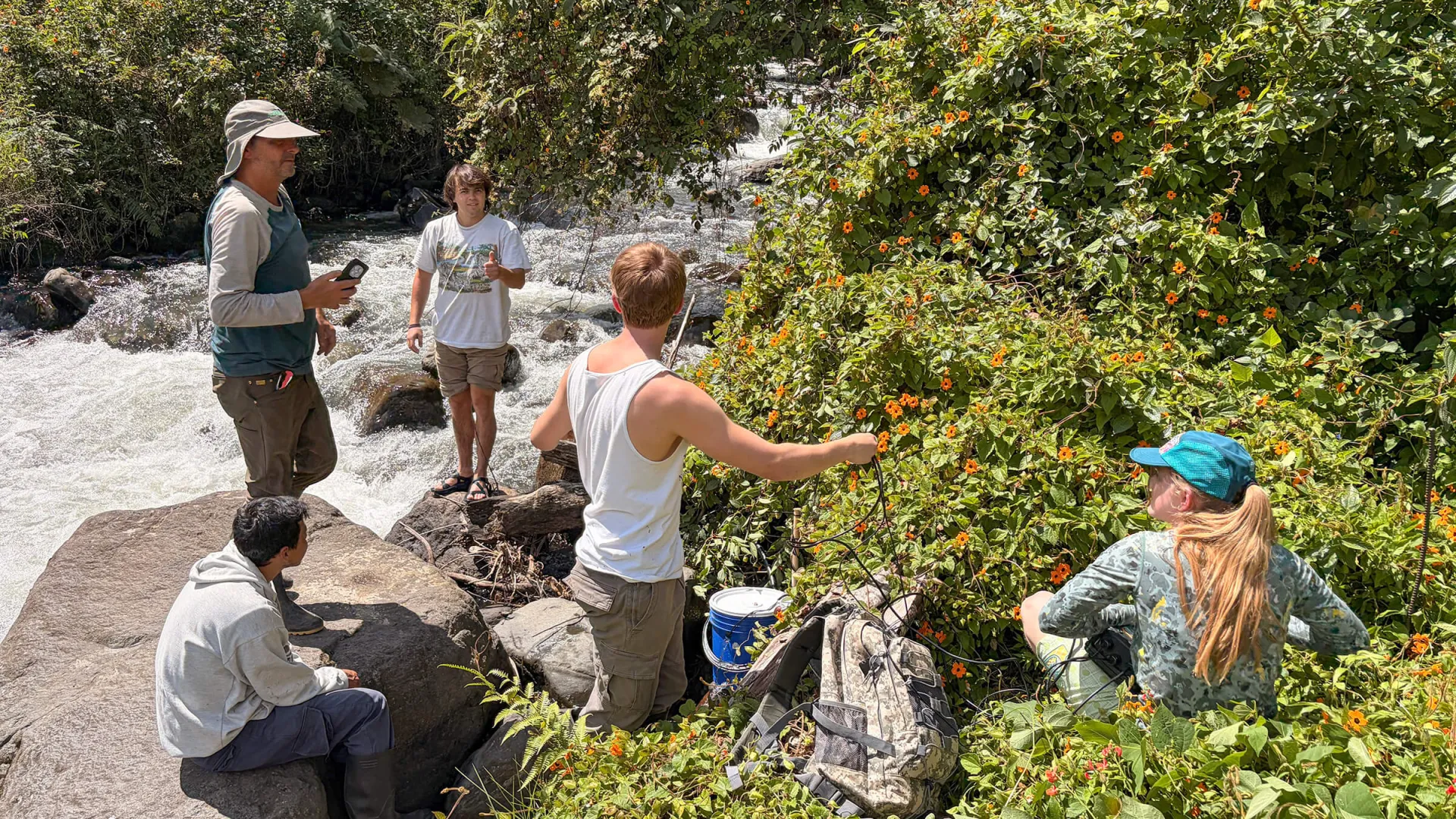
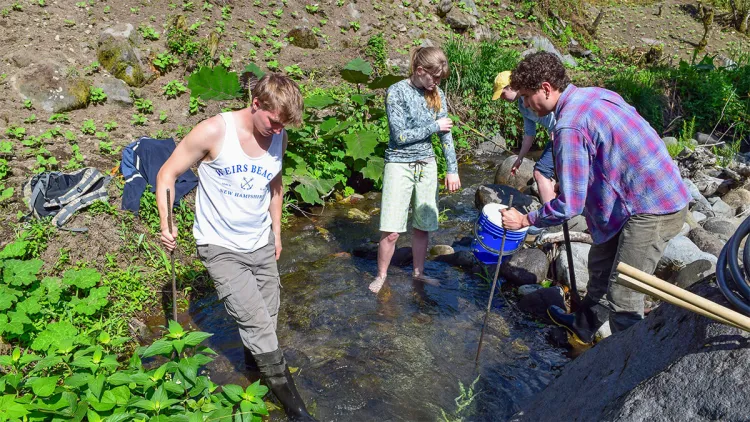
With less than a week to deploy and test their prototypes, the team quickly got to work with assistance and guidance from local APT-Norte members. Two testing sites were identified where the team could access flowing water downstream of areas of potential mining-related concerns. However, it became quickly evident that the team would need to improvise and flex their engineering skills as unanticipated challenges surfaced.
Unable to bring all the materials they needed on the plane, the team learned that the necessary hardware, commonplace in US hardware stores, could not be found in the smaller village hardware stores in the Intag region.
During pre-trip field tests in Vermont, the team used a stainless-steel stake to anchor a PVC pipe that housed the sensor bundle. While this approach worked well in Vermont streams, the only stakes they could source locally in Ecuador were rebar, which would erode over time and affect the conductivity readings.
In addition, they learned from their local guides that seasonal rains could raise river levels in the Intag Valley by up to six feet, creating rapid currents that could easily dislodge the rebar stake from the riverbed.
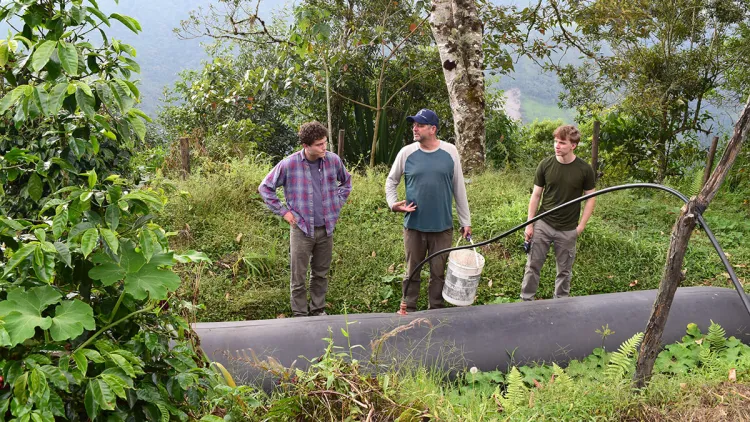
Evaluating the materials and resources available locally, the team pivoted to an entirely new sampling approach that used flexible tubing to siphon river water into a sealed bucket, where the sensors were now housed.
Engineering this field modification served as a valuable lesson for the students.
“One of the biggest takeaways from this experience for me was how I approach the engineering design process from assuming that things will go right to assuming that anything could go wrong and how I prepare for that,” said Duncan, who added, “I think I'm going to carry that with me as an engineer for the rest of my career.”
Another insight the team had while in Ecuador involved power strategies and the use of solar cells to help charge the monitoring stations' batteries. While the weather realities of a cloud forest might seem more obvious, what caught the team’s attention was the concern that even a small solar panel rising above the dense vegetation would likely alert mining companies to their existence.
For future field tests, the team is excited about the prospect of using micro-hydro turbines, driven by the same rivers being tested, to help power the stations. “This summer, Finn (Duncan) and I will be exploring how much voltage we can generate with inline turbines and determine a more reliable physical setup that can be easily implemented in Ecuador, said Myatt.
With discoveries made in the field, Thralow and Dabish are planning to further refine the electronics package and sensors with hopes of adding a TDS (Total Dissolved Solids) sensor to the array to measure the concentration of dissolved inorganic salts, minerals, and metals in the samples as a key indicator of overall water purity.
Perhaps most importantly, the experience served as an affirmation for each team member that the knowledge and skills they are building in CEMS labs and classrooms are leading to careers they are passionate about.
“I came to UVM knowing that I enjoyed math and wanted to pursue an engineering degree,” said Myatt, “This experience has solidified for me that environmental engineering is where I want to be and pursue a field where I can make a difference in people’s lives”
This fall, Johnson will head to California to continue his career in aerospace engineering at Relativity Space, a pioneering manufacturer of reusable rockets. With this transition, he leaves knowing that the future of the project he started remains in very capable hands.
