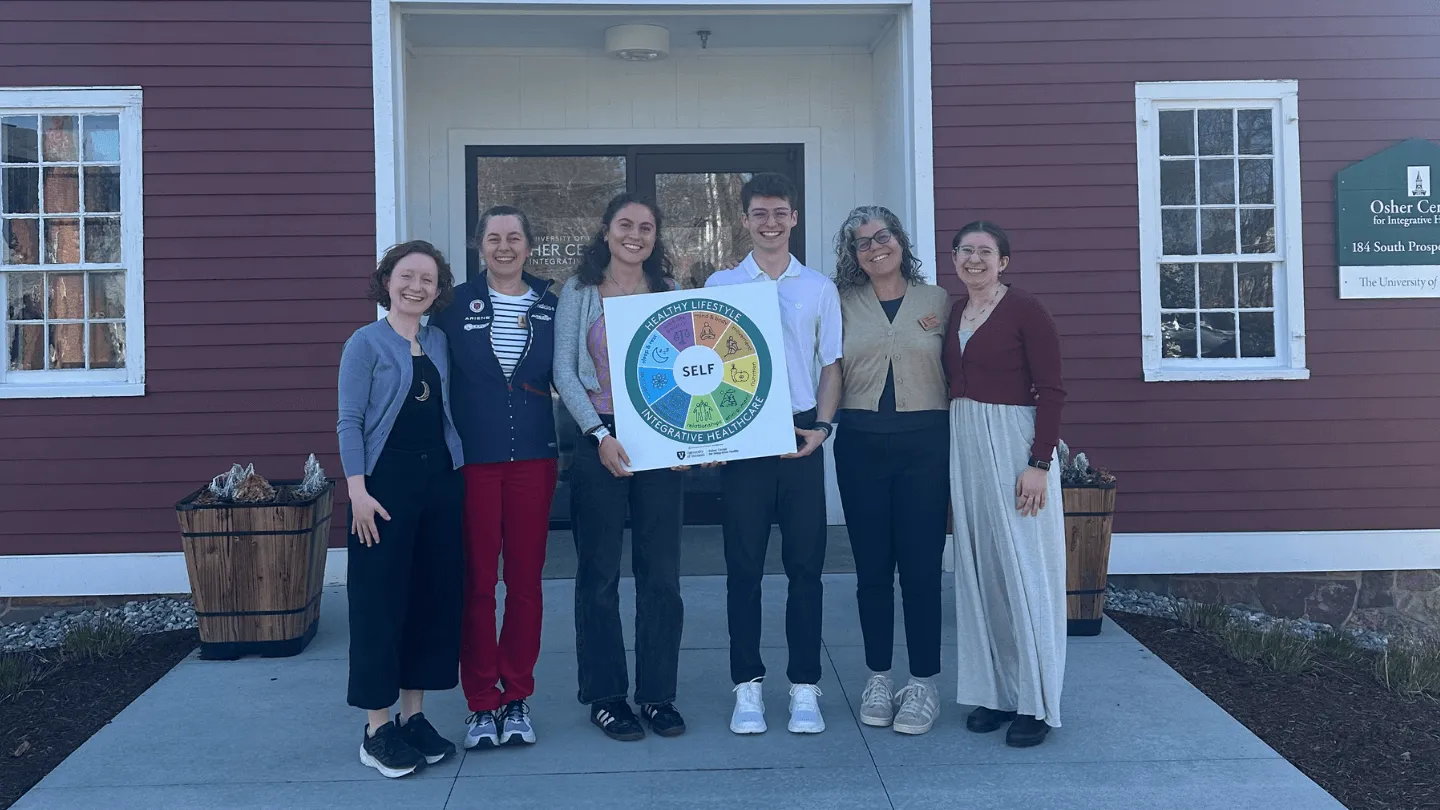
University of Vermont researcher Christine Vatovec—an environmental health social scientist and Planetary Health Lead at UVM’s Osher Center for Integrative Health—studies the deep connections between human and planetary well-being.
And there are connections, significant ones. The U.S. health care system is responsible for roughly 8-10% of the nation’s greenhouse gas emissions. Meanwhile, climate change affects human health in countless ways: increasing heat-related emergency department visits, driving injuries from extreme weather events, and worsening mental health.
A “whole person health” approach looks beyond the conventional medical model of tests, diagnoses, and prescriptions by moving away from focusing on what is the matter with a patient and toward what matters to the person. Whole person health care incorporates activities like spending time in nature, plant-forward nutrition, and other lifestyle changes that can improve a person’s quality of life and health outcomes, while also reducing carbon emissions.
In a peer-reviewed commentary, Vatovec—who is a Gund Institute Faculty Fellow, a clinical assistant professor in the College of Nursing and Health Sciences, assistant professor at the Robert Larner, M.D. College of Medicine, and a lecturer in the Rubenstein School of Environment and Natural Resources—makes the case that both patients and the planet stand to benefit when health care providers embrace the whole person health approach.
This interview has been edited for clarity.
Let’s start with what is planetary health?
Planetary health is a concept linking the health of humans and the health of the planet. At the most basic level, planetary health is about the planet’s ability to sustain the conditions necessary for life. The foundation of this concept is to help us remember, especially those of us in Western societies, that we are part of nature. We are not separate.
The term human exceptionalism is commonly referred to in planetary health—it’s this idea that we are separate from and therefore have dominion over the natural world. This concept has been the root cause of most, if not all, of the challenges that we are seeing in the world.
Planetary health is about looking for solutions to help overcome these challenges, based on the foundation that we are part of this world, and our actions have ramifications on life on this planet.
And the second, related concept—whole person health—what’s that?
Standard, conventional health care is what we normally think of when we go to a hospital: they run diagnostics, offer surgeries and pharmaceuticals, all of which are very important and have offered benefits to humans. But they’ve come at a cost to the planet, and they’re not the only options for promoting human health and well-being.
Whole person health involves looking at a person in a holistic way. What is the nutritional quality of your food? What role does physical activity play in your health status? What is the quality of your sleep? What are your social relationships? What inspires you? What are your goals in life? What do you want to engage with that makes you feel well? There are all these evidence-based complementary therapies that are incredibly beneficial, improving quality of life and health outcomes for people, and when we bring those complementary therapies together with conventional care, that's integrative care.
How are these two concepts intertwined?
From my perspective, our work is trying to transform the health care system, which is a big thing to say. This is a behemoth health care system we’re working with, and it has a role to play in planetary health.
We are seeing patients who have immediate, acute or chronic needs that are based upon planetary health challenges. For example, people coming into the clinic with exacerbations of asthma or allergies. Seasonal allergies are getting worse and lasting longer, and those are directly related to climate change. We’re seeing people come in with exacerbation of chronic obstructive pulmonary disease, or COPD, because of wildfire smoke and poor air quality, which is directly related to climate change and heat events. We have more people coming into the emergency room, and we must ensure that our clinicians, who are seeing patients, can respond to those acute needs.
On the opposite side, the health care system, through a whole person model, has an opportunity to help reenvision how health care is delivered in a way that is decarbonized and is more supportive of the planet, decreasing the environmental impact of health care.
And preventive medicine, like patient education, good nutrition, being physically active, stress management, decreases the amount of care people need, which decreases the footprint of health care.
Anything we can do to prevent illness and keep people from requiring care in the first place is a win-win. It’s better for the patient, and it decreases the footprint of care. The benefits are bidirectional. — Christine Vatovec
How does health care contribute to greenhouse gas emissions?
There are three major ways. First are direct emissions—these come from heating and cooling health care facilities and driving health care-owned vehicles. Second are indirect emissions from energy. The majority of emissions come from the third area which are medical supply chains—everything from the food that’s served in the cafeteria to the metal pole that holds an IV bag, the plastic the IV bag is made of, and the pharmaceutical in the IV bag. All of the equipment in a clinic came from somewhere in the environment, and then it’s processed and transported, all the while accumulating a carbon footprint. And then when we dispose of it, it creates emissions through incineration or in a landfill. This third pathway accounts for about 80% of the total carbon emissions from health care, so really anything we can do to keep people healthy and out of the health care system will benefit not only the patient, but also the planet. That’s why the whole person health model is so valuable.
What inspired this publication?
A paper came out last year about a modeling experiment looking at different health care approaches for a typical patient, comparing the outcomes of current standard care to whole person care. It showed both a substantial decrease in the cost of care and a significant improvement in a patient’s health outcomes and quality of life. When I read that paper, I was inspired. What if we started by asking a patient, what are your goals? And what’s making it hard for you to achieve your goals and be healthy? A patient might say their neighborhood doesn’t have access to fresh vegetables, so now, here in some clinics at UVM, a health care provider can prescribe a CSA subscription, so a person can get a box of fresh produce. With that sort of approach, you can help to prevent illness by promoting health and wellness early in someone's life. But when I read that paper, I also realized there's something missing: they haven’t talked about the role of planetary health here.
What are some steps that health care systems can take in the near future?
The thing that I'm most excited about personally is considering, what would improve in our health care system if we could shift a number of people from standard conventional care—often called “sick care”—into this whole person model?
As more people receive care that really promotes wellness and decreases the amount of time people spend in clinical settings, we're automatically going to see a decrease in the carbon footprint, decrease in pharmaceutical footprint, and that alone is amazing. And we can achieve even more if we are training our clinicians with this integrative, whole person perspective, which we are seeing increasingly across the country.
The U.S. Department of Veterans Affairs uses the whole person approach; there's your evidence base. If the government is doing it, there must be something good; it must be saving money in particular, and helping, in this case, veterans. If we only just started training health care providers in whole person health, that would be amazing. And if we start training people in whole person health with the planet in mind, with this planetary health angle in mind, that means we're not only going to improve people's nutrition but elevate this approach to think about things like plant-based diets, which is going to have an even bigger impact on lifestyle carbon footprints.
If we are thinking about whole person health, that includes active transportation. So, we can work with clinicians and health care administrators—people who have power and trust within their communities to advocate for changes, more walkable neighborhoods, so that kids can walk to school, so people can get to the places they need to be without driving.
We can also increasingly embrace evidence-based approaches like mindfulness-based stress reduction and other stress management tools that are available to us through lifestyle medicine. Those types of things help decrease anxiety and depression, help people become more engaged with issues that matter to them, for example, climate action. These approaches also improve people's outcomes in terms of their mental well-being and may allow us to decrease some of the medications that we are using. We can incorporate nature prescribing, which we’re seeing more and more.
Right now, not all providers know about these tools, but if more of us ask our providers about them, then our providers start thinking, ‘gosh, I better look into this.’
Not all of these different therapies work for everything—they still have to be used very thoughtfully for the conditions and experiences that people have—but the evidence is incredibly strong that these different whole person modalities are effective, in some cases more effective than standard care. It makes me feel very optimistic that there is a good opportunity here for moving in the right direction, in a more positive direction for people and planet.
"Making a Planetary Health Case for Whole Person Health" was published in the journal Global Advances in Integrative Medicine and Health.