This summer University of Vermont junior Nick Preschel had a unique commute.
Most days, Preschel, who is studying environmental sciences at the Rubenstein School of Environment and Natural Resources, trekked to Farrell Hall and then spent his days immersed in data collected some 4,000 miles away in Brazil’s tropical savanna—a two million square kilometer ecosystem that abuts the Amazon rainforest.
Preschel, who was selected for a Gund Institute Summer Research Award, joined a five-person UVM-based research team investigating how changes in land cover and land use, along with socioeconomic and environmental factors, influence childhood health in Brazil’s Cerrado. The project, funded by a Gund Catalyst Award, is led by Kelsey Gleason, an assistant professor in the College of Nursing and Health Sciences and Gund Faculty Fellow.
This summer marked Preschel’s first formal research experience and solidified his budding interest in the field.
“I found research very rewarding," he said. "It’s something I can see myself doing in the future."
Preschel spearheaded the team’s data analysis. His focus: how diarrheal disease, the leading killer of children globally, is affected by changes on the landscape and other factors.
“Nick stepped into this project with remarkable initiative and quickly took ownership of a complex, multi-source dataset,” said Gillian Galford, Co-PI of the project, associate research professor and Gund Faculty Fellow at the University of Vermont.
Day-in and day-out, Preschel sourced, documented, organized, cleaned, processed, and presented data from a variety of sources, including health records and climate data.
"It was challenging working with a lot of data,” he said. “That was new for me.”
Over the course of a few months, Preschel learned to program machine learning models, code in R, and became proficient with the geospatial software tools Google Earth Engine and ArcGIS Pro, skills that were all new to him at the beginning of the summer.
“This research opportunity allowed me to explore and do things on my own,” he said. “It was self-paced, which was really cool. It was a great balance of freedom and teaching when necessary.”
Beyond UVM
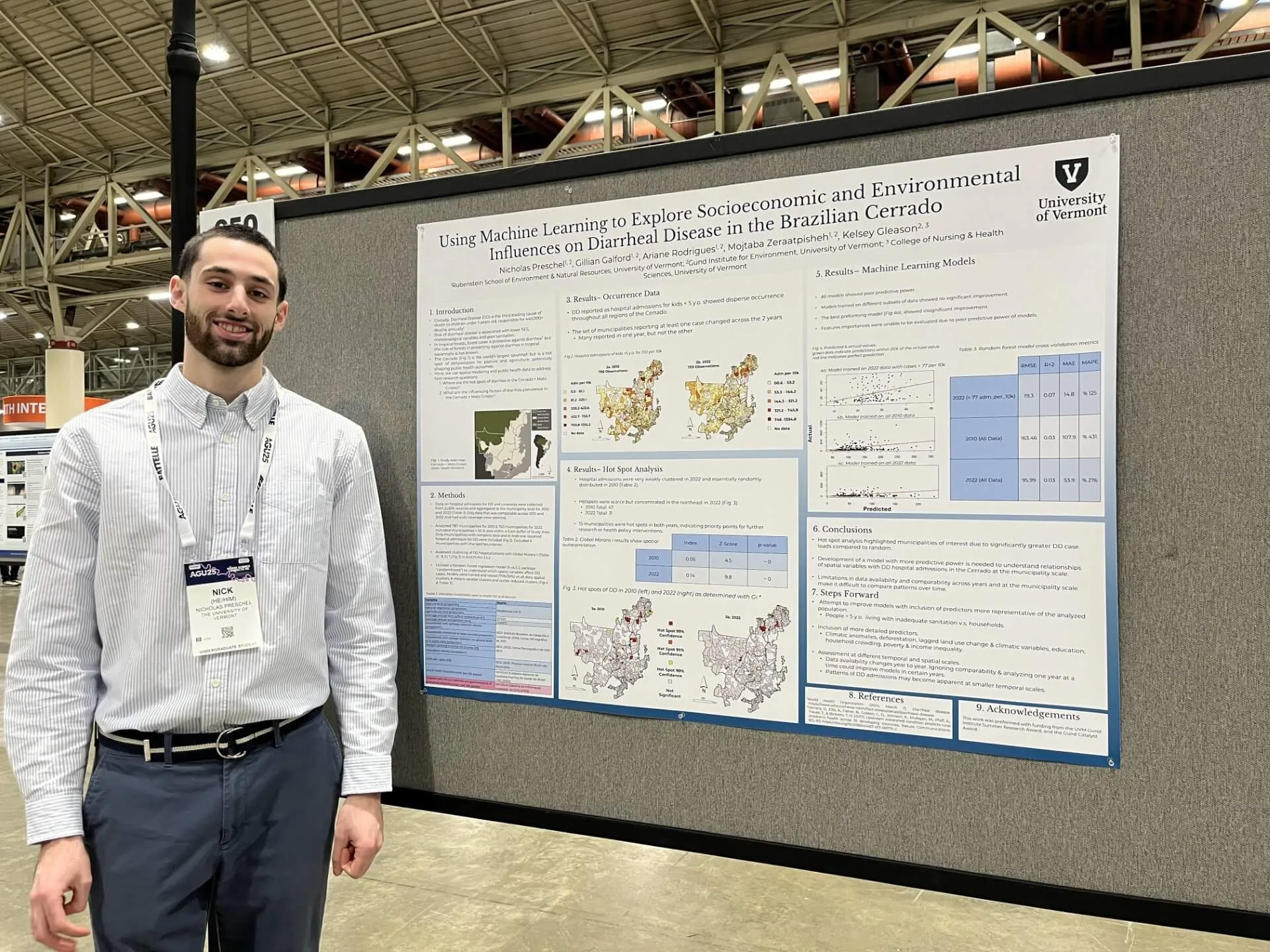
This winter the research team, including Preschel, had the opportunity to present their findings at the annual American Geophysical Union conference, which brings together upwards of 20,000 Earth and space scientists. Preschel submitted an abstract and presented a poster at a research conference on the team’s research. He called it a “special” opportunity.
“I was able to talk with other students that professor Galford had previously worked with, particularly colleagues at the World Wildlife Fund,” he said. “At the conference you can just talk to people who are interested in the same things as you and you can learn a lot!”
What's Next
Preschel’s research experience was made possible through partnerships with FOUR (the Office of Fellowships, Opportunities, and Undergraduate Research) and SURF (the Summer Undergraduate Research Fellowships Program), as well as support from the Gund Institute.
Backed by the Mayo-Smith Family Research Award Endowment, the Gund Institute provides undergraduate students with opportunities to participate in faculty research, complete thesis projects, attend events, and learn from visiting scholars.
Preschel reflected on his experience over the past eight months, proudly sharing, “I learned how to code using R. That’s one huge accomplishment I gained from this experience. A new skill that’s extremely valuable and relevant.”
He credited his success this summer to the strong sense of community at the Gund Institute and within the Rubenstein School.
“I talked to my academic advisor while I was applying and asked if they knew any Rubenstein students who had done this before,” he said. “That led me to sit down with two former researchers and learn what I needed to do to be successful. Utilize your resources, especially if you’re planning on coming up with your own research.”
Preschel encourages undergraduate students who are interested in conducting research this summer to reach out to professors and the SURF office.
“Don’t be afraid to ask for help,” he said. “Ask for guidance from other students who’ve done it.”
The application for the Summer Undergraduate Research Fellowship Program is open now and can be accessed here. The deadline is Monday, March 2 at 11:59 p.m.