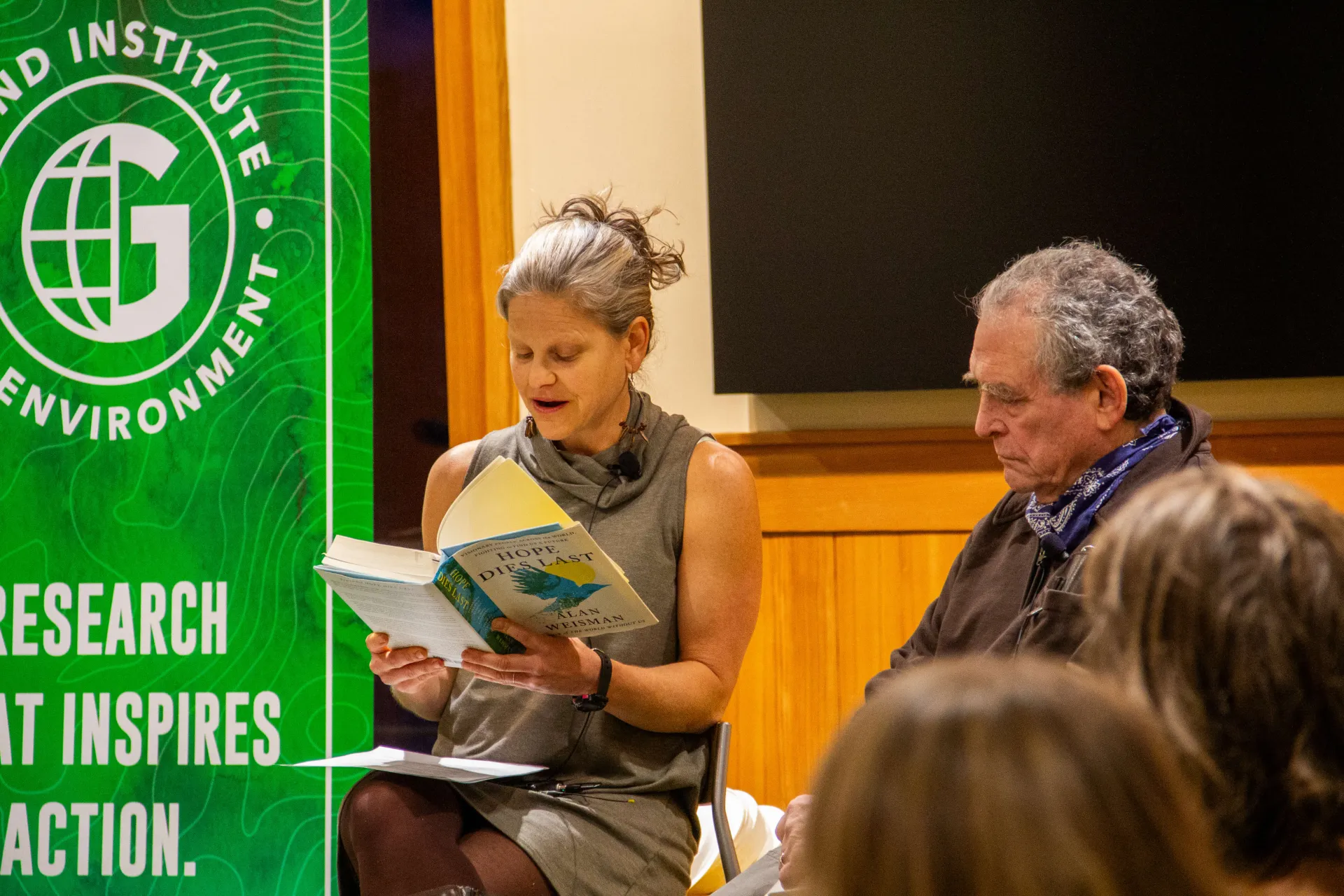
Scores of people braved chilly winds on Wednesday, Dec. 3 to hear Alan Weisman, bestselling author, journalist and professor, discuss his new book Hope Dies Last.
Released this year, the book spotlights a series of inspiring people and their work to save the planet. It is the latest from Weisman, whose work has for decades provided deep reflection on humans, our environment, and the relationships between them.
“He has an incredible way of describing really complex scientific topics related to the environment in really clear ways,” said Rachelle Gould, an associate professor in the Rubenstein School of Environment and Natural Resources and a faculty fellow at the Gund Institute for Environment. “When I saw this book, which is about hope, I said, ‘I need some of that right now,’ and I think a lot of people need some of that right now.”
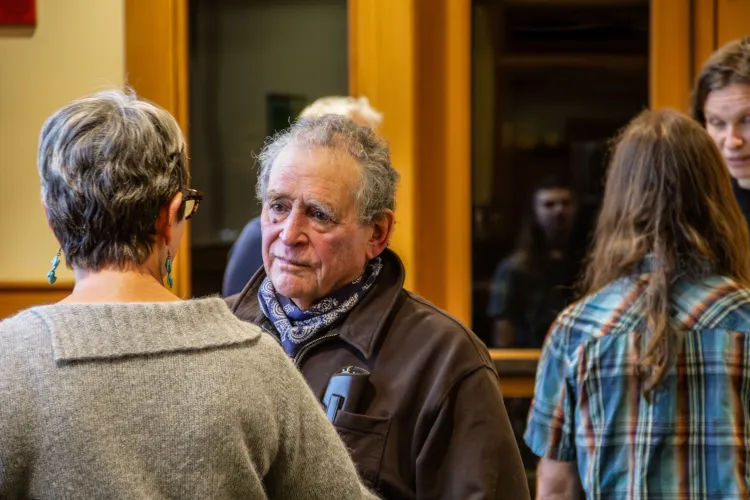
Gould was instrumental in bringing Weisman to campus as a Gund Institute Macmillan Visiting Scholar. Through the program, Gund Faculty Fellows may host visiting scholars to collaborate and engage with the University of Vermont (UVM) community.
In addition to his public talk, Weisman spoke to classes on campus and attended the final meeting of a book club comprised of faculty, graduate students, and staff who read and discussed Hope Dies Last this semester.
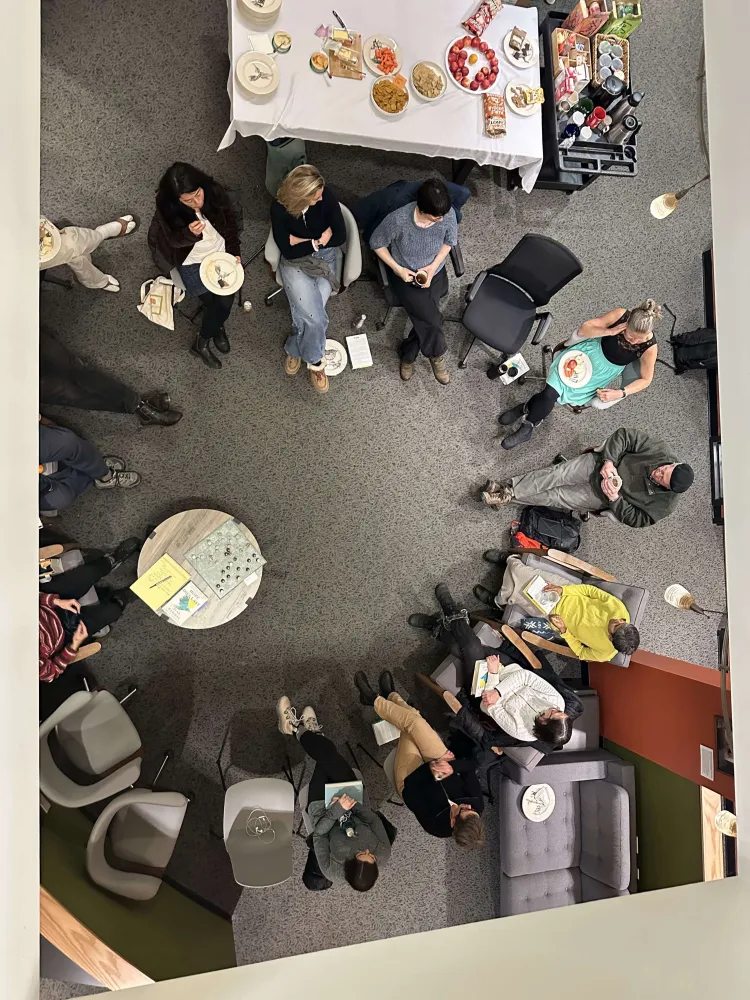
“In addition to being so accomplished, Alan's also a really warm, generous person,” said Gund Institute Director Taylor Ricketts. “He spent a lot of time with us and was just really gracious with our questions.”
In Wednesday’s wide-ranging conversation with Gould, Weisman brought the audience behind the scenes and into some of the places he visits in the book including the polders in the Netherlands, a NASA laboratory and the wetlands of Iraq, and a refugee camp to name a few.
And he spoke passionately about the people he met who are working to repair some of the damage humans have wrought on the Earth. In fact, despite the role that humanity has played in overtaxing the planet, Weisman said humanity also gives him hope.
“After doing this book, I am much more encouraged that there are some brilliant people out there who will come up with some things that feel downright miraculous, that could be big game changers,” he told the audience.
He also offered some advice about speaking with kids about the climate crisis: get children into nature any chance you can.
“There's just something about being of nature that just heartens us, and it shows us that as bad as we've been in this planet, it's still pretty beautiful out there,” Weisman said.
Looking forward, Weisman is cautiously optimistic.
“What I heard from a lot of people is that hope has to be an active verb,” he said. “It can't be just sitting around waiting, wishing for miracles. You have to go out and try to make them. And there are so many things that every one of us can do.”