Thanks to Vermont’s river-crossed terrain, the state is dotted with more than 4,000 bridges, from picturesque covered bridges to more prosaic overpasses that might not earn a second thought from motorists.
But the state’s bridges became a symbol of the sometimes destructive power of water during Tropical Storm Irene, when an amateur video captured the Bartonsville covered bridge sliding into the Williams River, wiping away one of the state’s more than 100 iconic wooden-roofed bridges. While that event was an extreme occurrence, it demonstrated a condensed version of a nonstop force that eats away at the state’s river crossings: water-wear.
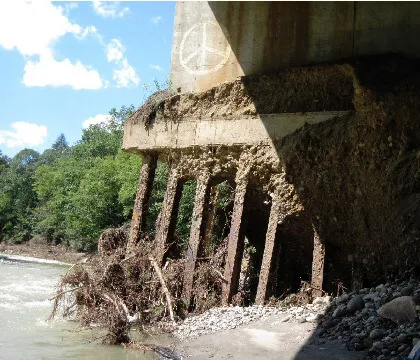
Called scour by engineers, the force washes away sediment from the base of a bridge, and can scoop holes into abutments and weaken a bridge’s structural integrity. Given enough scour, a bridge will become structurally unsound and could eventually collapse.
Investigating how scour impacts Vermont’s bridges is a line of research at UVM’s College of Engineering and Mathematical Sciences, with the college’s faculty and students working on research for the Vermont Agency of Transportation (or VTrans) to develop an understanding of how bridge and stream interactions lead to structural problems, and how to reduce the risk of scour damage.
VTrans is beginning to appreciate that rivers are dynamic systems, said VTrans Project Manager Carolyn Carlson, who graduated from UVM in 1985 with a degree in civil engineering and later earned an MBA at the university. “We tend to design our bridges to span river crossings in one location, and that it will last for 80 to 90 years,” she says. “However, we are observing that our rivers and streams want to go elsewhere during storm events.”
Tropical Storm Irene sparked the state’s interest in researching scour, with state officials and engineers realizing that bigger and more frequent storms may pose additional challenges for Vermont, says Glenn McRae, associate director of UVM’s Transportation Research Center, which is also working on the research for VTrans. Research will integrate information about both bridges and streams, with the goal of improving the understanding of how stream geomorphology is affected by and affects bridges.
Successfully mitigating scour-related problems associated with bridges is dependent on the ability to estimate scour potential, design prevention and countermeasures, designing safe and economical foundation elements that account for scour potential, and designing reliable and economically feasible monitoring systems, says CEMS associate professor Mandar Dewoolkar, who is one of the college’s faculty investigating the issue, along with graduate students Ian Anderson and Daniel Hagan.
“With an understanding of stream stability, we can better site bridges to reduce risk, and design in a manner that respects the streams’ natural adjustments,” Dewoolkar says.
Before Tropical Storm Irene in 2011, there were four previous flood events in 1927, 1936, 1938, and 1973. The 1927 flood was a major disaster for Vermont, destroying more than 1,200 bridges and killing 84 people, including the state’s lieutenant governor. The other events were smaller in scale, but also destructive, Dewoolkar adds.
“The storm in 1927 was a lot like Irene,” he says. “Both storms were the last efforts of hurricanes, and came after a month of higher-than-normal rainfall, resulting in saturated conditions that lead to greater runoff.”
After the 1927 flood, Vermont replaced many damaged bridges with truss bridges that were higher and had longer spans over rivers and streams, Carlson notes. Larger hydraulic openings were built into designs to prevent losing bridges to flooding and scour situations.
But some of these failed 84 years later during Tropical Storm Irene, when more than 200 bridges in Vermont were damaged or destroyed.
“Irene caused greater-than-anticipated damage,” Dewoolkar says. “I never thought it could happen. Of the damaged bridges we have record of, about 40 percent required major repairs or were completely replaced because of Irene.”
The nation is suffering from aging infrastructure, and Vermont is no different, Dewoolkar adds. “Irene was a good lesson. Moving forward we hope to develop more holistic bridge designs, and do it economically,” he says.
Rivers, streams, and their banks, as well as existing roads, flood plains, and many other variables come into play when conceptualizing a bridge design. Flood plain availability upstream and downstream and riparian vegetation that could add to floating debris or blockage are often hard to predict, while potential interactions are difficult to pinpoint.
Vermont’s 4,000 bridges are inspected regularly, with its 2,716 long structures – or those with spans of more than 20 feet – conducted every 24 months. The shorter bridges are inspected every 60 months, Carlson notes. Yet even with teams of inspectors traveling throughout the state to inspect the bridges, some still fail without warning.
Once such bridge was White River Junction’s Bridge Street bridge, a multi-span structure with piers built on timber piles that suddenly fell into the White River in 1990. “There was a massive ice jam that destroyed the supports and several spans collapsed into the river,” Carlson says. Engineers later found that progressive weakening due to scour was to blame.
Issues such as VTrans’ scour research are often brought to students at CEMS to take on in their senior year Capstone projects. The Capstone projects are required for all undergraduate engineering students, and the civil engineering students often work on projects for local municipalities.
“VTrans and UVM teaming up is important in a small state such as ours,” Carlson notes. “We both want answers to engineering problems and working together allows us to pool our resources and tools to come up with solutions to problems such as scour.”
For the past few semesters, CEMS students have been integrating information about streams and flood plains to help VTrans develop a Vermont-specific approach to bridge design and repair. “We hope to improve the existing ways of rating bridges for scour susceptibility, so the most vulnerable bridges could be more readily identified for immediate attention,” Dewoolkar says.
Because of their research, Vermont is actually one of the very few states where significant data on the health and conditions of streams are becoming available and are continuously being collected, Dewoolkar said.
“VTrans is also considering newer construction technologies such as rapid bridge construction and building longer spans that the new techniques allow,” Dewoolkar notes. “There is always more to learn.”
This article originally appeared in the Spring 2015 SUMMIT