As residents of the most rural state in the union, Vermonters have long been defined by a scrappy resourcefulness, a spirit that runs just as deep at the state’s namesake university. When the Vermont Agency of Transportation (VTrans) sought a research partner capable of balancing innovation with thriftiness, a team of engineers from UVM’s College of Engineering and Mathematical Sciences (CEMS) answered the call.
The challenge was significant. VTrans is responsible for maintaining and inspecting a vast network of underground culverts that channel stormwater to keep roadways safe and passable. It’s no small undertaking: more than 47,000 culverts lie beneath Vermont’s varied terrain, and with a goal of inspecting each one at least every five years, the agency must assess more than 9,000 culverts annually.
Further complicating matters is the fact that the culverts come in a wide variety of different sizes, lengths, materials, and locations—many of which can only be accessed from above. While some short or large culverts can be inspected visually, the majority of culverts in the state are quite small—less than 3 feet in diameter—and require an alternative inspection method.
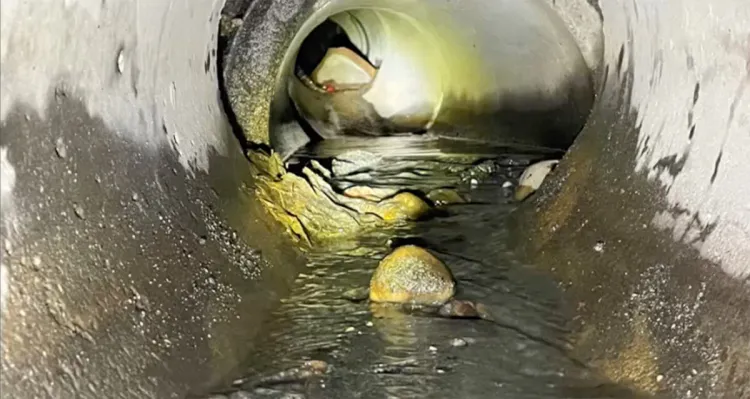
“It's incredibly important that we do inspect these culverts, many of which are aging and falling apart,” said VTrans Technician Meghan Brunk, who, along with District Project Manager Michelle Redmond, serves as a co-champion for the HIVE project. “Our primary concern is preventing safety hazards which can happen when a culvert collapses, allowing dangerous sinkholes to form.”
Along with risks to motorists, such failures carry steep financial costs as well. In the summer of 2022, a culvert collapse under Interstate 89 in Richmond created a large sinkhole that left a dangerous depression in the highway. The resulting repair took six months and cost the state over $12 million.
Hydraulic Inspection Vehicle Explorer (HIVE)
A promising solution to Vermont’s culvert inspection challenge originated roughly 1,000 miles west, in Minnesota. There, faced with a similar problem, the Minnesota Department of Transportation developed a low-cost, home-built inspection robot—a wheeled, remote-controlled vehicle called the Hydraulic Inspection Vehicle Explorer, or “HIVE.”
Commercial inspection robots, known as crawlers, are powerful but come with substantial drawbacks. Each unit costs around $80,000 and requires a specialized van and a two-person crew to operate—an impractical model for budget-limited agencies.
Minnesota’s HIVE offered a different vision. Built from modified RC cars equipped with cameras and lights, the robots were lightweight, Wi-Fi enabled, easy to deploy, and cost roughly $1,500 per unit. Perhaps most importantly, the design was open-source and relied on readily available parts.

VTrans soon recognized the potential of the HIVE approach, but limitations quickly surfaced. The wheeled drive systems were frequently outmatched by the obstacles they encountered in culverts, such as debris, large gaps, or steep inclines. In addition, the dark, damp, and dirty confines of a culvert proved a less-than-ideal environment for sending a vehicle housing an array of sensitive electronics without adequate waterproofing.
But the biggest drawback was the vehicle’s range. “On a good day, you could only drive in 30 or 40 feet into a long culvert before losing contact. So very few culverts actually were able to be inspected using these first HIVEs,” said Brunk.
Enter UVM
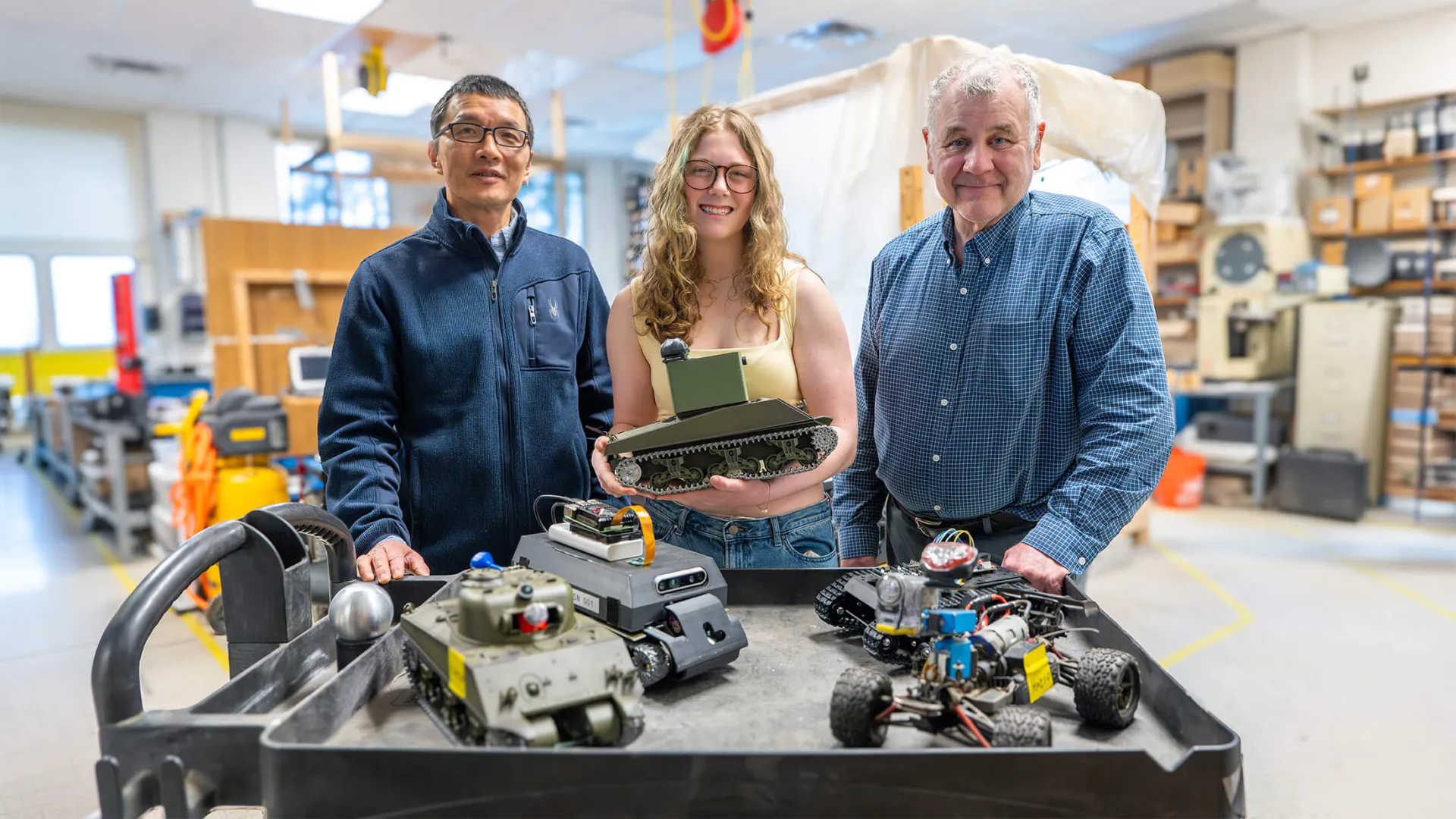
To improve the HIVE, VTrans initiated a competitive selection process for an external research partner. The project caught the interest of UVM Professors Dryver Huston (Mechanical Engineering) and Tian Xia (Electrical Engineering), who submitted a Letter of Interest to use their combined expertise, along with a dedicated team of graduate and undergraduate researchers, to develop a second-generation HIVE.
The design goals stipulated by VTrans were clear: the new robot needed to be cost-effective, capable of handling slopes and gaps, and equipped with an extended Wi Fi range—especially for “drop inlets,” culverts that can only be accessed from above.
The most striking change between the original HIVE (HIVE 1.0) and its replacement (HIVE 2.0) was that the new vehicle no longer had wheels. “Since culverts are usually built in segments that often separate at the joints, the four-wheeled vehicles would often get stuck in the gaps. So, for HIVE 2.0, we changed from a wheeled vehicle to a Sherman tank,” said Huston, who added that not only could the tank cross gaps that were twice as far, but it also performed better on slopes and the mix of surfaces found in different culverts.
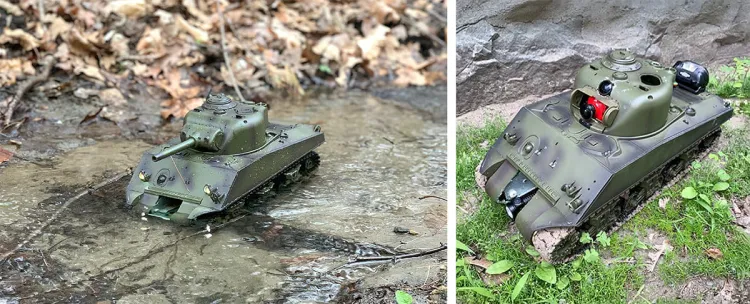
Extending the telemetry range for both vehicle control and camera feed proved more challenging. The narrow culvert geometry and varying materials complicated signal transmission. Nevertheless, after extensive analysis and prototype testing, the team succeeded in more than doubling the original HIVE’s range. “What we did is essentially chopped off the top and put in high-tech telemetry with two cameras— one looking up and one looking forward—and five gigahertz band communications,” said Huston.
After being awarded another VTrans research project through a competitive process, the UVM team developed more complex HIVEs, including a multi-robot concept, HIVE 3.0, allowing a pair of modified inspection tanks to relay signals to the operator as the culvert distance increased or the inspection became more challenging due to bends or similar scenarios where line-of-sight operation is limited.
For a hands-on instructional workshop where VTrans employees would learn to build their own inspection robots, the team settled on a refined single-tank version, HIVE 2.1, that met or exceeded VTrans requirements and extended telemetry range to nearly 300 feet.
The next challenge for the team was to design the workshop, including a comprehensive user manual covering how to assemble, waterproof, and repair the HIVE 2.1 tanks. For this hefty task, the researchers found their champion in an unlikely individual.
A STEM Scholar to the Rescue
When Leah Dennis first toured UVM as a high school senior, the upstate New York native was immediately drawn to both the university’s academic strengths and its idyllic setting nestled between the Green Mountains and Lake Champlain.
“When I first applied to UVM, I didn't have a lot of hopes for it since it was an out-of-state public school, so I applied mostly for fun,” Dennis said. “But when my mom and I toured the campus and the area, we both fell in love with it. I started looking for different opportunities to try and get myself here if I could. It was definitely my dream school.”
An email from UVM announcing a new four-year undergraduate program for admitted students, called STEM Scholars: Leading Change, changed everything. Designed to build both academic and leadership skills progressively, STEM Scholars is a cohort-based learning community at UVM that aims to develop future leaders in STEM (Science, Technology, Engineering, and Mathematics) disciplines.
Dennis went through the application process, which included a written short-answer prompt, an on-campus information session, and an interview. Last Spring, she learned of her acceptance into STEM Scholars and, by July, found herself on campus as part of the inaugural cohort. She was immediately immersed in a six-week summer bridge program that included a 3-credit course on transformational conversations, STEM skill-building sessions, leadership workshops, visits to local tech industry partners, and—perhaps most fortuitously for Professor Huston—a paid laboratory experience.

After spending several weeks participating in concrete research, Dennis moved into Huston’s busy lab to help fill a recent opening on the HIVE project. What followed was a crash course in engineering practice, with tasks ranging from writing an instructional manual to soldering electronics to coding firmware for custom circuit boards.
Like a generational Vermonter, Dennis approached each challenge with resourcefulness, drawing on mentorship from lab partners, the occasional YouTube tutorial, and a helpful dash of AI.
“Honestly, I think that really benefited me when writing the manual,” she said. “It put me in the perspective of someone who knows nothing about robotics. I made sure the manual could be easily followed by people outside the project, since that was me coming into the lab.”
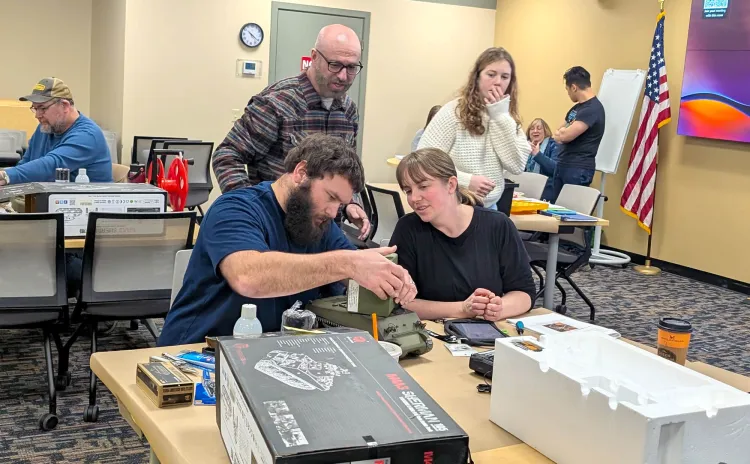
In January, Dennis took the lead at the VTrans workshop, guiding employees from eight maintenance districts as they transformed toy tanks into a rather sophisticated piece of robotic equipment destined to inspect culverts across the state. “It was so cool to see my manual up on the screen and think, ‘I wrote that,’” she said. “By the end of the workshop, we had all of these completed tanks whipping around the room.”
Just weeks later, she had the chance to share her research experience with prospective STEM Scholar students—standing on the other side of the program that made her own UVM journey possible only a short year ago.