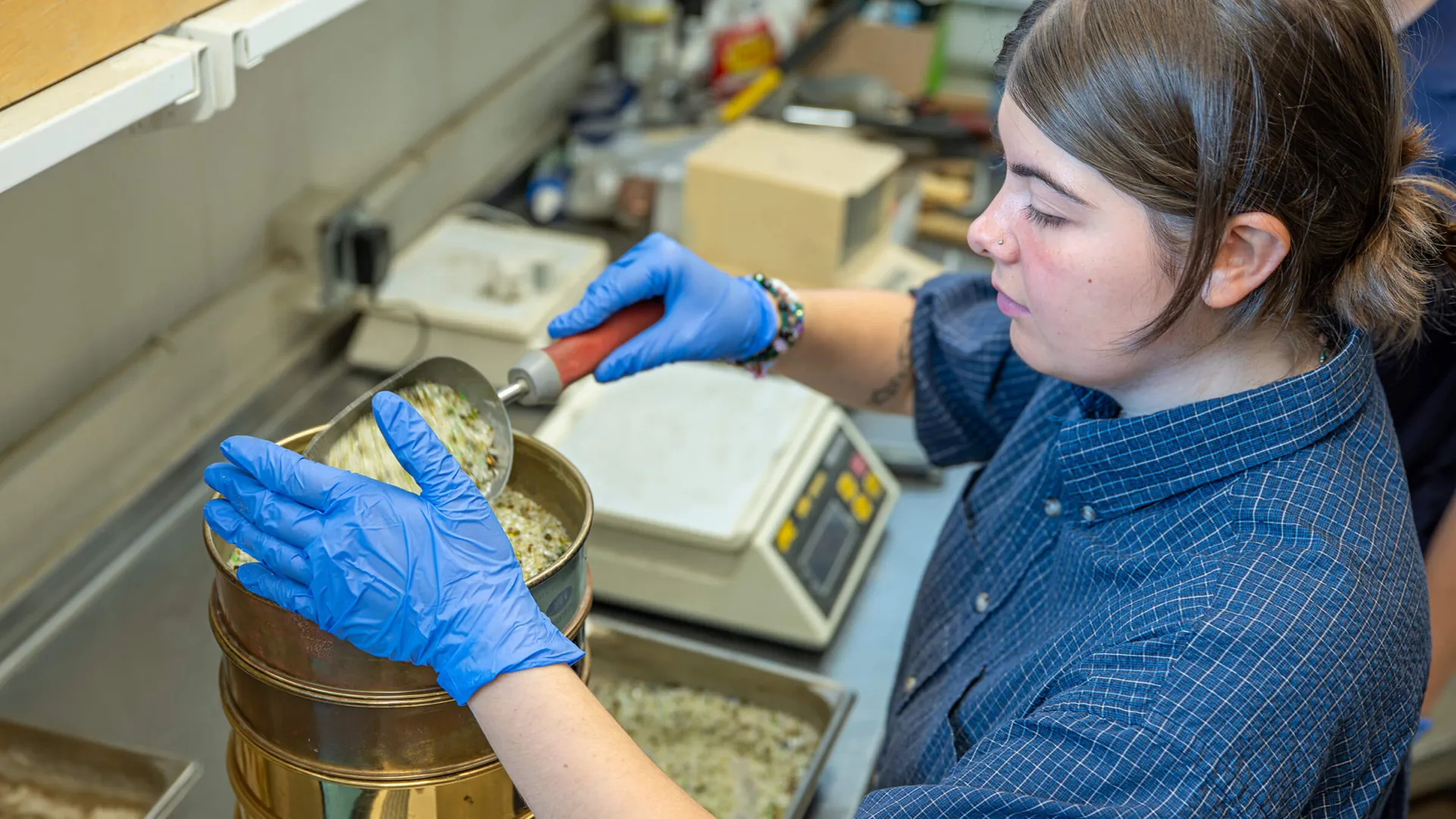
From scaling production of life-saving therapeutic food to testing self-healing concrete, improving wastewater treatment, protecting a culturally significant site, and analyzing river erosion, nine UVM engineering students spent summer 2026 applying classroom knowledge to real-world challenges as Richard Barrett Scholars.
For more than 20 years, the Barrett Foundation has served as a catalyst for environmental-focused research and stewardship at the University of Vermont, providing unique research pathways for both undergraduate and graduate students. At the same time, the convergence of funding, hands-on student experience, and faculty expertise has provided unique engineering support for communities and natural environments in Vermont and across the nation.
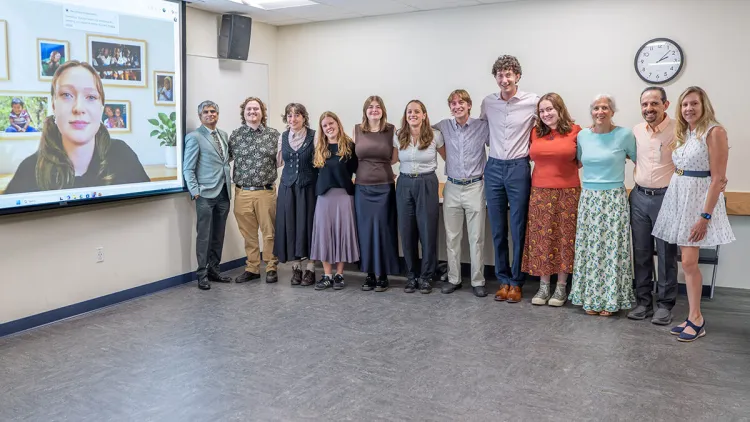
A 1966 graduate of UVM’s mechanical engineering program, Richard Barrett has always been grateful for his undergraduate internship experience. Through the Barrett Foundation, he and his wife, Elaine, have supported a thriving summer research internship program for undergraduate engineering students and doctoral fellowships jointly administered by the College of Engineering and Mathematical Sciences (CEMS) and the Gund Institute for Environment.
Coordinated by Civil and Environmental Engineering Professor Luis Garcia, with support from Acting CEE Department Chair Donna Rizzo and CEMS Dean Mandar Dewoolkar, the program selects undergraduate engineering students through a competitive proposal process modeled on the process used to apply for external research funding. Scholars work with faculty and industry mentors and participate in workshops led by Garcia on research methods and scientific communication. Their work culminates in research posters and final presentations.
“Since 2005, the generosity of the Barrett Foundation has enabled these invaluable opportunities for our undergraduate and graduate students, transforming their academic experience while, at the same time, supporting the interdisciplinary study of critical environmental challenges our planet is facing.”
— Mandar Dewoolkar
Dean, College of Engineering and Mathematical Sciences
In addition, the students are supported by a group of Gund-Barrett doctoral fellows who serve as mentors to the undergraduate scholars and help guide them through the program. This year’s doctoral fellows included Shaurya Swami (Computer Science), Joy Onuh (Civil & Environmental Engineering), and Robert Jones (Civil and Environmental Engineering).
At this year’s presentation event, Barrett Foundation Director Magdalena Paul was present to listen to the latest cohort of student scholars share their research as part of a program that she and Donna Rizzo formed over two decades ago.
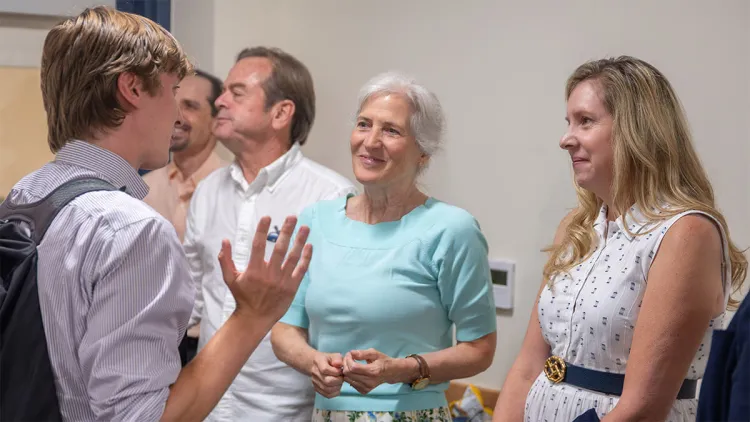
“I was reflecting today on the evolution of this internship, which was established nearly twenty years ago. As I listened to your presentations, what impressed me most was the depth of your understanding of your research topics and the way you effectively connected your work to real-world challenges. You presented complex ideas in ways that were both accessible and engaging,” said Paul.
This past summer, nine engineering students—Eli Baer ’27, Emma Bergsten ’27, Piper Floyd ’28, Sophia Golub ’27, Jess McGovern ’27, Bryn Miller ’27, Bella Mowrer ’29, Caleb Quinn ’27 and Riley Shue ’27—were provided Barrett Scholars awards. Six reflect on their experiences below:
Bryn Miller ’27, Biomedical Engineering
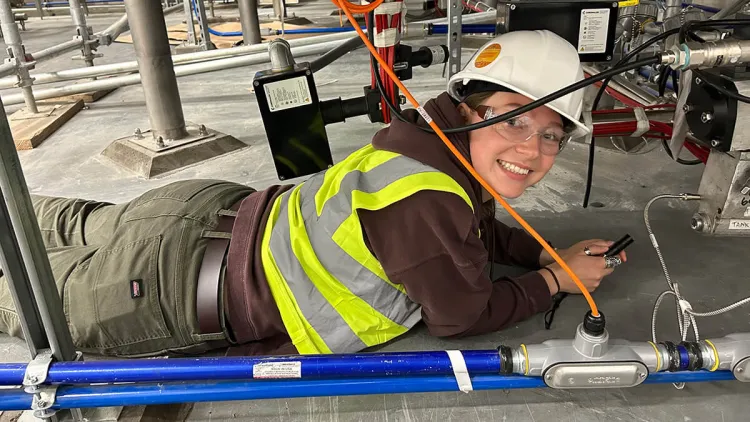
Research Project: Scaling Up Life-Saving Food Production: Ensuring a New Facility is Safe and Ready
Project Mentors: Ken McConnell, Kim Eagleston, Lauren Bartlett
Where did you intern: Edesia Nutrition
What was your research project: This summer I worked as a Richard Barrett Scholar at Edesia Nutrition in North Kingstown, Rhode Island, contributing to Commissioning, Qualification, and Validation (CQV) for Project Moonshot, a major facility expansion. The project triples Edesia's production capacity for Plumpy'Nut, a ready-to-use therapeutic food (RUTF), from 1.2 million to 3.6 million packets per day, allowing the company to reach roughly 800,000 additional children suffering from severe acute malnutrition each day.
What was your role? As a member of the CQV team, my role focused on the engineering validation needed to ensure new equipment and process systems for Project Moonshot were installed correctly, operated as designed, and were ready for safe, reliable production use. I co-authored commissioning and IQ/OQ (Installation Qualification/Operational Qualification) protocols for approximately 15 process systems, learning to read P&IDs, perform I/O checkouts, and troubleshoot PLCs along the way. I also gained hands-on experience with heat transfer systems and both dry and liquid ingredient handling equipment, including participating directly in equipment commissioning during a plant shutdown when I took on a project management role for a workstream connecting the new production line to the current packaging machines.
How did this opportunity impact your studies at UVM? This internship has genuinely reshaped how I think about my degree and career path. Heading into the summer, I was in the Accelerated Master's Program (AMP) on the Biomedical Engineering track, but this experience led me to switch my AMP track to Mechanical Engineering, with encouragement from my mentors at Edesia. Working on the CQV team at Edesia gave me tangible, build-it-and-validate-it engineering experience that complemented what I learned in the classroom.
Were there any unexpected surprises during your internship? I want to give a huge shout-out to my mentors at Edesia, Kim Eagleston, Ken McConnell, and Lauren Bartlett, who were generous and patient teachers throughout my summer internship. Beyond the technical work, I couldn't help but be moved by Edesia's mission. Knowing that every system I helped commission and validate was part of scaling up production of a therapeutic food that treats severe acute malnutrition in children made this internship feel different from a typical engineering job. It's rare to get real industrial engineering experience where the human impact is this direct, and I think that's what I'll carry with me most from this summer.
Riley Shue ’27, Civil Engineering
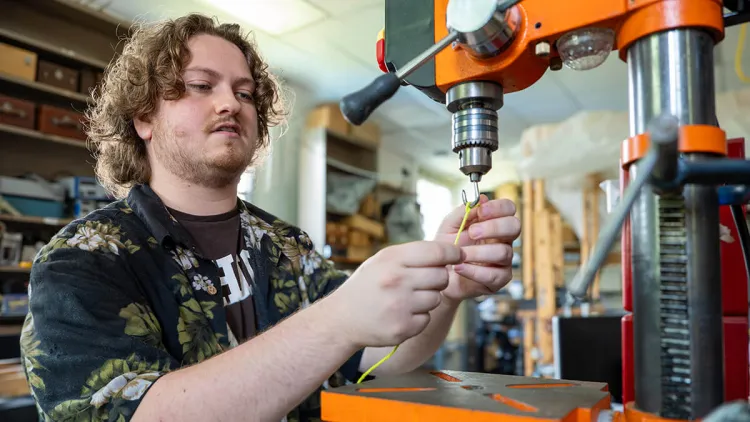
Research Project: Chitosan-Coated Yarns in Self-Healing Concrete
Project Mentors: Dryver Huston, Mandar Dewoolkar
Where did you intern: Dryver Huston's Lab
What was your research project: My project explored methods of prestressing concrete using coiled yarns coated in a chitosan gel. Chitosan, a natural polymer derived from the structural material that makes up the exoskeletons of crustaceans, reacts with the pH of the concrete mixture, causing it to shrink. When chitosan is applied to coiled yarns as a gel, the yarns are able to shrink and induce internal tension in concrete at a much higher strength than chitosan alone. The goal of the project was to determine the best fiber type and yarn construction for self-healing concrete applications.
What was your role? My role was mostly in making and testing the tensile strength of the yarns. I tested over 20 different combinations of fiber types and yarn constructions to determine which combinations had the highest tensile strength. I also made concrete samples with these yarns and ran multiple tests on them to determine if the yarns made a difference in cracking. As for the Richard Barrett Scholars Program, we met every two weeks to work on our presentations and posters, which was a great opportunity to learn how to present our research projects for a general audience that doesn't know every technical detail.
How did this opportunity impact your studies at UVM? In my spare time, I do a lot of fiber crafts (knitting, crochet, spinning yarn), so this opportunity allowed me to merge my interests in yarn/fibers with my major. I know now that I want to continue this research down the line and learn more about the science behind textiles. There is a lot of exciting research in textiles right now, and I'm glad I got to be a small part of it at UVM.
Share your Shoutouts! I want to give a big shoutout to all the Votey Staff and admin and the graduate students I worked alongside!
Emma Bergsten ’27, Environmental Engineering
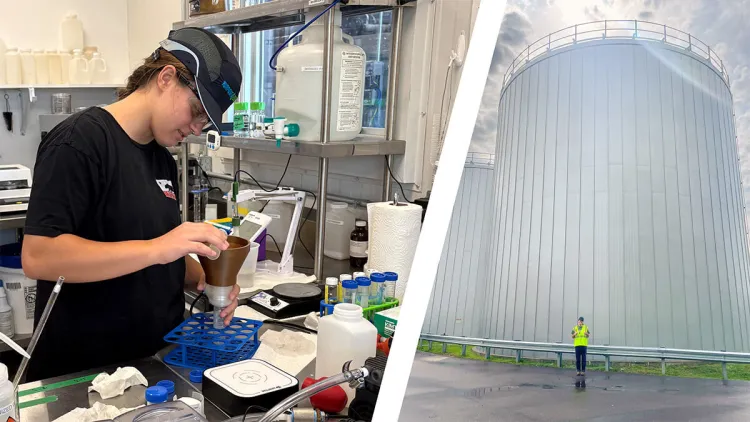
Research Project: Managing Wastewater Solids
Project Mentors: Wayne Hu, Senior Process Engineer
Where did you intern: PurposeEnergy
What was your research project: I studied the effect of various chemical coagulants on their ability to remove phosphorus from anaerobic sludge and increase the dewaterability of that sludge. Ferric chloride, lime, and magnesium hydroxide were added to sludge at varying doses and put through a dewatering simulation. We analyzed phosphorus removal and total solids concentration for each coagulant at each dose to determine the best chemical. These results will be applied to the anaerobic digestion process and analyzed for cost-effectiveness.
What was your role? I performed laboratory testing, met weekly with company engineers, analyzed data in Excel, and presented my findings.
How did this opportunity impact your studies at UVM? This experience provided me with the opportunity to connect with faculty and peers I otherwise would not have known.
Bella Mowrer ’29, Environmental Engineering
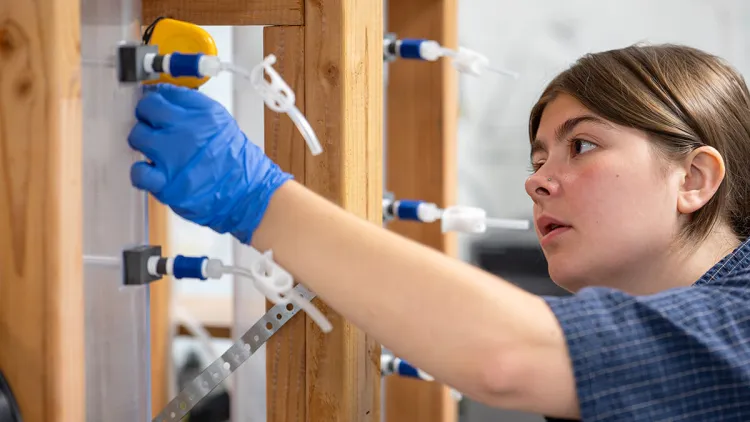
Research Project: Recycled Glass as an Alternative to Sand in Wastewater Treatment
Project Mentors: Mandar Dewoolkar, Matthew Scarborough, Joy Onuh
Where did you intern: UVM EMERG Lab
What was your research project: Our main goal was to evaluate the effectiveness of crushed recycled glass as a replacement for sand in wastewater treatment. This meant examining the geotechnical and treatment properties of both glass and sand to see whether they were compatible. Sand is used in domestic wastewater treatment systems in a sand mound, which functions like a traditional septic system. We used a column filled with crushed recycled glass to mimic a sand mound and periodically pumped in synthetic wastewater. To evaluate treatment performance, we monitored nitrification, an important microbial process in wastewater treatment that converts ammonia first to nitrite and then to nitrate.
What was your role? I did a lot of chemical and geotechnical testing, which meant I got to experience something different each day! Once a week, I tested the column effluent for ammonia, nitrate, phosphate, dissolved oxygen, chemical oxygen demand, and pH. I also completed various geotechnical tests on both sand and crushed recycled glass, including permeability, grain-size distribution, relative density, and shear. I would analyze and organize this data, and additionally, I presented my findings to the other Barrett Scholars and faculty members in meetings every two weeks.
How did this opportunity impact your studies at UVM? This opportunity had such a massive impact on my academic journey at UVM. Having the opportunity to learn how to complete all of these different geotechnical and chemical tests deepened my understanding of the content and concepts that I would learn in class. As a rising sophomore, there were many things that I had never been able to explore just because I hadn't had the opportunity to take the class yet. Being able to understand the theory while also completing the test itself was an incredible learning opportunity, and now, when I eventually take these courses, I'll have a deeper understanding.
Share your Shoutouts! I want to give a big shoutout to all the Votey staff, admin, and graduate students I worked alongside!
Eli Baer ’27, Environmental Engineering
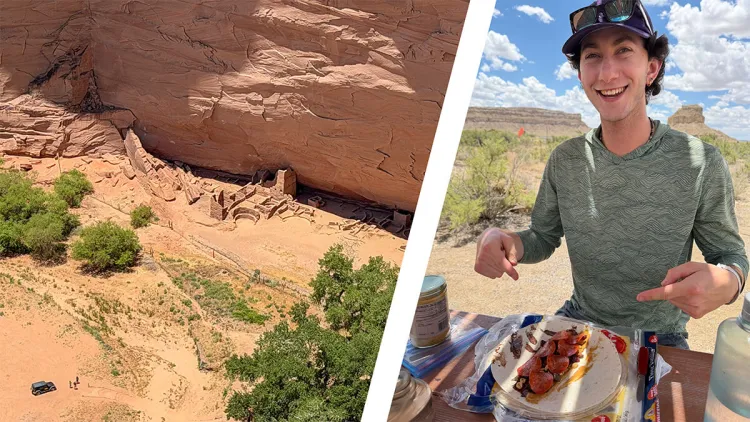
Research Project: Preservation of Antelope House in Canyon del Muerto
Project Mentors: Arne Bomblies and Douglas Porter
Where did you intern: I went to Arizona and New Mexico to do field research for 1 week at the start of the summer, then worked with my professors for the remainder of the summer.
What was your research project: In the Southwest US, there are a plethora of historical sites that have been around for over 1000 years. These sites are a key to the past and to unlocking an understanding of those who inhabited this land before us. Unfortunately, parts of these sites are being lost due to various forms of damage, erosion, and age. Our project focused on the preservation of a historical site called Antelope House located in Canyon del Muerto, Arizona. During the monsoon season, torrential flash floods cause large amounts of water to flow through the canyon floor. This water is eroding too close to Antelope House, so we used a hydraulic model to test different erosion prevention techniques. The software we used is called HEC-RAS, and we manipulated the terrain upstream of the site to produce a velocity that would prevent the movement of sediment.
What was your role? At the start of the internship, I went to Arizona and New Mexico to gain an understanding of the importance of these sites and learn about the relationship between the national parks and the Navajo Nation. Then, once I got back to Vermont, I was given a goal of reducing the velocity to a value that would completely stop erosion near the historical site Antelope. During the summer, I was primarily self-taught and self-paced as I worked to develop a solution. I worked mainly with hydraulic software, HEC-RAS, to simulate different erosion reduction techniques. I also used ArcGIS to manipulate the terrain when testing some of the erosion-reduction techniques. I developed strong problem-solving skills and learned how to affect water flow through a channel.
How did this opportunity impact your studies at UVM? I have made connections with teachers. I recently reached out to two professors who helped me during the summer internship to ask about academic advising this fall. Additionally, I feel better equipped for a Teaching Assistant (TA) position this fall due to gaining familiarity with the software I worked with and the problem-solving skills I developed during the challenging parts of the summer work.
Share your Shoutouts! Dr. Luis Garcia really ran a wonderful program and was aided by a stellar group of postgrads and faculty who helped shape our presentations into something each of us could be proud of.
Piper Floyd ’28, Environmental Engineering
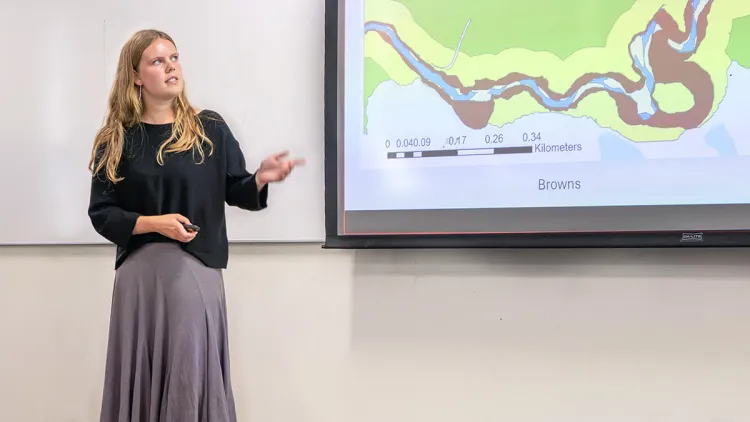
Research Project: Comparing Effects of Frequent Small-Scale Flooding and Infrequent Large-Scale Flooding on River Erosion
Project Mentors: Kristen Underwood and Rebecca Manners Diehl
Where did you intern: UVM
What was your research project: I used ArcGIS—a geographic information system (GIS) and geospatial software platform used to create, manage, analyze, and share geographic data—to map river segments and conduct sediment budget analyses. The sediment data was then used to evaluate the differences between small-magnitude, frequent flooding and large-magnitude, rare flood events.
What was your role? I created shapefiles for seven river segments, using data to trace the rivers for a certain time period. Using these, I created river zone layers that, combined with the data, allowed me to build a sediment budget using a technique called a digital elevation model of difference to quantify changes in sediment volume for each time period.
How did this opportunity impact your studies at UVM? This research opportunity helped to broaden my perspective on what Environmental Engineering is. I saw firsthand how impactful research can be, and it can fit into an engineer's career. It was inspiring to see the other scholars' projects and make meaningful connections with them and my mentors.
Share your Shoutouts! Thank you to my mentors and co-authors for their support on this project!
Together, the 2026 projects demonstrate what students can accomplish when they have the time, mentorship, and resources to pursue original questions. Their work reflects more than two decades of Barrett Foundation support for engineering education and research that serves communities and addresses important real-world problems.