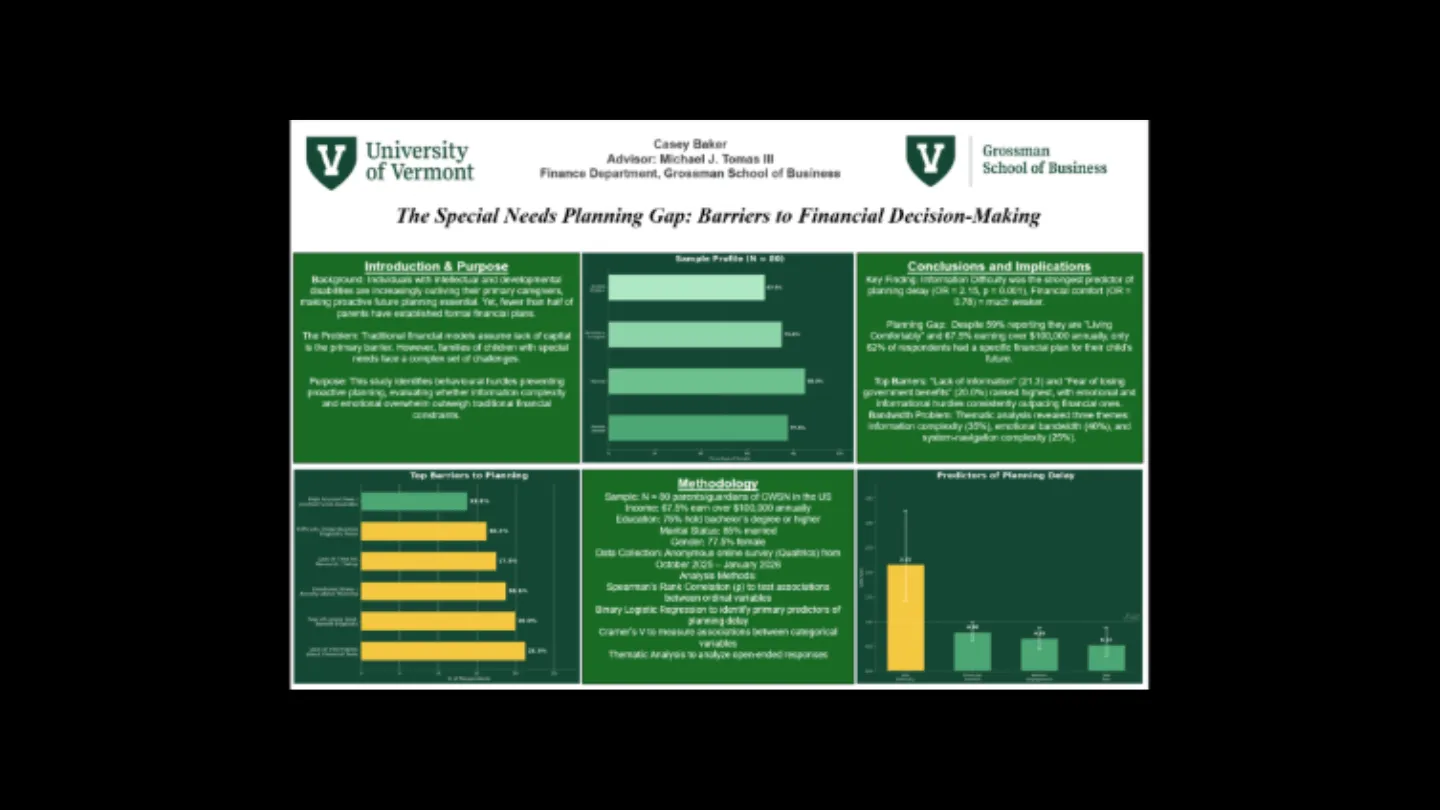
Property taxes and public education are among the most debated policy issues in Vermont. New research from Edward N. Gamble, Richard G. Vanden Bergh, and Thomas Chittenden explores how taxpayers perceive school funding systems and whether giving citizens more say in how tax dollars are allocated can improve perceptions of fairness and trust. Their study, Rethinking Local Choice: Experimental Evidence on Taxpayer Sentiment and Public School Funding, was recently published in Public Administration Review.
The research emerged through conversations with Vermont legislators who wanted to better understand growing concerns surrounding property taxes and education funding. Using a behavioral public administration approach, the team examined what drives taxpayer sentiment and whether policy design can influence public confidence in government systems.
“This research grew out of a challenge many policymakers face: hearing from constituents who are frustrated with rising costs while also recognizing the importance of investing in public education and community services,” said Thomas Chittenden, Senior Lecturer at the Grossman School of Business and Vermont State Senator. “We wanted to better understand what was driving those concerns and whether there were constructive ways to strengthen public confidence in the system.”
Understanding Taxpayer Sentiment
The study examined how Vermont property taxpayers think about fairness, accountability, and the use of public funds. Through qualitative analysis, the researchers identified four themes that consistently shaped taxpayer perceptions:
Fairness and equity
Transparency and accountability
Responsible use of public funds
The burden on vulnerable populations
Across responses, concerns about affordability and understanding how tax dollars are used emerged as common threads. Taxpayers frequently expressed frustration about rising costs, uncertainty about how funds are allocated, and questions about whether resources are being used effectively.
“When we analyzed taxpayer responses, concerns about fairness, transparency, and affordability surfaced again and again,” said Edward N. Gamble, Associate Professor of Accounting. “Those themes became an important lens for understanding not just how people feel about taxes, but how they evaluate public institutions more broadly.”
Testing the Power of Choice
To explore whether increased choice affects taxpayer attitudes, the researchers conducted an experiment with Vermont property taxpayers. Participants were presented with a proposal that would allow them to direct a small portion of their property taxes toward broad spending categories within schools and municipal services while keeping the overall tax burden unchanged.
The findings were striking. Participants who were given allocation choices reported significantly stronger perceptions of fairness, greater satisfaction with the tax system, and more positive views of how tax dollars were used. The results suggest that even limited opportunities for taxpayer input can influence how citizens evaluate public policies.
“One of the broader lessons from this research is that policy outcomes and policy design are not the same thing,” said Richard G. Vanden Bergh, Professor of Strategy and Finance. “Citizens care about results, but they also care about process, agency, and understanding how decisions are made.”
Bridging Research and Practice
A distinctive feature of the project was its collaboration with policymakers. Rather than studying a theoretical question in isolation, the researchers partnered with Vermont legislators to investigate a real-world challenge affecting communities across the state. This practitioner-academic partnership allowed the team to develop research questions grounded in public concerns while generating evidence that may help inform future policy discussions.
The study demonstrates how evidence-based research can contribute to ongoing conversations about education funding, taxpayer engagement, and public trust. It also highlights how Grossman School of Business faculty are applying rigorous scholarship to address complex societal challenges with practical implications for policymakers and communities.
Why It Matters
As states across the country grapple with questions of taxation, public services, and citizen trust, this research offers a valuable perspective: how public policies are designed may be just as important as the policies themselves. The findings suggest that creating opportunities for participation, even modest ones, can influence how people perceive fairness, accountability, and the legitimacy of public institutions.
By examining the relationship between choice, fairness, and taxpayer sentiment, the study contributes new insights for public administrators, elected officials, and communities seeking better ways to engage citizens in policy decisions. It also provides an example of how research conducted at the Grossman School of Business can help inform public dialogue and decision-making on issues that matter to Vermonters and beyond.