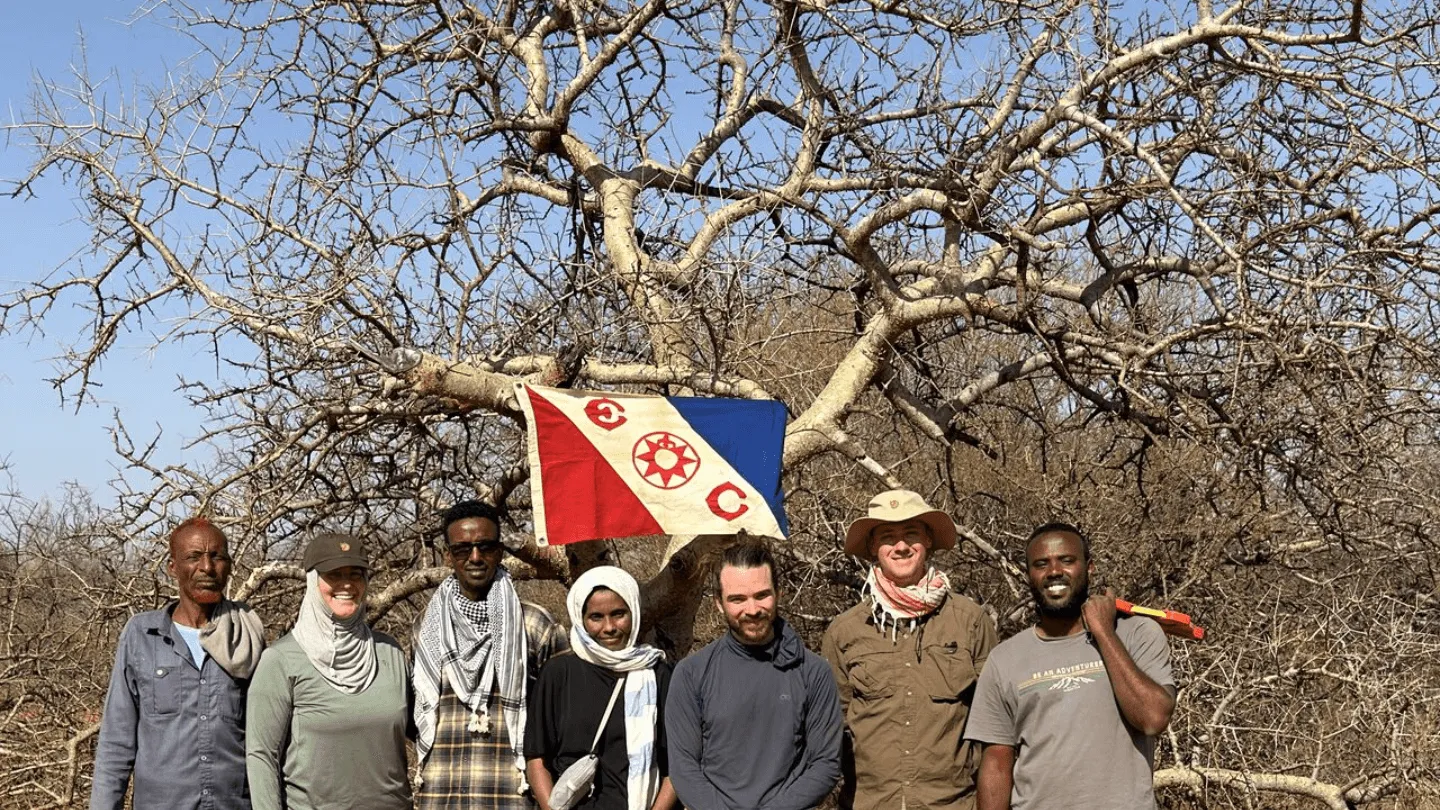
Burlington, VT — Faculty research in the Sustainable Innovation MBA (SI‑MBA) program is bringing students directly into the realities of global sustainability and ethical trade. A current field expedition studying the myrrh supply chain in the Somali Region of Ethiopia—where an Explorers Club Flag was flown during the team’s work—is examining how this ancient resin is sourced, traded, and conserved across international markets.
Understanding the Myrrh Supply Chain
Myrrh is traded internationally and used in cosmetics, perfumes, dietary supplements, and religious ceremonies, with significant markets in China, Europe, and the United States. Despite robust demand, collection of locations and harvesting practices remain poorly documented. This opacity leaves buyers uncertain about whether sourcing is ethical or environmentally sustainable, and it limits opportunities to invest directly at the source—especially where multiple intermediaries add cost but little value.
The research team is documenting collection practices, mapping trade pathways, and examining how traceability can strengthen environmental stewardship and improve livelihoods for the communities who manage myrrh‑bearing trees. Field operations are co‑funded by the American Herbal Producers Association (AHPA) and the Born Global Foundation, which matched the AHPA grant to support on‑the‑ground research activities.
“Myrrh is traded globally—used in cosmetics, supplements, and religious traditions—yet the places it comes from, and the people who manage the trees are often invisible. When sourcing lacks transparency, buyers can’t know whether their use is ethical or sustainable, and communities at the source have no pathway for direct investment. This research shows that everything is traceable if we take the initiative to understand the source. That’s where sustainability and ethics emerge, and where they can carry through an entire supply chain.”
— Dr. Anjanette DeCarlo
Connecting Fieldwork to the SI‑MBA Curriculum
This work directly enhances SI‑MBA learning, linking core program themes—transparency and traceability, ethical global trade, and base‑of‑the‑pyramid empowerment—to real‑world decision‑making. Students engage with primary supply‑chain findings, field research methods, videos from the expedition, and applied frameworks for designing and implementing traceability initiatives across complex global value chains.
Drawing on similar research across botanical supply chains worldwide, Dr. DeCarlo frames the work as a merger of business, anthropology, and environmental science—an interdisciplinary approach essential for addressing complex sustainability challenges.
“This research draws on decades of fieldwork across botanical supply chains and applies it to myrrh, a resin with significant international demand. Because the work is supported by industry funders who actively source myrrh, it has real‑world application. For students, it demonstrates what traceability looks like in practice—and why diverse, international teams and long‑term research are essential for creating supply chains that are both ethical and resilient.”
— Dr. Anjanette DeCarlo
Field Partnerships and Global Collaboration
The expedition is conducted in partnership with SoRPARI — the Somali Region Pastoral and Agro‑pastoral Research Institute, a prominent research institution in Ethiopia. SoRPARI was established to address the challenges faced by pastoral and agro‑pastoral communities in the region and plays a central role in locally grounded research, knowledge exchange, and applied solutions. The work is further distinguished by its affiliation with The Explorers Club. Dr. DeCarlo is an Explorers Club Fellow and was awarded Explorers Club Flag 136 for this expedition. Since the Club’s founding, only approximately 850 individuals have been awarded an Explorers Club Flag for Flag 136, Dr. DeCarlo is the first woman to carry the flag as team leader.
Sustainability, Livelihoods, and Global Equity
The research underscores the lived realities of communities managing myrrh trees—many facing drought, food insecurity, and limited economic alternatives. For some households, resin harvesting represents the primary or only source of income. Given strong international demand, greater transparency and direct investment are needed to ensure that benefits flow more equitably to collection communities while supporting long‑term conservation of non‑timber forest products.
“The communities who manage myrrh trees are essential to a global supply chain, yet they are often obscured by layers of intermediaries that add cost but little value. Transparency creates the opportunity—and the responsibility—to invest directly at the source, supporting livelihoods while strengthening conservation of non‑timber forest products. This work brings together business, anthropology, and environmental science to show how ethical trade can benefit both ecosystems and the people who depend on them.”
— Dr. Anjanette DeCarlo
Research Leadership Grounded in Sustainability Practice
The expedition is led by Dr. Anjanette DeCarlo, who earned her doctorate in Natural Resources and Environment from the University of Vermont. Dr. DeCarlo is a former Chief Sustainability Scientist at the Aromatic Plant Research Center and currently serves as a Board Member. She conducts primary anthropological and ecological field research and ecological supply‑chain analysis on aromatic and medicinal species. She founded the Save Frankincense initiative and, as sole proprietor of her LLC, consults with the private sector on green and ethical supply webs while providing education and public outreach.
A development expert with extensive cross‑cultural field experience, Dr. DeCarlo has led and contributed to post‑conflict evaluations of natural assets, supply chains, and environmental projects in Somaliland, Ethiopia, Sierra Leone, Burkina Faso, Peru, Cuba, Mexico, the Dominican Republic, Canada, and China. Previously, she served as Program Director of the Gund Institute for Ecological Economics and worked with the Natural Resources Defense Council, contributing to early efforts in socially responsible business benchmarks and triple bottom line reporting. She currently serves on the Board of Directors of the Somaliland Biodiversity Foundation and as a Northeast Regional Board Member of the National Park Conservation Association. Her frankincense research has been featured by major media outlets including CNN Inside Africa, The New York Times, and National Geographic.
About the Research and Publications
This myrrh supply‑chain research is part of a multi‑year study currently in its third year. Findings will be formally published upon completion of the full research cycle to ensure rigor, completeness, and appropriate community engagement.
In the meantime, a curated selection of Dr. DeCarlo’s academic publications, media coverage, and ongoing commentary on the myrrh trade and related botanical supply chains is available via the Save Frankincense initiative: