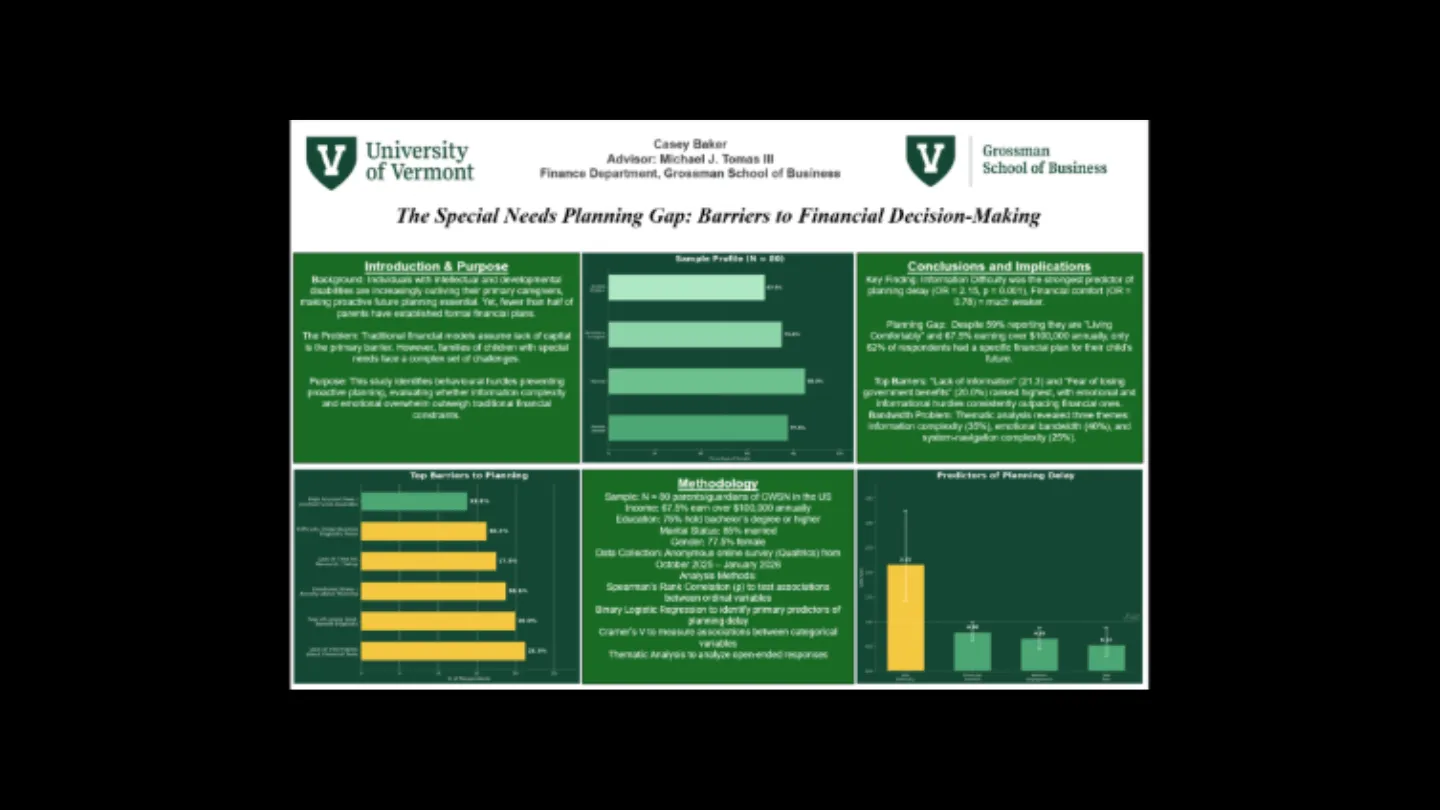
For many families raising children with special needs, financial planning involves far more than numbers on a page. Emotional strain, uncertainty about the future, and limited access to specialized guidance can create significant barriers to sound financial decision-making. These challenges are at the heart of Casey Baron Baker’s Honors College thesis, The Special Needs Planning Gap: Barriers to Financial Decision-Making.
A senior in the University of Vermont’s Grossman School of Business Honors College, Casey majors in Business Administration with a concentration in Finance and a theme in Entrepreneurship, while also pursuing a minor in Psychology. His interdisciplinary academic path reflects the core focus of his research: understanding how financial systems intersect with human behavior, emotion, and lived experience.
Through his thesis, Casey explores why traditional financial planning models often fall short when applied to families of children with special needs. Drawing on research conducted during his time in the Honors College, he examines structural, informational, and emotional challenges that can limit families’ ability to plan effectively. His work also highlights opportunities for financial advisors to play a more empathetic, informed, and impactful role in supporting these families.
“Special needs financial planning isn’t just about the returns on a portfolio; it’s about reducing uncertainty for families navigating lifelong responsibility,” said Casey Baron Baker. “My research explores how advisors can pair technical expertise with empathy and compassion to better serve these families. I hope this work, and my continued efforts, help shift the profession toward a more human-centered model of advising, especially when serving families planning for a child’s lifelong care.”
Casey’s interest in this topic has been shaped by professional experience at Northwestern Mutual and National Life Group, where he developed a strong foundation in financial services, risk management, and client-focused decision-making. His research is driven by a desire to bridge financial planning theory with the human side of advising, particularly within wealth management and special needs planning.
During Research Week (April 13–17, 2026), Casey will defend his honors thesis and share his findings with the UVM community. He will also present his work at the 2026 UVM Student Research Conference on Wednesday, April 15, in the Davis Center’s Grand Maple Ballroom. The conference brings together students from across disciplines to showcase research that is both innovative and socially impactful.
Casey’s work underscores the power of interdisciplinary research to address complex, real-world challenges. By connecting finance, psychology, and lived experience, his thesis contributes meaningful insights to the future of inclusive and human-centered financial planning.