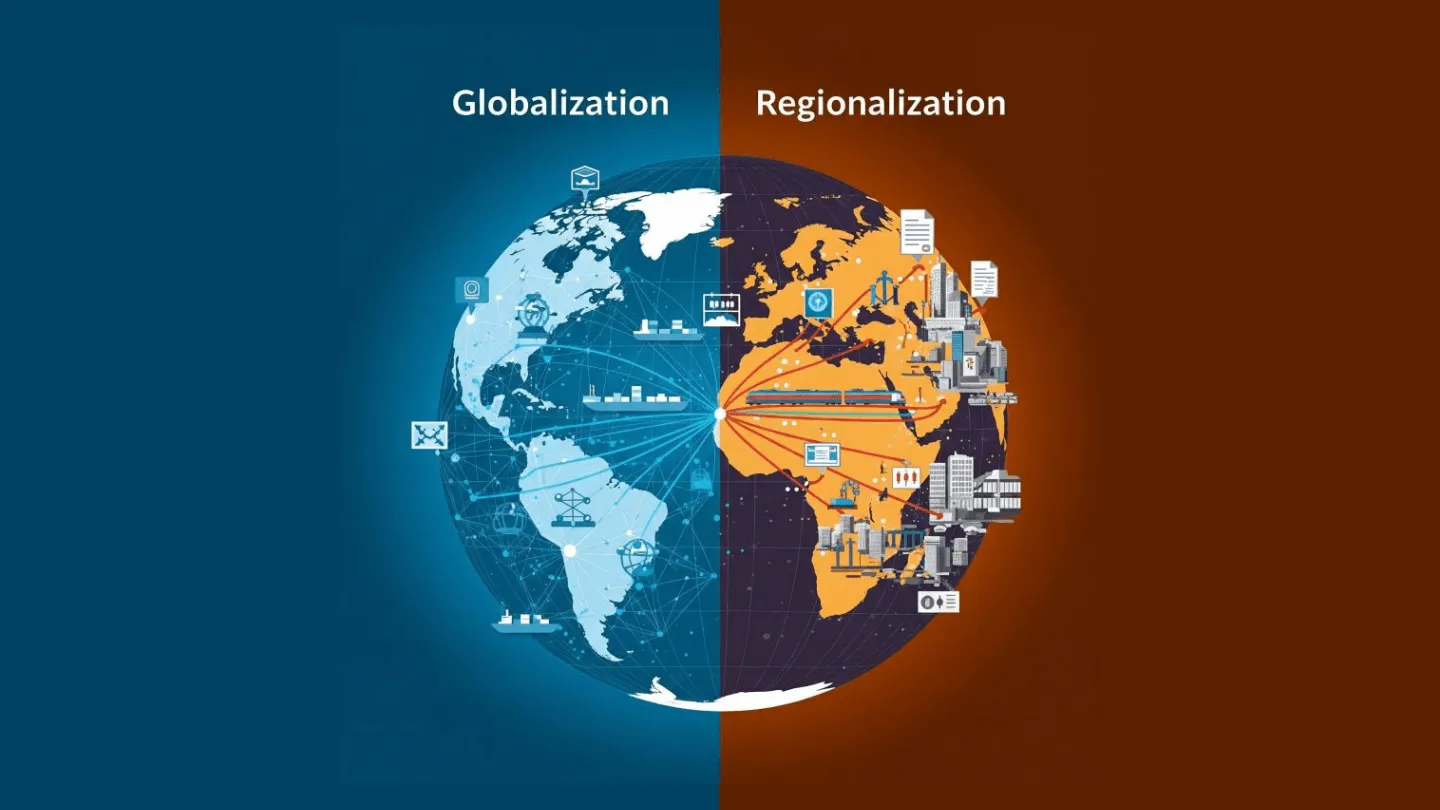
As global supply chains continue to shift in response to geopolitical pressure, rising costs, and systemic risk, new research from David Novak at the Grossman School of Business offers a timely perspective: the future of competitive advantage may depend less on cost efficiency and more on innovation potential.
View research: https://onlinelibrary.wiley.com/doi/full/10.1111/jscm.70023
David Novak, Converse Professor in Commerce and Economics, brings a distinctive lens to this work. His research sits at the intersection of decision sciences, operations research, and real-world system design, with a focus on complex networks such as transportation, communication, and supply systems. At the Grossman School of Business, he teaches courses spanning decision analysis, data modeling, and information systems, helping students build practical skills for navigating complexity and uncertainty.
In his recent article, published in the Journal of Supply Chain Management, Novak and co-authors Kevin Dooley and Zhaohui Wu examine how firms can rethink supply network design as they move from global to more regional configurations.
From Cost Efficiency to Innovation Potential
For decades, firms optimized supply networks for cost, often locating production where labor and inputs were cheapest. But today’s environment is changing. Companies are increasingly regionalizing their supply networks in response to geopolitical shifts, resilience concerns, and policy pressures.
Novak and his co-authors argue that this shift introduces a strategic choice. Rather than trying to recreate global cost efficiencies, firms can use structural change to unlock new forms of innovation.
“Many firms find it difficult or impossible to recreate the cost-minimizing efficiency-based relationships and processes (that worked well in globalized supply chains) in a regionalized setting. In many cases, focal firms are working in a completely different environment, with different constraints, which requires a different strategic approach. Focusing on innovation potential represents a long-term forward-looking perspective that recognizes that global structures cannot necessarily be replicated regionally.”
A New Framework for Regional Supply Networks
The research introduces three structural archetypes that describe how supply networks adapt during regionalization:
Replication – recreating existing global networks in a new region, enabling incremental innovation
Substitution – replacing global suppliers with regional ones, allowing moderate capability recombination
Reconfiguration – redesigning both relationships and processes, enabling more transformative innovation
These archetypes reflect varying degrees of structural change and create distinct trade-offs between cost, risk, and innovation potential.
This systems-level thinking reflects Novak’s broader research approach, which examines how relationships between nodes, flows, and structures influence outcomes across complex networks.
Rethinking the Trade-offs
A key contribution of the study is reframing regionalization as a strategic balancing act. While regional networks often come with higher costs and coordination challenges, they also create opportunities for new knowledge flows and innovation.
“Obviously, there is not a single approach that works for all firms or across all industries, and the archetypes we introduce in the paper are ideal types. Generally speaking, if the goal is cost and risk minimization, the focal firm can persuade suppliers to relocate, and global process structures can be replicated and maintained in the new location, replication represents a great option, as it maintains stability. However, innovation potential is going to be constrained. Depending on the industry, this may or may not be a reasonable long-term solution.
On the other hand, if the new region lacks resources or capabilities, provides significant investment to the focal firm to regionalize, or the focal firm must regionalize for policy reasons, reconfiguration is likely to be the optimal strategy. It will be disruptive and costly but offers the best opportunity for long-term differentiation and competitive advantage.”
Why It Matters
The study fills an important gap in supply chain research by linking structural adaptation to innovation outcomes—something previously underexplored.
For practitioners, the takeaway is clear: regionalization is more than a response to disruption. It is an opportunity to design smarter, more innovative systems.