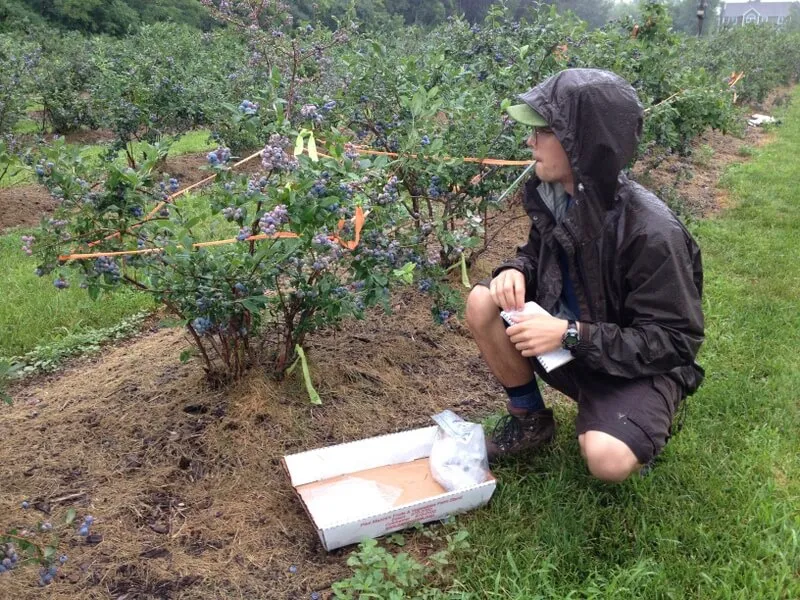
The Massachusetts native, who earned a B.A. in Biology from Skidmore College, came to the University of Vermont’s Rubenstein School of Environment and Natural Resources as a doctoral student in 2013. He spent the next five years learning firsthand what that could look like through his research on pollinators.
We recently caught up with Nicholson, who was a Gund Graduate Fellow and recently became a Global Affiliate, to learn how that work is being used today in his role as an assistant professor in Roger Williams University’s Department of Biology and why students and postdocs should “embrace the flounder.”
Tell me how you came to be a part of the Gund.
Coming out of undergraduate, I was very interested in ecology and specifically plant mutualisms. And for me, the happy place where those two things met was pollination. But I had just come out of a study abroad experience in Tanzania and was feeling very much that doing a life of basic research wasn't for me, and that I wanted to do applied work that mattered to people. Right at about that time, there was a grant that was funding applied pollination research. And so I found a list of PIs [Principal Investigators] on that grant and emailed all of them who were working in places where I would want to work, including [Gund Institute for Environment Director] Taylor [Ricketts]. And Taylor reached out to me, and the rest is history.
What was your research during your time at the Gund?
I worked with Taylor on a project studying crop pollination of blueberries. We were interested in understanding what the diversity and abundance of wild bees were on different blueberry farms, and whether or not that diversity and abundance of bees conferred any benefit to those farms—even going so far as to calculate the economic benefit of that wild bee pollination.
We found that farms that managed their blueberries less intensively and existed in a landscape with more natural area had more active bee communities. And those more active bee communities were related with improvements in terms of not only the quantitative aspect of yield—how many blueberries were produced—but also qualitative aspects of yield, like how soon those blueberries were ready to be picked, and how much variation there was in the blueberries’ size. We found that farms with more active bee communities were associated with the production of consistently large berries sooner.
What are you doing now?
I'm teaching biology, ecology and environmental science. I'm also doing a historical survey—a type of ecological study where you go back and redo somebody's methods that were done decades ago. We're resurveying the plant and pollinator phenology of a natural area in Rhode Island. We just finished our second field season this summer.
I'm still active with collaborators in Sweden, where I've been studying the use of pesticides, the exposure of bees to those pesticides, and the effects of that exposure. That work combines my training as a community and landscape ecologist with ecotoxicology—approaching the study of pesticides and pollinators as a socioecological system to better understand the landscape ecotoxicology of pests and pollinators.
How would you say your time at the Gund prepared you for your current research?
I think the biggest thing the Gund did for me was equip me with the desire and ability to answer that question, “So what?” If I am asked what I do, I now always tell people, here's what I do and here's why it matters.
Any advice for current students and postdocs?
I'd say embrace the flounder. Know that there is a portion of your PhD or postdoc where you should and will benefit from feeling a little bit adrift in the theory, in the literature, in the policy. But stick with it and crystallization will come.