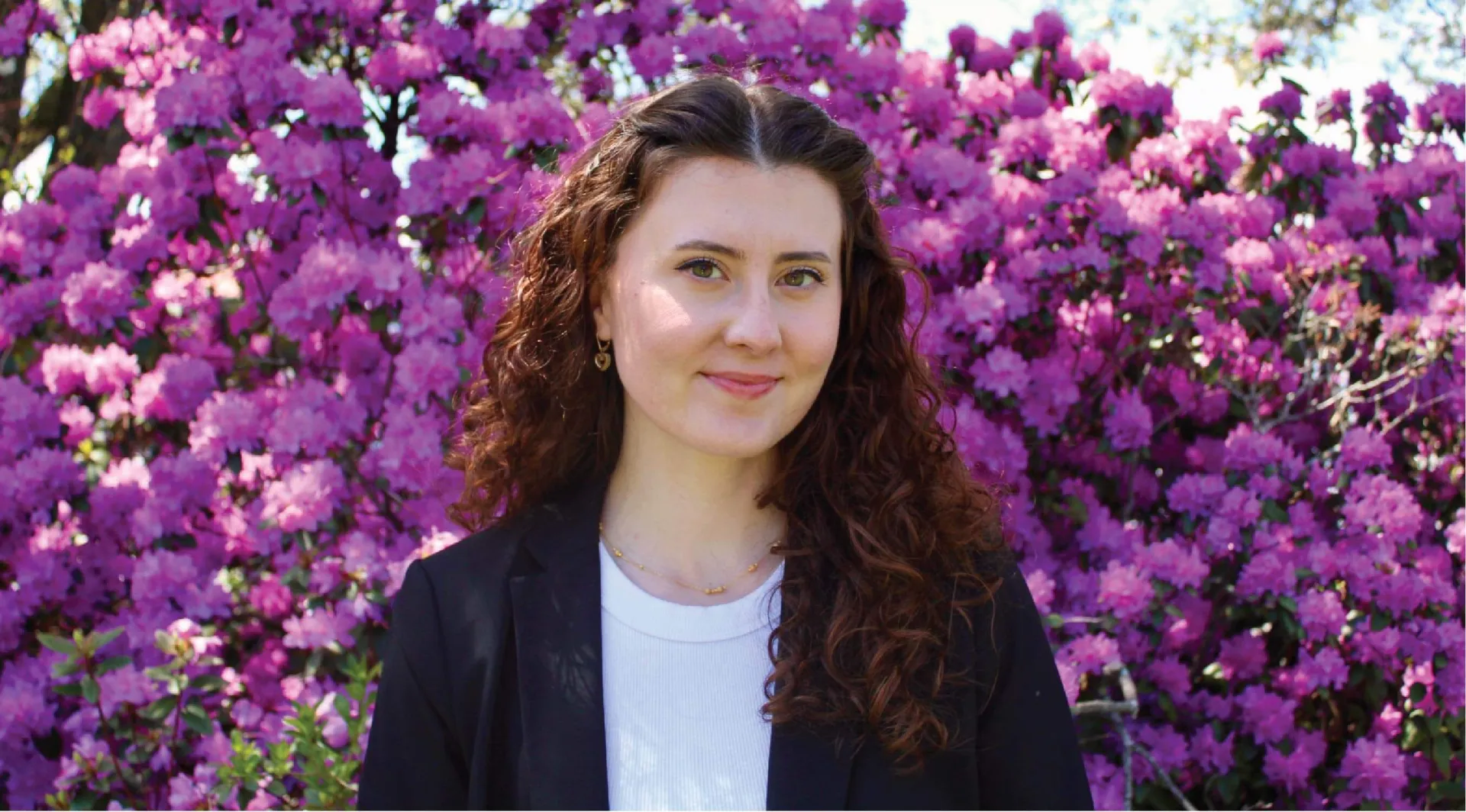
If you were to ask graduate students what success looks like, you would most likely hear “a first-author publication”, “obtaining a fellowship”, and “receiving an award” as examples of successful milestones. This summer, UVM Cancer Center trainee Amila Šemić has found herself in the unique situation of succeeding in all three of these areas. She was awarded an F31 Fellowship from the National Institutes of Health; she published two first author papers in the journals Proceedings of the National Academy of Sciences (PNAS) and Molecular Biology of the Cell; and she earned the UVM Cancer Center Trainee Engagement Award. We sat down with Amila to learn more about her work and involvement with the UVM Cancer Center.
Tell us a little bit about yourself: where are you in your educational journey and what brought you to UVM?
I am a rising 5th year PhD candidate in the Cellular, Molecular, and Biomedical Sciences program and a UVM Cancer Center Trainee Member. I am conducting my dissertation work in the laboratory of Jason Stumpff, PhD. I grew up in Vermont, completed my undergraduate at Amherst College, before deciding I missed Vermont and returned home for my graduate studies. Luckily, UVM was a great fit.
Can you tell us about your recent publications and NIH F31 Fellowship? Are they all related?
Our recent publication in PNAS explores how the mitotic motor protein KIF11/Eg5 is regulated by post-translational modifications, such as the addition of a phosphate group to key regulatory sites on the motor protein. KIF11 is required for formation of the mitotic spindle, the structure that aligns chromosomes during mitosis and facilitates chromosome segregation. We demonstrated that post-translational modifications can alter the mechanics of the motor protein, such as speed, force, or stability in the cell. These modifications on KIF11 are carried out by kinases that are often upregulated in various cancers. Broadly, this work helps us understand how activity of cancer-associated kinases can regulate forces within the mitotic spindle by modifying this mitotic motor protein and contributes to our understanding of the wide variety of molecular mechanisms of cancer.
My NIH fellowship is focused on the activity regulation of a different mitotic motor protein, KIF22, which exerts forces on chromosomes during mitosis. Pathogenic variants in KIF22 have recently been identified in patients with a rare skeletal dysplasia called spondyloepimetaphyseal dysplasia with joint laxity type 2 (SEMDJL2), which is mainly characterized by skeletal growth plate abnormalities. Although these mutations occur at different positions within the protein, they all produce a similar cellular phenotype: chromosome segregation is slowed or impaired during anaphase, in some cases leading to cytokinesis failure. We think that these mitotic defects ultimately slow cell proliferation within the growth plate, resulting in impaired skeletal growth. One central question behind this project is how mutations in a ubiquitously expressed mitotic kinesin selectively disrupt growth of skeletal tissue in SEMDJL2 patients, while other tissues seem unaffected. This is part of a broader line of questioning in the Stumpff lab, where we are trying to understand the tissue-specific requirements for cell division across different cellular contexts and disease states. Our work analyzing several of the pathogenic variants associated with SEMDJL2 was recently published in Molecular Biology of the Cell.
You also received the Cancer Center Trainee Engagement Award. What has your involvement with the Cancer Center added to your educational experience?
I have really enjoyed participating in various Cancer Center outreach events throughout my time at UVM. During the Careers in Cancer events, as well as the BioMobile High School Program, I got the opportunity to explain my research to a new audience. This experience challenged me to reflect on my research and find ways to communicate the key findings and questions so that high schoolers or middle schoolers could get excited about the science. I also enjoyed teaching basic microscopy and helping students set up their own questions and hypotheses to explore. This experience was really rewarding, and the students had so much fun!