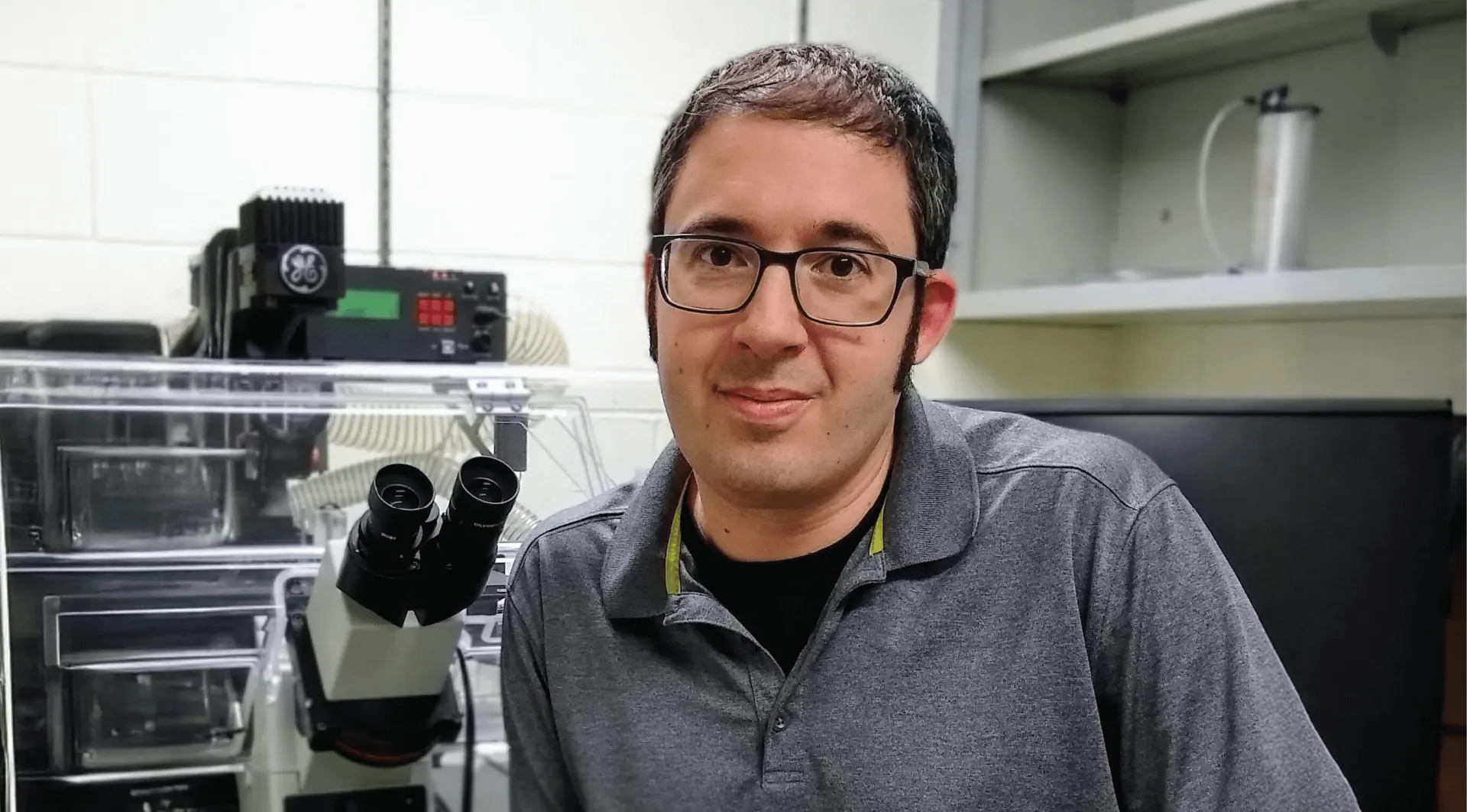
The UVM Cancer Center Cancer and Host Interactions research program recently welcomed new member, Haicen Yue, PhD. Dr. Yue, an Assistant Professor in the Department of Physics, is an expert in computational and theoretical soft matter physics and biophysics. Read on to learn more about Dr. Yue’s research and the impact it could have on our communities.
Why did you join the UVM Cancer Center?
One important part of my research focuses on emergent behaviors and mechanical properties of biological tissues, as well as interactions between tissues and their environment – such as collective cell migration, solid-to-fluid transitions, and tumor invasion into extracellular matrix. These processes are directly relevant to cancer metastasis. Understanding metastasis, and ultimately improving treatment, requires integrating theoretical, experimental, and clinical perspectives. Thus, I joined the UVM Cancer Center to build collaborations, to learn from cancer experts, and to contribute my expertise in cell migration and tissue mechanics to interdisciplinary cancer research.
Tell us about your research. What is the biggest takeaway?
Traditional cancer research has largely focused on biological and biochemical mechanisms, such as genes and proteins. While this is essential, there is growing recognition that mechanical interactions and emergent collective behavior also play a critical role. For example, tumor invasion into the extracellular matrix may not be driven solely by individual cell motility, but by collective, flow-like instabilities – similar to how a fluid moves through a porous medium. In this view, invasion depends not only on intracellular processes, but also on cell-cell and cell-matrix interactions.
My group uses computational models to quantify how these interactions influence collective migration in complex environments. The key takeaway is that linking intracellular biochemical regulation to multicellular physical behavior provides a more complete framework for understanding cancer progression.
Why cancer research?
Cancer remains a major unsolved problem with profound impact on human health. Moreover, compared to normal tissues, tumors exhibit highly dynamic and heterogeneous behavior. This complexity raises fundamental questions that are particularly well suited for theoretical and computational approaches, making cancer an especially compelling system to study.
How does your work directly impact the UVMCC catchment area?
My research on collective cell motion and tissue mechanics addresses fundamental processes underlying tumor growth and metastasis. By developing computational and theoretical frameworks, this work can help interpret experimental data and guide future studies relevant to cancers affecting populations in Vermont and the surrounding region. In addition, I contribute to training students in relatively new interdisciplinary perspectives on solving biological questions, helping to strengthen the regional research.
Is there a finding from your research you are particularly proud of?
One direction I’m particularly excited about is our recent work on mixtures of motile and non-motile particles. We find that even a small fraction of motile components can significantly alter collective behavior and mechanical properties. What I find compelling is that relatively simple models can already capture nontrivial effects like changes in rigidity and flow driven by a minority population. This provides a framework for understanding how heterogeneous activity – like what we see in many biological tissues – can influence large-scale behavior, which is relevant for processes such as tumor progression.
Do you work with trainees? If so, what do they add to your research?
Yes, I am currently working with graduate students, postdocs and undergraduate students. They contribute at every level – from implementing models, analyzing data to developing new ideas. In mentoring, I try to balance guidance with independence. While I share my experience, I also encourage open explorations, since perspectives not constrained by prior experience often lead to the most creative and insightful advances.
What is an interesting fact about you or something you’d want people to know?
As a physicist, I’ve spent a lot of time working with highly idealized “spherical cow” models, but I’m particularly interested in bridging those abstractions with real biological systems and experiments.
Dr. Yue’s work has been supported by the following grants:
UVM start up, and NSF CAREER: Tissues as Adaptive Materials: Investigating the Role of Cellular Adaptability in Tissue Mechanics
You can learn more about Dr. Yue’s research by reading the below publications:
Shee, A., Bandyopadhyay, R., & Yue, H. (2025). Tuning Steady Shear Rheology through Active Dopants. Physical Review Letters, 135(16), 168302.
Yue, H., Burton, J. C., & Sussman, D. M. (2024). Coalescing clusters unveil regimes of frictional fluid mechanics. Physical Review Research, 6(2), 023115.
Yue, H., Packard, C. R., & Sussman, D. M. (2024). Scale-dependent sharpening of interfacial fluctuations in shape-based models of dense cellular sheets. Soft Matter, 20(47), 9444-9453.