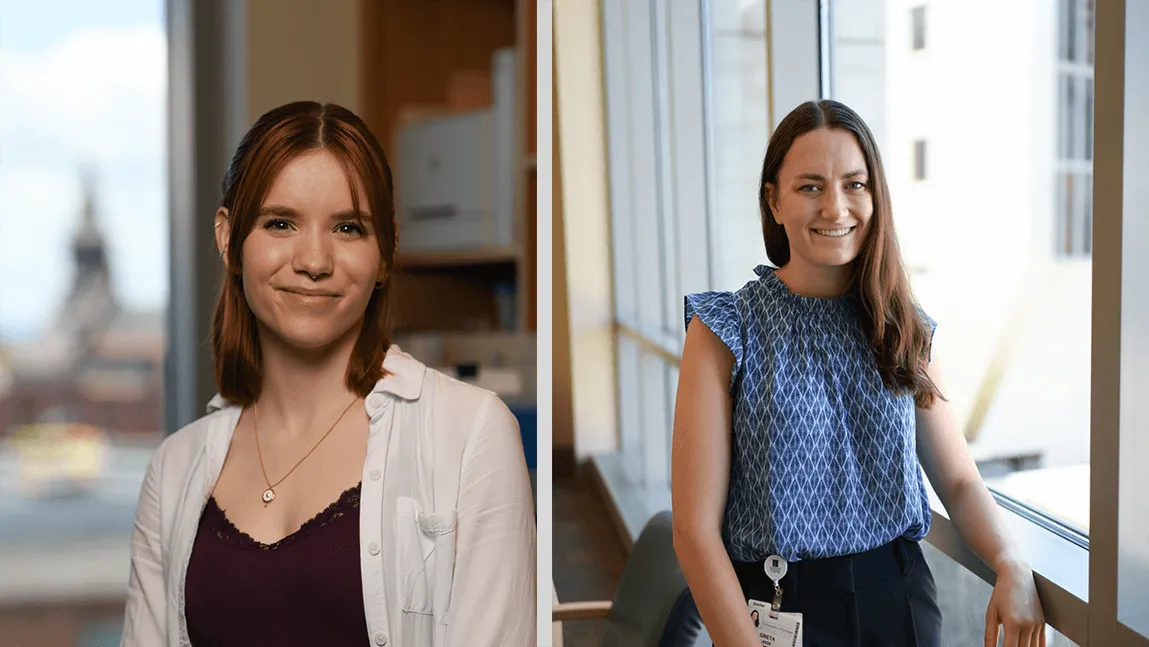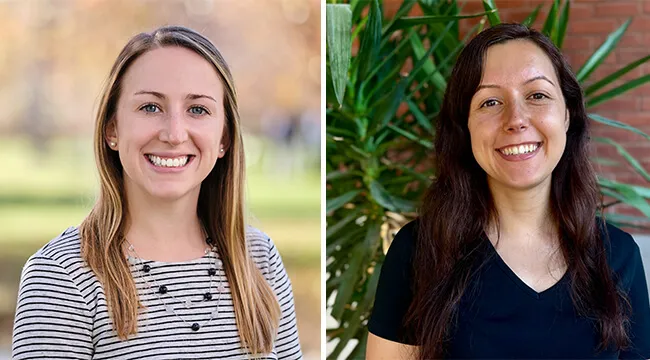
Introducing UVM Cancer Center's 2026 Juckett Summer Fellows
The UVM Cancer Center is buzzing this summer as mentors and scholars dive into research. Out of 49 applicants, 20 students received $4,000-stipends to advance their skills and discoveries under expert guidance. Two standout scholars scored in the top 10% of all applicants and earned the distinguished Juckett Summer Fellowship, in recognition of their promising cancer research and potential to make a lasting impact. These fellows received an additional $1,000, or up to $5,000, depending on their graduate student status.
2026 Juckett Summer Fellows
Alyssa Hurley
Mentor: Steve Roberts, Ph.D., Professor, Microbiology and Molecular Genetics, Co-Leader, UVM Cancer Center Cancer Cell Program
Project Title: Transcriptional Regulatory Mechanisms of APOBEC3A in Breast Cancer
Lay summary: Every cell in our body has its own copy of our DNA, which is like a cookbook full of recipes that our cells use to make proteins they need to function. I study a protein called APOBEC3A or A3A for short. A3A is supposed to help your cells fight off viruses by damaging viral DNA, preventing viruses from making their own recipes. However, A3A can’t tell the difference between viral DNA and our DNA, which can lead to cancer if it damages our DNA. I’m trying to understand what causes breast cancer cells to make more A3A, by looking at the DNA “recipe” for A3A. Similarly to a cookbook, the recipes for our genes have instructions for cooking and may be bookmarked or have notes to speed up the recipe. These details may be the key to understanding why cancer cells make too much A3A.
Alyssa’s “Why”: “Many people think about cancer research in terms of “curing cancer” but cancer is actually a collection of diseases that can be caused by different factors. This is why there isn’t a one-size-fits-all treatment.
My research is focused on understanding APOBEC3A, an enzyme that causes mutations found in more than 50% of sequenced tumors. These mutations can contribute to cancer initiation, progression, and therapeutic resistance. Understanding how APOBEC3A is dysregulated in cancer has the potential to improve therapeutics and patient outcomes.
Since these mutations are prevalent in multiple cancer types and arise at different stages of disease, this research has the potential to extend beyond a single cancer type and could broadly be used in cancer treatment, potentially helping a significant number of patients.”
Stasha Medeiros
Mentor: Elise Tarbi, Ph.D., APRN, Assistant Professor, UVM College of Nursing and Health Sciences, Deputy Program Leader, UVM Cancer Center Population Science and Cancer Outcomes
Title: Identifying Communication Factors Influencing Connection in Telehealth Serious Illness Conversations with Rural Cancer Patients, Caregivers, and Clinicians (TeleConnect-2.0)
Lay summary: Many factors shape communication interactions between patients and clinicians, including what is said, in what way, and in what setting. In this study, we explore how communication factors influence how rural-dwelling people with cancer develop a sense of connection with their clinician using telehealth for their cancer care. Traditional research approaches, like interviews, can highlight “good communication” strategies, but cannot tie those strategies back to patient experiences and health outcomes. Simulated communication experiments provide a research tool that can overcome these challenges. This study is part of a multi-phase study which seeks to build realistic communication scenarios for later testing in simulated environments. In our previous interviews with rural patients with cancer about their telehealth experience, we learned what communication factors matter to them; this study builds on these findings, using interviews with patients, caregivers, and clinicians to develop and get feedback on telehealth simulations for later experimental testing.
Stasha’s “Why”: My background is in communication, with a focus on autism and language development, and I am particularly interested in how communication shapes experiences across the lifespan. That interest naturally connects to cancer care, especially as telehealth has become more common, and communication plays such a critical role in how patients connect with providers.
This work is also deeply personal. Cancer has touched my family in multiple ways and that’s what really motivates me to continue in this field and pursue it moving forward.
In rural communities, accessing care can mean hours of travel, which can be difficult, especially for someone who is very sick. Telehealth can help ease that burden; thus, we want to examine how we can improve communication in this setting. Our goal is to understand which aspects of verbal and nonverbal communication foster connection in telehealth.
Learn about all 2026 summer fellow projects.
Trainees will showcase their projects at the annual summer poster session in Hoel Gallery on August 20, 2026.
To learn more about the UVM Cancer Center Summer Research Fellowship, please visit: https://go.uvm.edu/uvmccsrf.