University of Vermont Extension Assistant Professor of Forestry Dr. Ali Kosiba wrote four articles on the topic for Northern Woodlands. The magazine has compiled and published those articles as a book, titled: Forests in a Changing Climate: A Guide to Impacts, Species Shifts, and Stewardship Options. Funding for the project came from the Virginia Wellington Cabot Foundation and University of Vermont Extension.
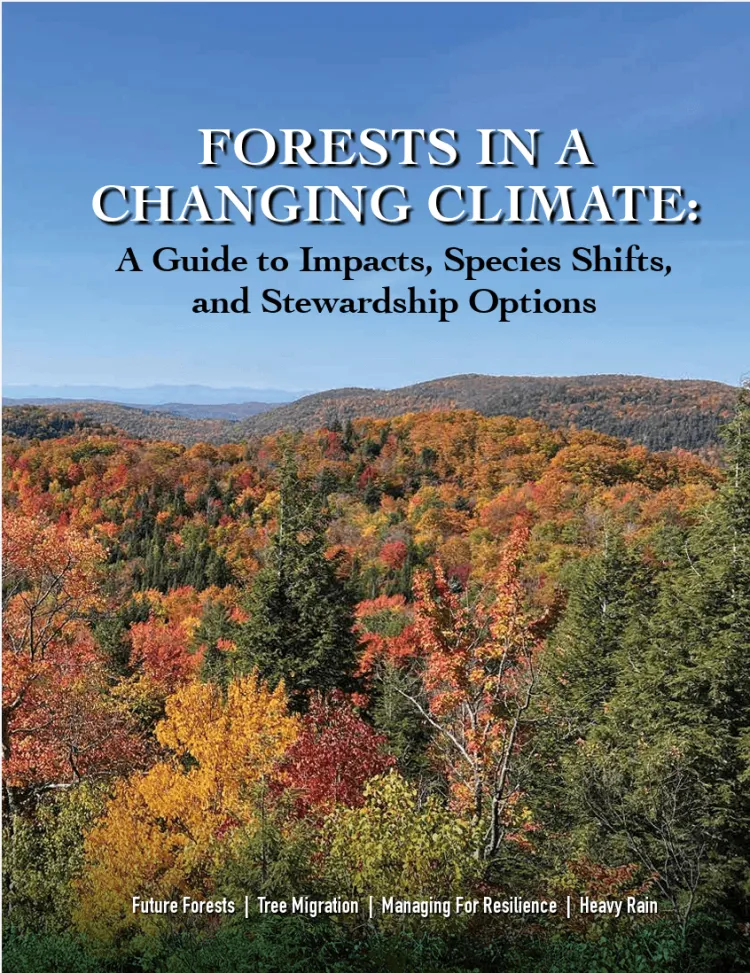
The guide is available for free online as a PDF, and paper copies can be found at UVM Extension offices and Extension Forestry events. They can also be ordered through the Northern Woodlands website (shipping costs apply).
In the following interview, which has been edited and condensed for clarity, Kosiba explains what information can be found in the guide.
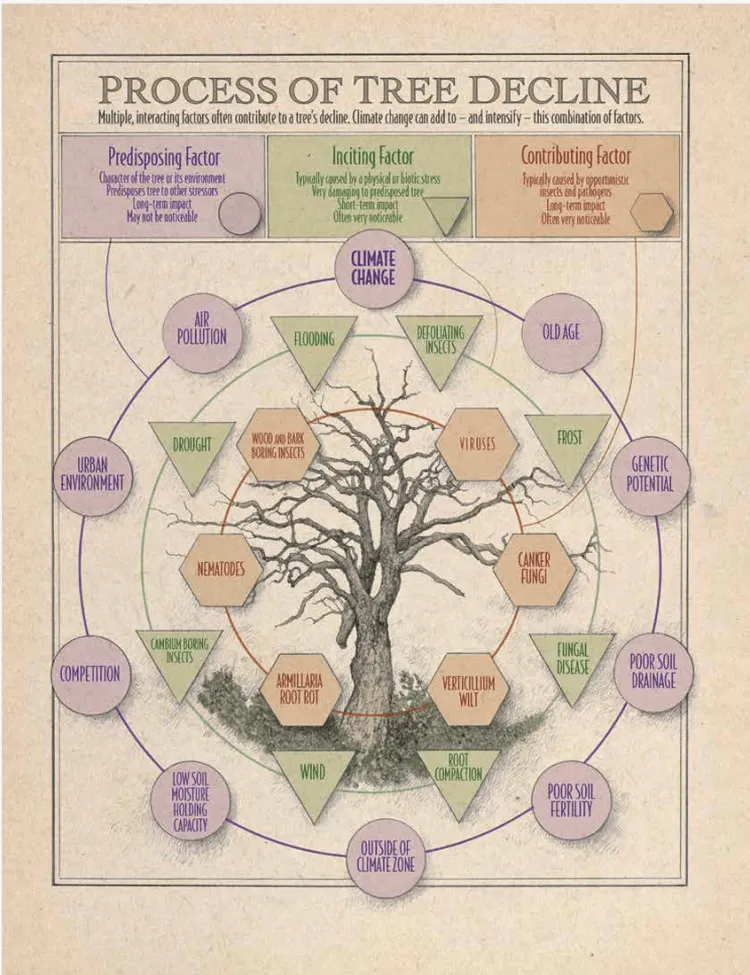
Elodie Reed, UVM Extension Communications Manager: In the first part of this series, you make a point to go through the many layers of climate change impact on forests in the Northeast. Everything from altered snow dynamics to warmer summer nights to heavier rain events. And there's also this really useful infographic in there that shows the multiple, interacting factors that contribute to tree decline. Can you share why you think it's important for readers to understand those overlapping dynamics?
Dr. Ali Kosiba: One of the challenges that we experience with climate change, or any novel condition, is that nothing's happening alone. We have layering stressors, and that's really a concept that we've known about for a long time in forest ecology and forest health.
And I found it really resonates with a lot of foresters and landowners, too. Usually a tree doesn't die of one cause, it's really this concept of interacting stressors. So that's where our stewardship can come in.
One of those is soil compaction. So, keeping equipment away from tree roots unless we're going in and harvesting that tree, but the trees we want to remain in the forest, being very careful about the tree roots, making sure we don't disturb soil, soils are either frozen or dry when we go in with equipment, or even going in with an ATV. Hiking trails are the same way. We can do a lot of damage when soils are wet, they get compacted, and that actually impacts tree roots.
There are some things we can do if we have that framing of: we can't remove stressors, we can't avoid disturbances, but can we limit some of these overlapping disturbances or recognize when they're happening?
UVM Extension: So in the second and third columns in the series, you describe how climate change can influence tree species migration, and then you also point out how historical land use practices can make forests, for instance, less diverse and therefore more vulnerable. How [do] you hope this context might inform forest management for landowners and communities?
Ali Kosiba: A big part of how I view forests and how our forest stewardship should be informed is not only looking at what's in the forest right now, but thinking about the past, as well as the future.
Climate change does encourage us to think about the future. The future is going to be more uncertain, and we're prepping that forest for more uncertainty. But we also want to look [in the] past, at what happened in this forest. And there are some good clues we can find from past land use history, whether it was agriculture or what logging occurred in the past. Those decisions can have shifted the trajectory of the forest into different conditions. And oftentimes, it simplified our forests and reduced the complexity that would be there, had that not happened.
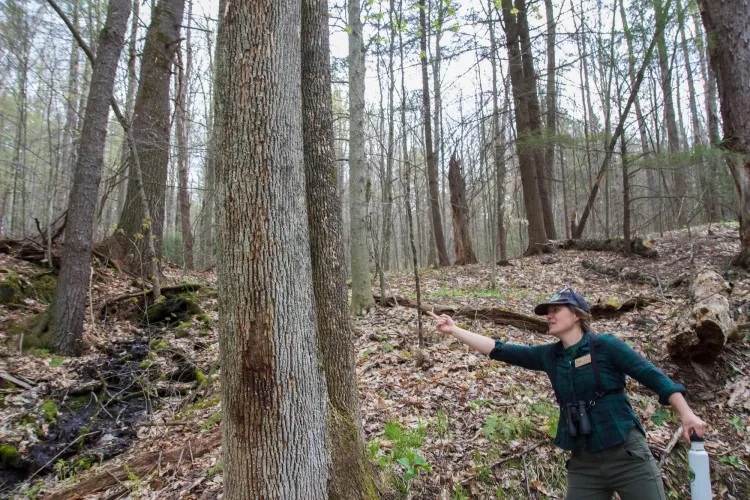
One good example is: most of our forests don't have much in terms of dead logs on the forest floor. It's just something in the past, folks — and it happens today — folks like to tidy up the woods. And of course, the park looks beautiful. But that's not what a healthy forest looks like. And so now we're encouraging folks, if you can leave dead, downed logs where they are, if they're not blocking a trail, they're not on your lines for your sugaring, just leave them where they are. They're really great for forest resilience, for soils, for little seedlings that regenerate on those trees, all sorts of things. And so that's just one example of how we can kind of shift thinking about that past and where that forest is on that trajectory.
Really, forest management is thinking about that trajectory of the forest, and what can we do with active forest management that can set that forest on a trajectory that provides more habitat, provides more resilience in the future.
One of those is thinking about species that might do better, might fare better. And this doesn't mean we're going to get rid of all the species in the forest, but promoting some of those, what we call “future climate-adapted species.”
I do this in my woods. There is red oak that's not very far from my forest, but it's not a red oak-dominated canopy. It's sugar maple, yellow birch, American beech. And I'm not getting rid of those species, but where I see a red oak come in, or I've even been planting little acorns and promoting red oak. It's great for diversity. It's much more heat- and drought-tolerant than those other species. And it provides a great food source for a lot of wildlife. It has all these great benefits, not to mention it's a great timber species. You can use it for firewood. It has all these human uses, too.
But it doesn't have to be this rapid shift, but thinking about: we are at this time, as the climate continues to change. Can we promote some of those species that sets our forest up to be more resilient in the future?
UVM Extension: There’s actually a tool, right, that people can use to look up like what species might be more adapted to future climates?
Ali Kosiba: The U.S. Forest Service and NIACS — Northern Institute of Applied Climate Science — has this tool called the Climate Change Tree Atlas [now called the Forest Ecosystem Atlas]. It's for the eastern U.S., for tree species. And from that, we've extracted a Vermont-specific list. So that exists on the UVM Extension Forestry website. And you can look up which tree species are projected by 2100 to have more suitable habitat here in Vermont, and which ones are projected to have less.
And so, we're not going to lose sugar maple from the forest. But in certain warmer locations, maybe lower elevation locations, sugar maple might be more stressed than a more adapted species to those conditions. And so, we have a ton of species in Vermont. We're very fortunate. And there's a lot that exists just in the south of us, like in Massachusetts, that are, we're already seeing more abundance of species like hickories and oaks.
UVM Extension: I also wanted to ask if you could briefly touch on what you talk about in the last section of this guide, which is the role upland forests can play in mitigating flood damage.
Ali Kosiba: These flooding events we have, and of course, where most of our people live in the state, and where this damage is incurred — is downstream, is in our lowlands, and our valleys. But it's coming from uplands.
I live in upland area, it has slope and it's not going to flood. But I was seeing — with these events, we're seeing more woods roads damage, more erosion. And so that's indicating that the rainwater is not percolating into the soil, it's actually flowing over the surface as runoff.
In the past, with some of our water management we've done, we've channelized water. We dig ditches, and that just moves water really fast, which increases its velocity, its force, and it can move more soil and rocks. So what we actually want to do is think about ways to slow it down. There's often natural depressions in the woods, even if they're small and getting water in there, letting it sink, rather than having it find these paths of least resistance where it just accelerates.
There's some fairly simple things that landowners can do. Deadwood is awesome for this. Even pulling a dead log that's already on the ground, or you can fell a tree to sort of run perpendicular to the slope. And that's going to physically slow down the water. It's going to trap leaf flitter and little twigs and all that kind of stuff. And as that log decays, it holds water. It'll actually be wet and like a sponge, and it builds the soil.
And then in terms of our forest stewardship, having multiple canopy layers and complexity in our forest, that actually slows down rainfall when it drops from the sky. A raindrop takes longer to reach the ground, and that's really good, too.
No one thing is going to be a magic solution, but if we do a lot of little things, it can add up.
UVM Extension: I feel like we should really make bumper stickers that say “Let Deadwood Lie” or something.
Ali Kosiba: Yeah!
UVM Extension: I can see it.
So you've written this guide, these four columns that give Northeast landowners and communities information so they can make stewardship decisions that promote forest adaptation, resilience, and ultimately, hopefully, health. And I'm wondering if we can finish by you sharing an example that you might have of people doing this already that you've seen in your work.
Ali Kosiba: There are examples of future-adapted tree plantings. So the Randolph Town Forest is a good example of that, where they worked with Professor Tony D'Amato, here also at the University of Vermont, and they planted a variety of tree species to see how the trees do in those conditions. Some are tree species that exist in that forest, and some are ones that maybe exist a little bit south of that forest.
You don't have to do everything all at once. Even just a little thing -- even just being aware and noticing some of these changes and observing, monitoring what's going on in your woods, is really helpful, too.
There are going to be more and more resources and technical help available to landowners. I am working with the state of Vermont on a big project that's funded through the Inflation Reduction Act program about forest resilience. And so we're really helping to get more training for technical forestry professionals, and more help to landowners, including things like cost-share and connecting them with professionals. So there's all sorts of efforts going on.