At the recent Agricultural Producers night at the Vermont Statehouse, a group of Vermonters were discussing the impacts of UVM Extension on the state and ways that producers rely on Extension expertise, when one local producer spontaneously added to the conversation, “...and Ali Kosiba is a stealth weapon for Vermonters, she’s a one-woman forestry powerhouse.”
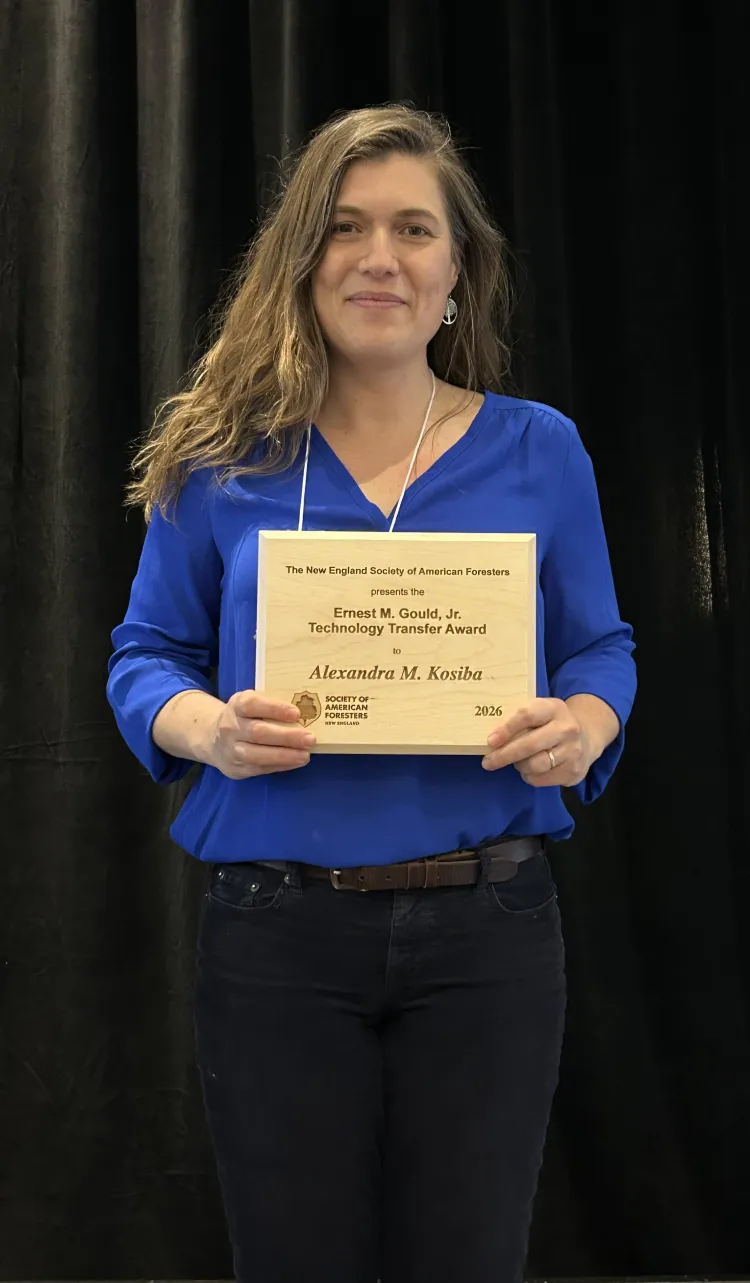
Kosiba's forestry peers recently concurred with the sentiment voiced by this producer when the New England Society of American Foresters (NESAF) awarded her the Ernest M. Gould, Jr. Technology Transfer Award, which, according to NESAF's website, is presented to a member who has made an outstanding contribution to natural resource science and management through education, extension, or youth service.
Mike Snyder, who presented Kosiba with the award, prefaced the presentation with these remarks, “This award recognizes something that is both essential to our profession and surprisingly rare: the ability to take complex forest science and translate it into knowledge that people can actually use — in the woods, in policy, and in everyday understanding. And that is exactly what Dr. Ali Kosiba does, exceptionally well.”
Quoting another mutual colleague, Matt Russell, he adds, “Beyond the publications, presentations, and programs — what stands out most is how she shows up: with clarity, generosity, and a genuine commitment to helping others understand and engage with the work we do. That combination of expertise, communication, and character is exactly what this award is meant to recognize.”
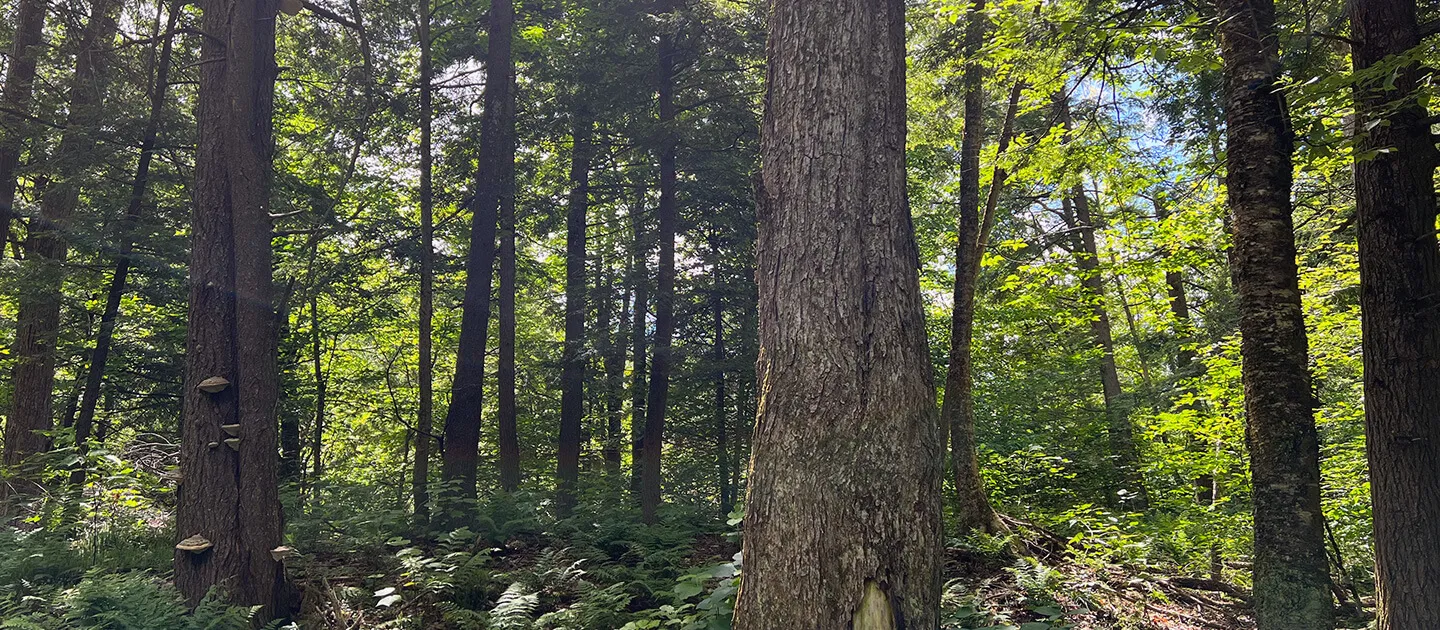
One of Kosiba's most important contributions to the American Forest Community is her work to advance our understanding of old-growth forests and their unique role in carbon sequestration.
A New Vision for Old-Growth Forests Takes Root
For centuries, humans have treated forests as renewable resources. Valuable as timber and used for fuel, they are consumed with the assumption that what is cut down is the same as what will eventually grow back. But a growing body of scientific research is challenging that assumption, drawing a sharper distinction between younger, regrown forests and old-growth ecosystems that take centuries to develop.
Kosiba explains that there are many reasons for the revisions to our understanding of old growth. Some come from new technological innovations, such as aerial sensing and surveying abilities, which help to identify previously unmapped areas of old-growth forest. Also, our ability to age trees more accurately, which is known as dendrochronology. Tree aging is still done by extracting a tiny tree core, smaller than a pencil’s width, and counting the annual growth rings. This technology has been used for more than a century, but now scientists can take high-resolution images of these tree cores and upload them to databases, enabling improved analysis. Some surprising findings Kosiba mentions include a revised understanding of some tree species’ lifespans, such as one study by scientists from the Harvard Forest, which discovered a Red Maple in New England that was 348 years old, a remarkable 100-year increase from the prior oldest collected example of that species.
Kosiba also underscores that more scientific research shows that old-growth forests offer all the positive attributes of any forest, such as clean air, clean water, and reduced soil erosion, but also a wealth of unique additional benefits, including increased biodiversity and carbon sequestration. As larger data sets and expanded mapping technologies refine our understanding of forest systems, scientists like Kosiba are advancing a new vision for old-growth forests: one that explains why old-growth forests matter and emphasizes continuity, ecological complexity, and long-term protection.
An Evolving Definition of “Old Growth”
Old-growth forests are not simply collections of old trees. Historically, many foresters mistakenly identified old growth primarily by areas containing groups of very large trees. But increasingly, scientists understand that although size can be an indicator of advanced age, there are many examples of old-growth forests where factors such as poor soil or high elevation limit tree size, thereby disguising the true age of the tree stand. In the Northeast, old growth is now most commonly defined as a developmental stage characterized by uneven-aged canopies, large living and dead trees, abundant coarse woody debris, and a dynamic pattern of gaps created by natural disturbances. It is not the size or even the age of individual trees that define old growth, but rather the recognition that undisturbed old-growth forests support ecological processes and species interactions that are uncommon or absent in younger or managed forests.
Today, old-growth forests are increasingly scarce. Less than 1% of forestland in the Northeast is seen as old growth. The relative youth of our forests is the result of widespread, intensive land clearing and logging following European settlement. Although much land has been reforested over the past century, scientists like Kosiba emphasize that these secondary forests differ fundamentally from the original landscapes they replaced. Species composition has shifted, some organisms have been lost entirely, and ecological interactions that once defined the forest have not fully returned.
Advances in forest science are helping explain why. Research shows that many of the defining characteristics of old-growth forests do not emerge until a stand of trees is at least 200 to 300 years old. Long-lived species such as hemlock, sugar maple, beech, and red spruce can persist for centuries, gradually creating the large trees, cavities, and dead‑wood structures that form the backbone of old-growth habitat. Dead wood -- both standing snags and fallen logs -- plays a particularly critical role, supporting fungi, insects, birds, mammals, and amphibians while also regulating nutrient cycling and soil health. Studies have found that old-growth forests contain two to four times as much coarse woody debris as new forests, and that the volume and size of this material continue to increase as forests age. Large-diameter dead trees provide essential habitat for species ranging from pileated woodpeckers to fishers and martens, while decaying logs create microhabitats that support mosses, liverworts, fungi, and seedling regeneration. In some regions, up to half of all bryophyte species found in old-growth forests are absent from younger forests.
Beyond biodiversity, researchers are increasingly documenting the broader benefits that old-growth forests provide to human communities, from improved mental health to stronger community well-being. The dense, mature canopies of growth may provide exceptional help in cooling local temperatures, clean the air more effectively than younger forests, and regulate water by acting as natural filtration systems within watersheds. Large, intact forests of all kinds help store vast amounts of carbon, keeping it out of the atmosphere and mitigating climate change. Though younger trees have higher annual carbon sequestration rates, older forests have been documented to have higher total carbon storage.
These findings are reshaping policy discussions. In recent years, federal land managers have been directed to formally define, inventory, and map old-growth and mature forests on public lands, an effort made possible by high-resolution aerial imagery, large-scale data analysis, and decades of accumulated dendrological research. The result is a clearer picture of how much old growth remains, where it exists, and how vulnerable it may be to development, road building, and logging.
At the same time, competing pressures are intensifying. Recent proposals to expand logging and infrastructure into previously protected forest areas have heightened concerns among scientists and conservation groups, who argue that once old-growth systems are disrupted, they cannot be replaced within any human timeframe. A forest can be replanted in decades, but the ecological continuity that defines old growth takes centuries to re-establish, if it returns at all.
The emerging vision for old-growth forests draws a firmer line between sustainable management and irreplaceable ecosystems. While younger forests can be managed for timber and regeneration, old-growth stands are increasingly viewed as living archives: repositories of biodiversity, climate resilience, and ecological knowledge that have been shaped over thousands of years. The world’s oldest known trees, some predating the pyramids of Giza, serve as reminders of that vast timescale.
Old Growth in Vermont and New England
Across Vermont and the broader New England region, forests define both the landscape and the culture. From maple-dominated hillsides to Tamarack-rimmed highlands, trees shape local economies, recreation, wildlife habitat, and our community identities. While New England today is one of the most heavily forested regions in the country, researchers including Kosiba emphasize that most of these forests are relatively young, and their youth makes them fundamentally different from the original old-growth forests that once covered the region. Before European settlement, Northern hardwoods stretched across Vermont, New Hampshire, and Massachusetts, forming the ecological backdrop for thousands of years of plant and animal evolution. Oak, hickory, pine, spruce, and fir were intricately linked with Indigenous land-use practices that shaped parts of this local landscape.
That ecosystem changed rapidly in the 18th and 19th centuries. Within decades of European settlement, much of the region’s forest was cleared for agriculture or heavily logged. Although much of that farmland has since reverted to forest, today’s secondary-growth forests do not replicate what was lost. Species composition has shifted, forest structure is simpler, and many ecological interactions associated with long‑undisturbed forests are rare or absent. In Vermont, remaining old-growth stands are often small, scattered, and located in remote or rugged terrain, places that escaped clearing because they were difficult to reach or unsuitable for farming.
Studies suggest that many old-growth characteristics do not appear until forests are at least 200 to 300 years old. In New England, long-lived species such as sugar maple, beech, hemlock, and red spruce play a central role in old-growth tree communities. Hemlocks can live 600 years, red spruce more than 400, and sugar maple well over 300. As these “forest elders” age and die, they create large cavities, snags, and coarse woody debris that provide habitat for a wide range of species, from pileated woodpeckers and martens to the many species of amphibians that depend on moist, decaying logs. Research in the Northeast has shown that old-growth forests contain two to four times as much coarse woody debris as new forests that were clear-cut a century ago. This dead wood supports fungi, mosses, and soil microbes that are often absent from managed forests. These organisms play a quiet but critical role in nutrient cycling, soil formation, and forest regeneration. In New England’s warming, wetter climate, old-growth forests help moderate local temperatures and slow water runoff in our watersheds. Dense, mature canopies protect drinking water sources and stabilize soils, services that are especially important in Vermont’s steep terrain and flood-prone river valleys.
There are also social dimensions. Studies in the Northeast and Mid‑Atlantic have linked increased tree canopy to improved public health outcomes and reduced crime rates. 1 Locally, intact forests underpin outdoor recreation economies, from hiking and hunting to leaf‑peeping and backcountry tourism, and forests provide residents with psychological benefits tied to access to mature, complex natural landscapes.
The new vision emerging here in Vermont and across much of New England does not reject forestry or working landscapes. Instead, it calls for a clearer distinction between forests that can be sustainably managed and those that represent irreplaceable ecological legacies. Younger forests may support timber production and active management, while old-growth stands are increasingly viewed as living archives, repositories of biodiversity, climate resilience, and ecological knowledge shaped over thousands of years.
The state of Vermont, through legally mandated goals for land conservation and climate action, has taken major steps by passing a few pieces of ambitious legislation, such as Act 59 from 2023, which intends to conserve 30% of Vermont’s forests by 2030 and 50% by 2050.
Regional Momentum: The Northeastern Old Growth Forest Conference
This new emphasis in forestry stewardship was on display in Vermont in September 2025, when more than 200 researchers, forest managers, conservationists, policymakers, health professionals, artists, and community members gathered in Ripton, Vermont, for the Northeastern Old Growth Forest Conference, co-hosted by UVM Extension’s Forestry program and Middlebury College. Held at Middlebury’s Bread Loaf Campus and broadcast online, the multi-day conference focused on “Wildlands and Old‑Growth Forests: A Vision for the Future”, underscoring the urgency of protecting the Northeast’s remaining intact forest ecosystems.
Participants also visited nearby old-growth sites through guided field trips, providing a context of being-in-the-woods alongside scientific findings and policy debates. One such trip was led by Kosiba. She escorted conference goers to the old-growth stand at Gifford Woods State Park in Killington. A hike that is very easy to access, and where there is a little old-growth interpretive trail. Kosiba emphasizes that these firsthand experiences are critical for understanding why old-growth forests cannot simply be “restored” once logged or fragmented.
“Some of the field trip attendees said they had never seen a Yellow Birch of that size!” Kosiba exclaims with a mix of pride and delight, showing how much she loves sharing her enthusiasm for old growth with others.
The conference reflects a growing regional consensus that while working forests remain important, remaining old-growth stands require a higher level of protection informed by science, long-term continuity, and place-based knowledge.
Kosiba and other scientists at the conference emphasize that old growth is not a static endpoint, but a dynamic process defined by continuity: as one generation of trees reaches old age, another rises beneath it, maintaining the structure and functions of the forest over centuries. Protecting those systems, Kosiba argues, is less about preserving a snapshot in time and more about safeguarding the long, slow processes that sustain both forests and the human communities that depend on them. In a region where forests have rebounded but true old growth remains rare, the question now facing New England is not simply how much forest exists, but what kind? The answer, researchers say, may shape the ecological and cultural future of Vermont and its neighboring states for generations to come. Old-growth forests are increasingly at the center of an even larger question: how society values time, resilience, and ecosystems that operate beyond a single lifetime. The new vision taking shape suggests that some forests can no longer be seen simply as resources to be used but must be recognized as living legacies that need to be protected.