Biomedical Engineering
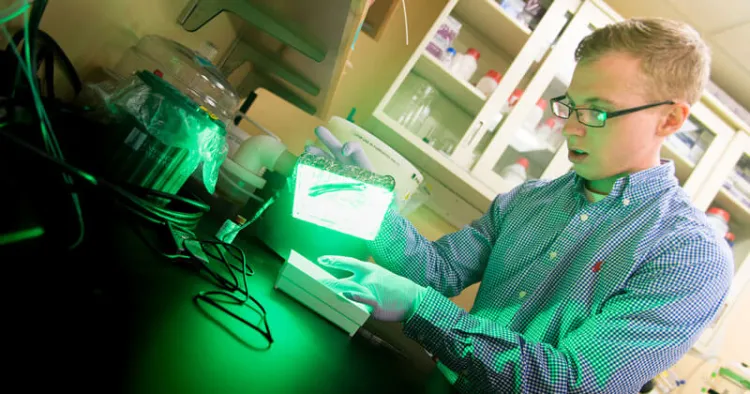
Leveraging strong ties and close proximity between the University of Vermont's College of Engineering and Mathematical Sciences and the Larner College of Medicine, our graduate programs in Biomedical Engineering (BME) prioritize hands-on, interdisciplinary learning to provide our students the opportunity to employ cutting-edge technologies and advanced engineering methods to address real-world problems related to human health.
UVM offers programs of study leading to Master of Science (M.S.) and Doctor of Philosophy (Ph.D.) degrees in BME with areas of research expertise, including digital health, neuroengineering, biomaterials, biomechanics, and computational modeling.
Program Coordinator: Dr. David Jangraw - djangraw@uvm.edu
Complex Systems and Data Science
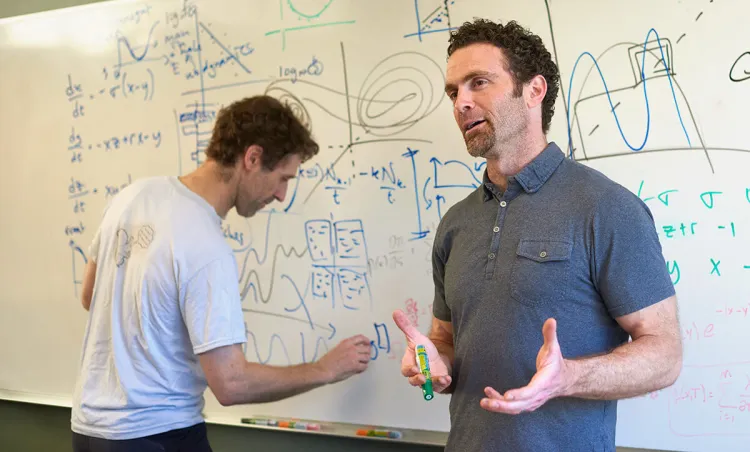
Our interdisciplinary graduate programs in Complex Systems and Data Science allow students to engage with faculty from Computer Science, Mathematics & Statistics, and the engineering departments within CEMS, as well as other faculty researchers from across the University.
Recently, the CEMS Complex Systems Center evolved into a University-wide Vermont Complex Systems Institute to better catalyze computational research, drive collaboration, and extend its impact well beyond campus borders. Pan-Disciplinary research groups within the Institute, such as the Computational Story Lab and the MassMutual Center of Excellence for Complex Systems and Data Science have emerged as national leaders in their respective fields, receiving multimillion-dollar funding from research foundations and industry partners.
CSDS Program Coordinator: Dr. Nick Cheney - ncheney@uvm.edu
Master of Science (MS) in Complex Systems and Data Science
Doctor of Philosophy (PhD) in Complex Systems and Data Science
Certificate of Graduate Study in Complex Systems and Data Science
Ph.D. in Computational Studies of Culture and Society

The Ph.D. in Computational Studies of Culture and Society prepares scholars to tackle today’s most pressing social challenges by combining humanistic inquiry with computational power. Grounded in the theories and methods of the arts, humanities, and social sciences, the program trains students to think critically about culture, society, and human behavior while developing the technical skills needed to analyze large-scale data and complex systems.
Students learn to integrate qualitative insight with computational methods, gaining hands-on experience in data mining, visualization, and emerging tools such as large language models. Research interests span issues like algorithmic bias, misinformation in social networks, racial inequities in health care, AI-driven threat detection, and the cultural dynamics of data science itself. Through a flexible curriculum that balances a strong core with electives, students develop deep area expertise and learn to translate their work across disciplines—ensuring their research reaches and influences diverse academic, policy, and public audiences.
Program Director: Dr. Randall Harp, Department of Philosophy
Please see the academic program link below for additional details: