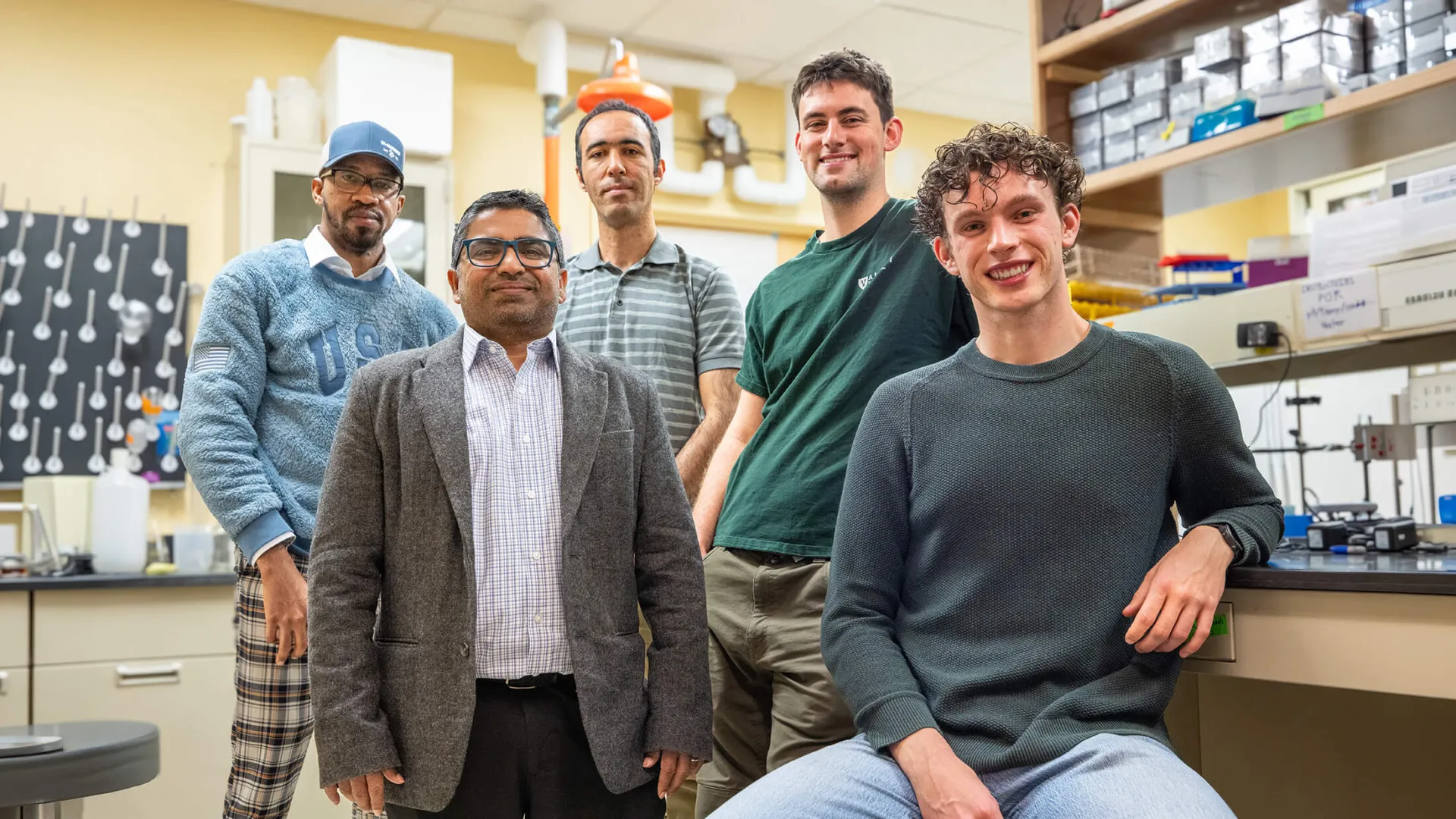
Engineering is synonymous with magic in Dr. Raju Badireddy’s ALCHEMIST lab. Here, the Associate Professor in the Department of Civil and Environmental Engineering and his students — from undergraduates to PhD candidates — create real-world solutions for water and wastewater treatment. Badireddy's lab, whose full name is the Advanced Laboratory for Contaminant and Hydro-Environmental Management using Innovative Sustainable Technologies, transforms both water systems and students, preparing them to become better scientists and engineers. Unlike sorcerers, these researchers are turning costly, energy-intensive processes into sustainable and resource-efficient ones using cutting-edge science and emerging technologies.
“The world is shifting from reactive solutions to regenerative solutions,” said Kehinde Ojasanya, a third-year PhD student in Civil and Environmental Engineering. Alongside Badireddy, Ojasanya is working to develop closed-loop water treatment and resource recovery systems that benefit rural communities in Vermont and around the world. Collaborating with researchers from UVM’s Larner College of Medicine and the Center for Biomedical Innovation, they are developing an innovative forward osmosis-based system to convert medical wastewater into medical-grade saline.
“We are using natural principles — similar to how plants extract water from soil through their roots,” said Badireddy.
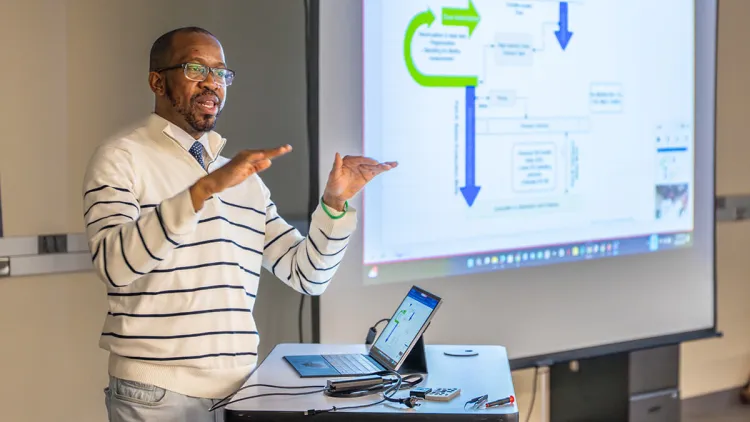
Saline is used in IVs and for wound cleaning, but rural hospitals worldwide often lack direct access to this essential fluid. Instead, they must ship it from distant suppliers at a significant cost. Ojasanya and Badireddy, in collaboration with Dr. Yuri Hudak (Director of the Center for Biomedical Innovation) and Dr. Richard Grunert (Department of Surgery, Larner College of Medicine), are building a patented medical-grade saline generator prototype that will allow hospitals in Vermont and beyond to recycle their medical wastewater onsite. Even if global supply chains are disrupted, facilities will still have the independence they need to continue providing quality medical care.
The interdisciplinary project, named RECLAIM (Real-Time Medical-Grade Fluid Recycling System to Support Rural Vermont Hospitals), was awarded a $250,000 grant from the Leahy Institute for Rural Partnerships this past spring.
Ojasanya and Badireddy also work with municipal wastewater treatment plants to recover struvite, a mineral compound- typically composed of magnesium, ammonium, and phosphate- that serves as a critical fertilizer. This can accumulate on filtration equipment, rendering it ineffective. To prevent buildup, these valuable minerals can be recovered and used in other compounds. Existing recovery systems are designed for facilities larger than those in Vermont. To fulfill this need for smaller wastewater treatment plants, Ojasanya and Badireddy developed a trailer-truck-sized Pe-Phlo (“Pee-FLOW”) system (Dr. Badireddy’s Patented Technology) to extract phosphorus from wastewater in collaboration with the Essex Junction Water Resource Recovery Facility. Instead of returning struvite minerals directly to Vermont’s waterways, their patented system enables smaller facilities to extract phosphorus and repurpose the material as fertilizer for use by local farmers. The interdisciplinary Pe-Phlo project was awarded a $150,000 grant from the Vermont Agency of Agriculture, Food and Markets.
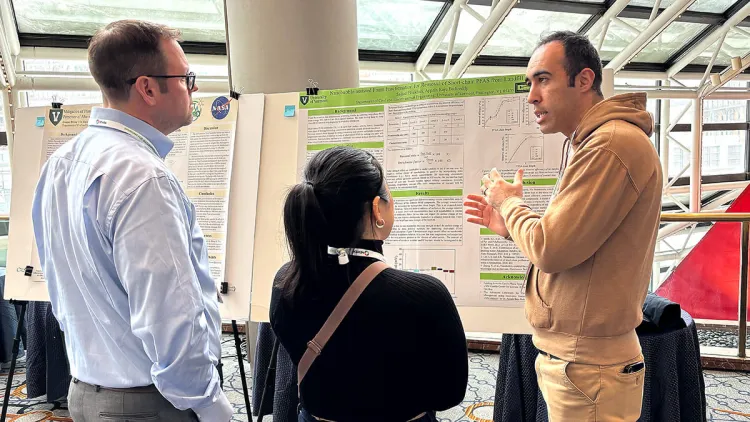
Another disruptive class of contaminants in wastewater is per- and polyfluoroalkyl substances or PFAS, more commonly known as "forever chemicals" because they do not naturally break down. These compounds have been linked to a range of health risks, including developmental delays, decreased fertility, and certain cancers. Three students in the ALCHEMIST lab, including second-year PhD candidate Sajjad Eftekhari, are developing systems to both capture and destroy PFAS as they become more ubiquitous and dangerous.
“These chemicals can be found everywhere, in products such as textiles, footwear, and cosmetics,” said Eftekhari, who added that relatively high concentrations can be found in wastewater from landfills, called leachate. Unlike other forms of wastewater, leachate is not typically processed by municipal water treatment plants.
Eftekhari’s focus is on trapping PFAS found in leachate. This task is challenging, particularly with ultrashort-chain PFAS, because they are highly evasive molecules. In fact, the Environmental Protection Agency regulates drinking water at a maximum of four nanograms per liter for both perfluorooctanoic acid (PFOA) and perfluorooctane sulfonate (PFOS).
“You can imagine one drop of PFAS and 20 Olympic-size swimming pools of water,” Badireddy said.
To capture PFAS, Eftekhari uses a technique called foam fractionation, a process that aerates wastewater to create bubbles that attract hydrophobic PFAS. This concentrates the contaminants, making them easier to eliminate. This project was funded by UVM’s Casella Center for Circular Economy and Sustainability.
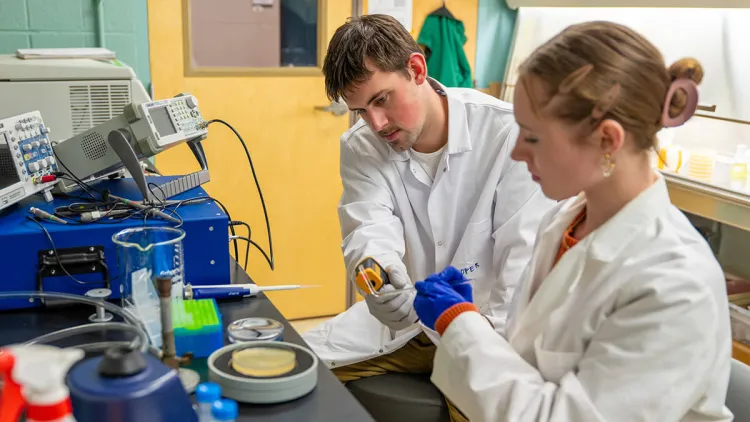
Destroying PFAS is where Eftekhari’s younger colleagues Cooper Petrie and Garrett Webster come in. Petrie graduated in May with a master’s degree in Environmental Engineering from the accelerated program. Under a project funded by the Vermont Space Grant Consortium and NASA EPSCoR, Petrie worked to develop new technology for the International Space Station (ISS), intended to replace a resource-intensive chemical disinfectant system used to remove biofilms (slimy bacteria) from the spacecraft’s wastewater recycling equipment.
To disinfect drinking water, Petrie uses a reaction between magnetic nanoparticles that the bacteria adhere to and a proprietary green chemical concoction. In the presence of a low-input magnetic field that Petrie developed, the nanoparticles spin, and the reaction speeds up, destroying the bacteria. Since Petrie’s magnetic field operates on low power, it’s ideal for an area that needs to ration electricity, whether that’s in space or in a rural community enduring the wake of a natural disaster.
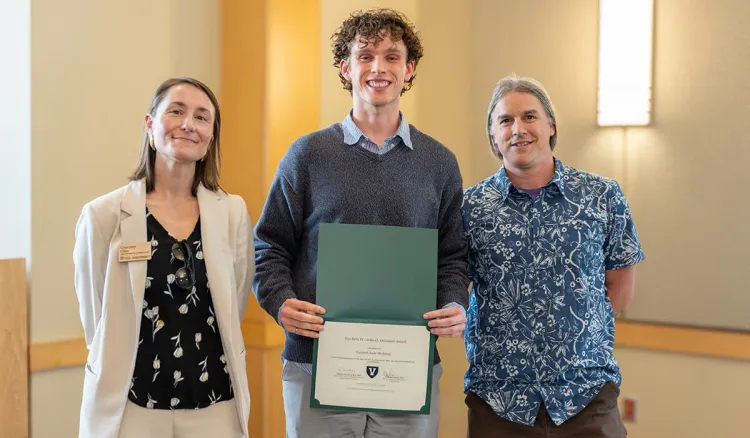
Petrie and Webster, a 2026 graduate with a B.S. in Environmental Engineering, soon realized that the magnetic field application could enhance Webster's Honors College thesis project on degrading PFAS using activated biochar —a highly porous, carbon-rich form of charcoal used as a soil amendment.
Webster creates activated biochar using organic materials like peanut husks and coats them with magnetic nanoparticles. The biochar has an extremely large surface area — equivalent to a football field per gram. In the presence of Petrie’s magnetic field, the nanoparticles react with a chemical mixture and spin, creating a superheating and mixing effect that breaks down PFAS. The resulting byproducts, carbon dioxide and fluoride, are harmless to the human body, unlike PFAS.
Together, the PFAS projects and others in Badireddy’s lab address wastewater treatment holistically, from contaminant capture to destruction and resource reclamation. “We are all working towards a common, bigger goal, which is not just treating wastewater, but more importantly, building resilience against the environmental pressures of human activity using sustainable, innovative technologies,” said Ojasanya, who added that collaboration between undergraduate, graduate, and doctoral students only enhances their success.
Petrie said that without Webster’s need for a magnetic-field approach, he would never have discovered how versatile and durable his invention is. Together, the students used the equipment for long periods, which forced them to develop ways to keep it running and cool it down. Webster’s desire to push boundaries gave them “a broader glimpse of where this technology could go.”
“The work in the ALCHEMIST lab will improve accessibility to clean water in rural Vermont and around the globe,”
—Dr. Jeffrey Marshall
Associate Dean for Research and Graduate Education
College of Engineering and Mathematical Sciences
At this year’s annual New England Water Environment Association (NEWEA) conference in Boston, Petrie earned first place for a poster presentation of his research in the ALCHEMIST lab. He looks forward to applying the skills and experience he developed in his new position with Carollo Engineers, a Seattle-based water engineering consulting firm.
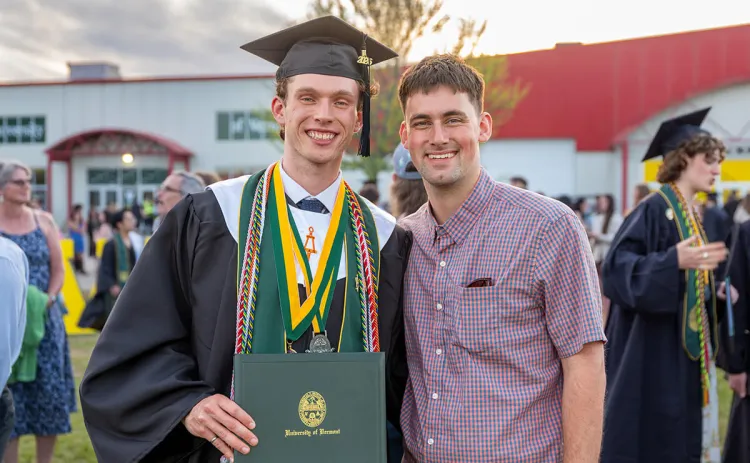
Badireddy’s lab provided Webster with the opportunity to take the lead on his research project and design his own experiments. “How much I’ve had to put in myself makes it so much more rewarding,” he said, “When I defended my thesis, I felt very confident up there, because I was like, okay, this is my work.”
Webster also presented his research and participated in a panel comprising industry experts at the NEWEA conference. Following his graduation this past month, Webster will move to New York City to join Hazen and Sawyer, an international consulting firm specializing in water infrastructure and treatment.
Ojasanya’s experiments in the ALCHEMIST lab have inspired him to launch a start-up called Keloks Technologies. Using a $25,000 grant awarded by the Seeding the Future Global Food System Challenge, Ojasanya’s new venture will further develop a wastewater treatment and struvite recovery system he calls Wastexus.
Eftekhari won first prize in the sustainability category at the NEWEA conference for his poster covering his foam fractionation and PFAS research. As he continues his PhD, Eftekhari emphasized the impact innovations from the ALCHEMIST lab could have. “Each of these projects utilizes very unique and very novel ideas that, if we succeed, we can introduce disruptive technologies to the field of environmental engineering.”
“In CEMS, we are proud to provide opportunities for students to engage in community outreach and partnerships and develop sustainable solutions for advancing the health of water resources and ecosystems,” Badireddy said this is the ideal team to transform the water treatment industry. “I’m proud to say these are all my best alchemists.”