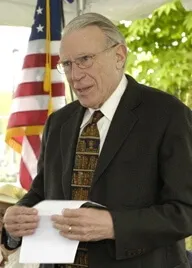
Excerpts from Philip Lintilhac's Remarks at the James M. Jeffords Hall groundbreaking ceremony May 16, 2008 on site, near the University of Vermont greenhouses.
Thinking back to my first encounter with plant science, I realize that it was 45 years ago that I enrolled in Fred Taylor's introductory botany — one of the most thoughtfully presented and ably taught courses I have ever taken. When I ask myself what it was that attracted me, I realize that it was really three things: the people, the materials and the obvious relevance of plant science to the place that is Vermont.
Regarding the people, I can still remember thinking to myself that I wanted to be like these people. I wanted to share their enthusiasm and their knowledge and their love for what they did every day.
As far as the materials go, I was seriously engaged by the beauty of the materials at all levels, whether through the microscope or out in the field.
But then there was the third element — the place that is Vermont, and the direct connection between real science and a real place — a historical connection that was strong and that was evident in all the various disciplines of plant biology.
Now, plant research at UVM is well into its second century, and right from the beginning it has been grounded in mature science with a strong international reputation. All the plant sciences really date back to L.R. Jones, the first chair of botany, a man of broad interests and a scientist of international repute. Fred Taylor referred to him as "a giant in his time." Jones came to the department in 1893 at a time when potato late blight was causing widespread problems in one of Vermont's staple crops. He was primarily a plant pathologist, and he successfully established protocols for dealing with that problem as well as the problem of storing carrots (which were prone to soft rot). Jones was devoted to students. In 1910, he moved on to establish the department of plant pathology at the University of Wisconsin.
The chairmanship passed to George P. Burns, who served as chair for more than 30 years, during both World Wars and the Depression. Burns awarded the first three PhDs granted at UVM, and he was instrumental in building the university's commitment to the maple sugaring.
Burns was succeeded in 1944 by James Marvin and then by Beal Hyde, Hub Vogelmann, Dave Barrington and Tom Vogelmann. I'm proud to be able to count all of them, since Burns, as friends. Hub Vogelmann, along with his student Tom Siccama, were, of course, the first to document forest decline and the effects of acid rain on Camel's Hump. It was the first longitudinal study of its kind. Hub was also one of the co-founders of the Vermont chapter of the Nature Conservancy.
Tom Sproston came to UVM at the peak of a major apple scab infestation, so he developed protocols to deal with it. He also tried for many years to develop a fungal antibiotic called 'Lambertellin.' He was trained at Cornell University by (H.H.) Whetzel and was passionate about the fungi. He was frequently called upon to identify fungi that amateurs had harvested and to make quick assessments of likely toxicity for the hospital. His knowledge of and love for the fungi was infectious — he started the careers of many scientists. He probably had the most active grad. student program in the college for many years.
Meanwhile, of course, other plant-science-related activities were growing in Vermont, with the establishment of UVM's forestry department; horticultural research facility; departments of plant biochemistry, microbiology, agronomy; and the UVM Extension disciplines — all of these grew out of Vermont's unique connection to the land and the landscape and to plant science.
In the 1960s Win Way started the soil testing lab, and the plant and soil science department originated with the merger of agronomy and horticulture in 1964.
The synergy between lab and research/education was one of the factors that helped Vermont gain and keep its reputation as a national leader in soil fertility and chemistry. For example, the pre-side-dress nitrate test for corn was developed here in Vermont in the 1980s by Fred Magdoff and co-workers, and it is still widely used throughout the eastern and central U.S. and Canada. Likewise, Rich Bartlett pioneered the use of aluminum as an indicator of phosphorus availability, and this application too has been used in various areas of the world. Bertie Boyce's work at UVM on cold hardiness and mulching was instrumental in establishing the fruit and berry industry in Vermont. Alex Gersho, a cytogeneticist, who developed birdsfoot trefoil as a forage crop for Vermont and was the world expert on the genus Viola, is another UVM plantsman.
But the history of plant biology in Vermont really goes back before the botany department was established, because Vermont's most renowned botanist was Cyrus Pringle, a plant breeder from Charlotte, a Quaker imprisoned during the Civil war for his refusal to take up arms and, later, a plant collector for (another famed botanist,) Asa Gray. Pringle traveled widely across Mexico and the Southwest. His collections form the core of UVM's Pringle Herbarium, now the third largest herbarium in New England and curated by Dave Barrington. Pringle and L.R. Jones were great friends and colleagues; it was Jones who persuaded Pringle to donate his personal collection to the university. Conversely, Pringle often tried to persuade Jones to join him on one of his frequent trips to Mexico. Putting it to him once more, he exclaimed, "Jones, if you will only come along with me you may even have the thrill of discovering a new plant."
To which Jones replied quietly, "Yes, Pringle, and so I might, but while you are in Mexico, I may have the thrill of discovering a new scientist, right here at home."
Somehow I think this embodies everything that the plant sciences at UVM stand for
Lintilhac: Five-Minute History of UVM Plant Science
ShareJuly 29, 2008