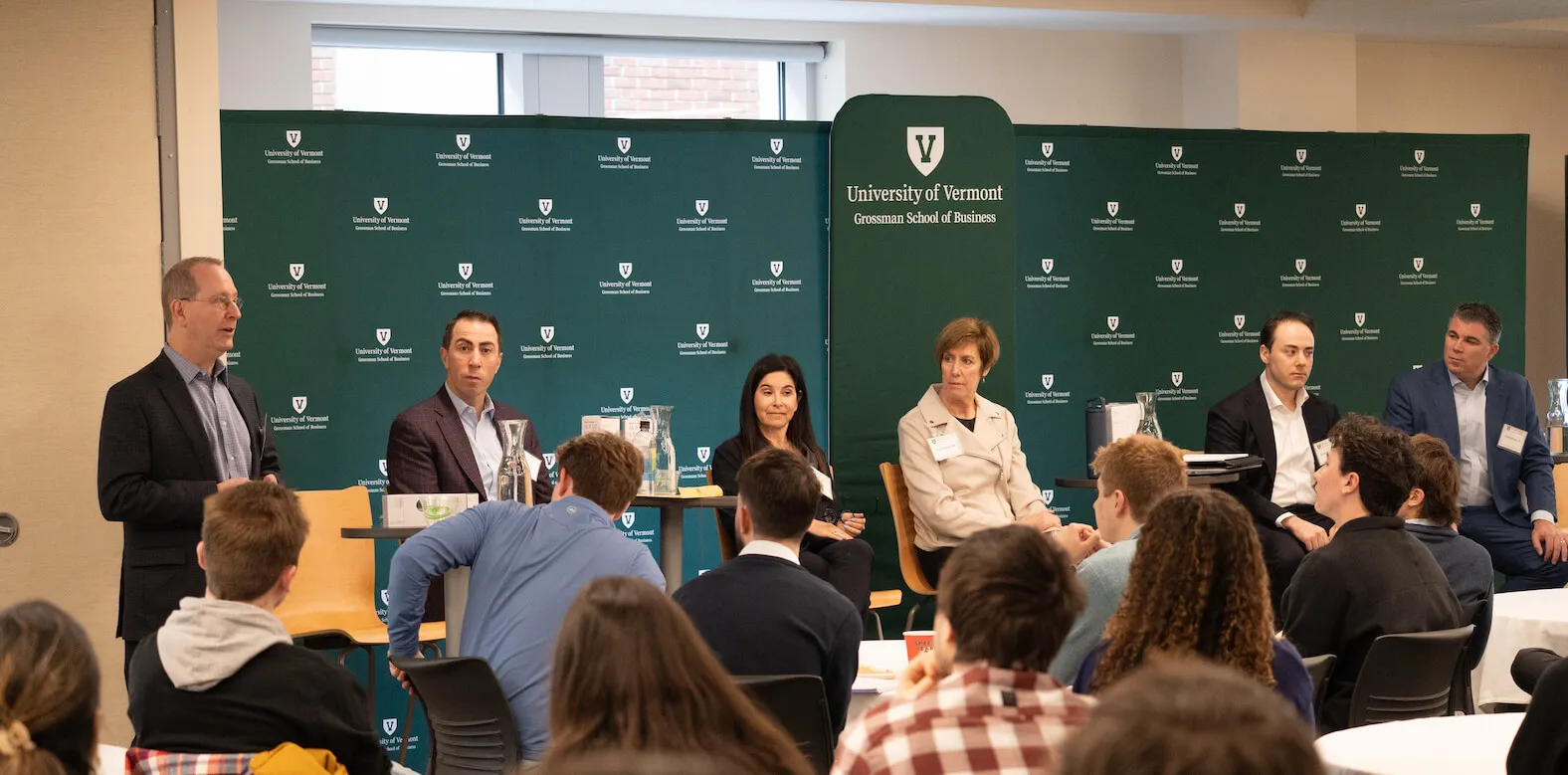
The Grossman School of Business at the University of Vermont transformed Ifshin Hall into a hub of learning, connection, and career exploration on Friday, March 27, during its annual Careers in Finance event. Now in its 14th year, the program brought together students and accomplished alumni for a full day of learning, panel discussions, and networking designed to demystify finance careers and highlight multiple paths into the industry.
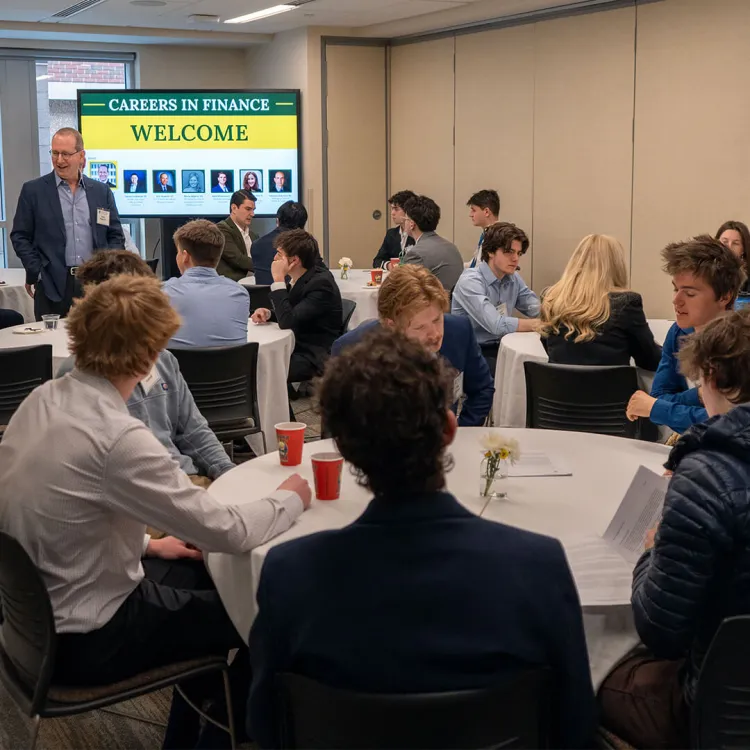
Hosted by James Flicker ’87, CFA, Managing Director at TAP Advisors and member of the Grossman School of Business Board of Advisors, the event opened with a networking breakfast before transitioning into specialized breakout sessions, a main alumni panel, and small‑group conversations over lunch.
“Wall Street is a complicated ecosystem,” Flicker told students. “Our goal is to make it easier to understand what these jobs actually are and, just as importantly, how people find their way into them.”
From Textbooks to Practice: Wall Street 101
The morning’s Wall Street 101 session, led by Adis Muminović ’16, Business Manager at Swiss Re, offered students a hands‑on look at how finance professionals model cash flows and evaluate distressed companies in real time.
Using a real restructuring case, Muminović walked students through how analysts translate lengthy credit agreements into Excel models that reflect amended loan terms, interest structures, and payment schedules. Rather than focusing on complexity, he emphasized fundamentals, clarity, and communication.
Students explored concepts including discounted cash flow (DCF) modeling, amortization, payment‑in‑kind (PIK) interest, floating versus fixed rates, and present value analysis — all rooted in the kinds of legal documents and financial data professionals encounter in practice.
Equally important, Muminović underscored the role analysts play in explaining financial outcomes clearly to decision‑makers.
“The numbers matter, but the ‘so what’ matters just as much,” he said. “If you can explain what the model means in plain English, you’re already adding value.”
Wall Street 102: Activist Investing and Corporate Transformation
During Wall Street 102, students examined the Starboard Value takeover of Darden Restaurants—the parent company of Red Lobster and Olive Garden—through a transaction that has since been adopted as a Harvard business school case study. The session was led by Anthony Rokovich ’89, Managing Director at Moelis & Company, who drew on his experience advising clients in the real estate, lodging, and leisure sectors to unpack the strategic, financial, and governance pressures that shaped the high‑profile activist campaign.
Rokovich guided students through how activist investors identify underperforming companies, assess sources of embedded value, and build persuasive strategic arguments at the board and shareholder level. The discussion highlighted the role of investment bankers during moments of transformation, emphasizing judgment, communication, and the ability to weigh complex trade‑offs—not just financial modeling alone. By engaging with a case used in top business school classrooms, students gained insight into how classroom concepts translate directly into real‑world advisory work and market‑shaping decisions.
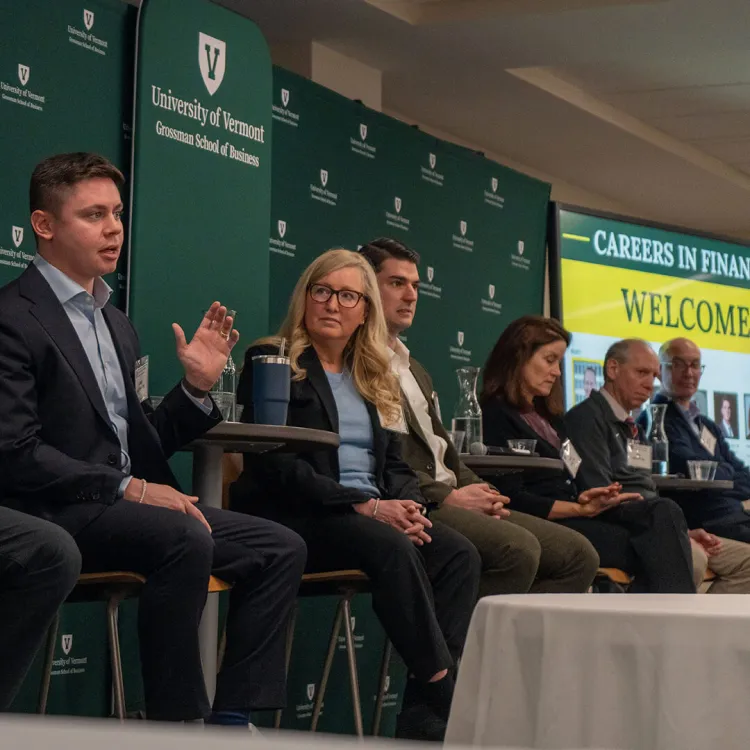
Alumni Perspectives Across Finance
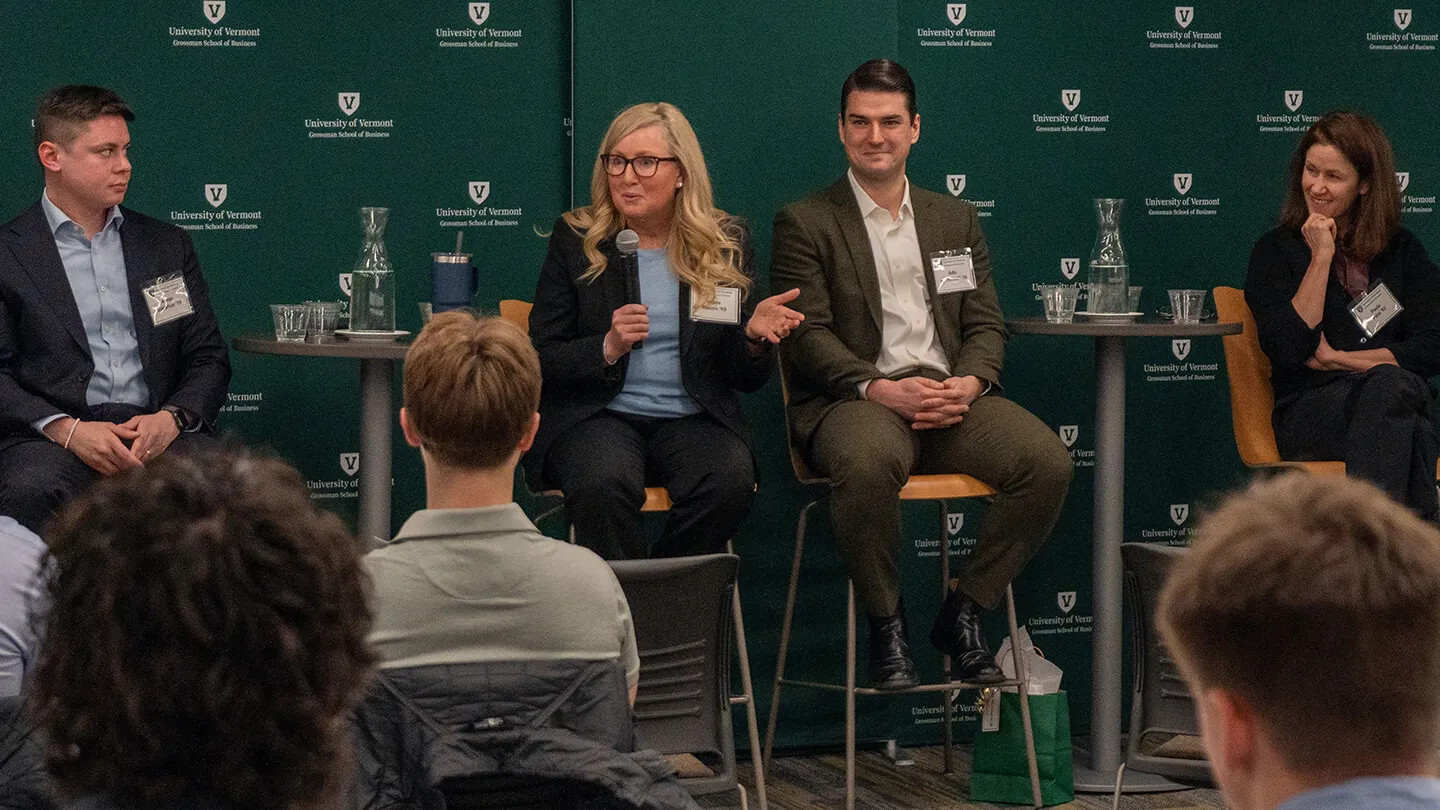
The main panel featured alumni whose careers span private investments, investment banking, asset management, financial advising, and technology strategy:
Aaron Goldstein ’19, Senior Associate, Private Investments, Viking Global Investors
Eric Krawitt ’92, Senior Vice President, Financial Advisor, Morgan Stanley
Marie Mastro ’93, Vice President and Stable Value Portfolio Manager, Goldman Sachs Asset Management
Adis Muminović ’16, Business Manager, Swiss Re
Paula Clairmont Poss ’92, Head of Asset Management Technology Strategy & Delivery Governance, Fidelity
Anthony Rokovich ’89, Managing Director, Moelis & Company
Panelists shared candid stories about non‑linear career paths, early‑career uncertainty, setbacks, industry disruptions, and the skills that helped them progress. Several emphasized that meaningful finance careers are built over time — often through persistence, adaptability, and relationships.
“There’s a misconception that Wall Street only hires from a small group of target schools,” Flicker said. “Every person on this stage found their way in a different way.”
Navigating Change and Opportunity
A recurring theme throughout the discussion was how financial professionals respond to disruption — from the 2008 financial crisis to COVID‑19 and today’s rapid advances in artificial intelligence.
Panelists encouraged students to see change as an opportunity rather than an obstacle. Many noted that while technical skills matter, adaptability, judgment, and communication remain essential — traits that technology cannot replace.
“Embrace AI,” said Poss. “Use it, learn it, and let it make you more efficient — but don’t underestimate the power of soft skills and relationships.”
Others echoed the importance of resilience and long‑term perspective, reminding students that careers rarely unfold exactly as planned.
Building Connections That Last
The event concluded with a networking lunch that gave students the opportunity to rotate through small‑group conversations with each panelist. These informal discussions allowed students to ask questions about internships, first jobs, graduate school, and career decision‑making in a relaxed setting.
Beyond the schedule, Flicker emphasized that Careers in Finance is more than a one‑day event. Alumni who participate each year are committed to supporting Grossman students well beyond graduation.
“Every person who has been part of this program is willing to take a call, meet for coffee, or offer advice,” he said. “Use that network.”
Open to students across the University of Vermont, the event reinforced the school’s commitment to experiential learning, alumni engagement, and preparing students for meaningful careers in finance and beyond. Students who attended also earned PEAKS points for their participation.