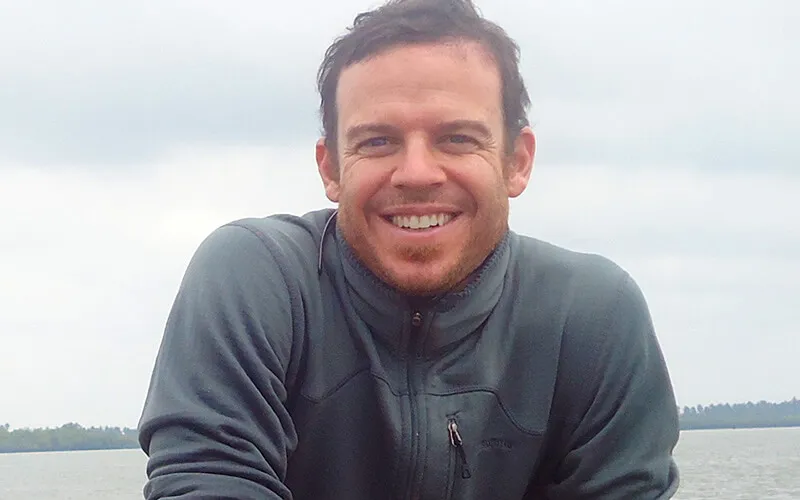
Familiar to many in the Rubenstein School, Dr. Brendan Fisher, most recently Research Associate Professor at the Gund Institute for Ecological Economics, transitions to Associate Professor in the School this fall. He will contribute his expertise in sustainability science, economics, health, and human behavior to both the School and the UVM Environmental Program. He will also remain a Fellow in the Gund Institute.
“We are tremendously fortunate to have Dr. Fisher join the Rubenstein School, as a tenure track Associate Professor, through the Environmental Program's cluster in Sustainability Studies and Global Environmental Equity,” shares Dean Nancy Mathews. “Dr. Fisher’s expertise in ecological and behavioral economics, global resource equity, and sustainability science will enhance the School's international research presence. He has established himself as a top notch scholar through his work using the concept of ecosystem services to understand tradeoffs between conservation and development. We are delighted to have him also serve as the convener of the Sustainability Studies cluster."
Dr. Fisher's research addresses how environmental change and management affect human well-being and health, longer-term ecological and biodiversity outcomes, and how a better understanding of human behavior can impact social, economic, and ecological sustainability.
“Much of my research, based in some of the poorest communities of Africa and Asia, has to do with how people benefit from well-functioning ecosystems and pay a cost when they are degraded,” he explains. “There are equity issues here, too. For example, who benefits and who bears the costs when a tropical forest is converted into large scale agriculture?”
Dr. Fisher has research projects in Mozambique and Tanzania to better understand how social, economic, and environmental factors interact to affect human health and well-being. With support from the World Wildlife Fund (WWF), CARE, and the Rockefeller Foundation, Dr. Fisher also investigates the importance of household gender roles in health outcomes of children. He is discovering different effects between male versus female heads of households in poverty-stricken areas.
In collaboration with Dr. Taylor Ricketts, director of the Gund Institute, and an interdisciplinary team of scientists, Dr. Fisher will continue his work on a global-scale research project funded by the National Science Foundation’s Socio-Environmental Synthesis Center (SESYNC). The research team created a database with social, economic, and environmental attributes of close to 10 million households in the poorest countries of Sub-Saharan Africa, Latin America, and Asia. Their goal is to answer some of the world’s most pressing questions related to links between environmental degradation and human health.
Dr. Fisher has a deep interest in behavioral economics or why and how we make the economic and environmental decisions we do. Together with UVM undergraduate Charlie Martin, he is currently studying how to publicly frame and boost the success of Act 148, Vermont’s Universal Recycling and Composting Law. The law includes the phasing in of mandatory composting of yard debris and food scraps over the next five years to reduce waste going to landfills.
“How can we set up our society to behave more sustainably?” he asks. “There are tons of little things we can change with little cost that can positively affect our happiness, consumption, and how much pressure we put on our world’s ecosystems. There is a lot to learn. The cost of this type of research is relatively small, but the potential benefits for our social, economic, and environmental sustainability are great.”
Dr. Fisher received his Ph.D. in the Rubenstein School at the University of Vermont, his M.S. from Oxford University in the UK, and his B.S. from Bucknell University. He held postdoctoral positions at the University of East Anglia and Princeton University and was a senior program officer at WWF, where he is currently a Fellow.
His recently published research focused on how logging and large scale oil palm plantations in Southeast Asia affect areas of globally important biodiversity. One paper from those studies, in the Proceedings of the National Academy of Sciences this June, analyzed the finances of a major palm oil company to determine impacts of conserving land on biodiversity and profits.
“It turns out that under certain conditions, protecting biodiversity can actually help generate profit for oil palm companies,” he notes.
With Dr. Ricketts and Gund Affiliate Dr. Robin Naidoo of WWF, Dr. Fisher also published A Field Guide to Economics for Conservationists. This 2015 book provides an easy to understand version of economics that will help conservationists safeguard biodiversity in a more sophisticated and effective way.
Dr. Fisher will continue to teach his graduate level Behavioral Economics course and NR 205, a Rubenstein School undergraduate core course called Ecosystem Management: Integrating Science, Society and Policy. In the spring, he will teach a course in sustainability science in the Environmental Program.
“I hope to incorporate the economic side of environmental studies into the Environmental Program to show students how important it is when looking at solutions for environmental crises,” he shares. “I have been lucky to have worked in far-flung places around the world and have witnessed people coping with environmental change, natural resource scarcity, and poverty. I hope to infuse my experiences into my courses and advising.”
He lives in Burlington, close to UVM campus, with his wife Leigh, a business and marketing expert who cares full-time for their three children. The family manages a very active life style. They walk in Centennial Woods from their backyard, ski at Bolton Valley, bike on the Burlington Bike Path, and play soccer and ice hockey in the local community.