Our History
The University of Vermont has long recognized the importance of providing educational opportunities in the environment, with forestry courses dating back to 1888. Since then the natural resource curricula evolved until, in 1973, the School of Natural Resources (SNR) was established as one of nine degree-granting units within UVM.
In 2003, the School became the Rubenstein School of Environment and Natural Resources (RSENR), the first named and endowed academic unit at the University, following a generous gift from the late Steve (UVM, 1961) and Beverly Rubenstein of New Vernon, New Jersey, and their family. Steve was a charter member of the Rubenstein School Board of Advisors, and his wife, Beverly, and son, Andy, are currently members.
Our Community
The School has been housed in the George D. Aiken Center since 1982. In addition to the Aiken Center, the Rubenstein School campus has expanded to include members of the Environmental Program, the Rubenstein Ecosystem Science Laboratory, and the USDA Forest Service Northern Research Station. We also maintain many other special partnerships. Our School is home to more than 1200 undergraduates and more than 120 Master’s and Ph.D. students, 18 post-doctoral associates, 54 tenure-track, research, and teaching faculty, and 76 research and administrative staff. Our alumni now number over 6000.
Rubenstein School Organizational Structure
Leadership and Faculty Organizational Chart
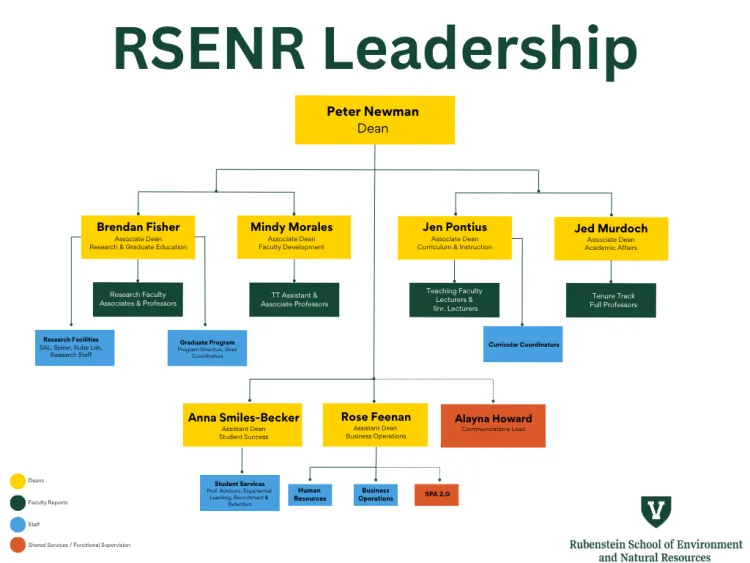
- Peter Newman, Dean
- Brendan Fisher, Associate Dean of Research and Graduate Education
- Research Faculty - Associates and Professors
- Mindy Morales, Associate Dean of Faculty Development
- Tenure-Track Assistant and Associate Professors
- Jed Murdoch, Associate Dean of Academic Affairs
- Tenure-Track Professors
- Jennifer Pontius, Associate Dean of Curriculum and Instruction
- Teaching Faculty – Lecturers and Senior Lecturers
- Rose Feenan, Assistant Dean of Business Operations
- Anna Smiles-Becker, Assistant Dean of Student Success
- Alayna Howard, Communications Lead
- Brendan Fisher, Associate Dean of Research and Graduate Education
Administrative Staff Organizational Chart
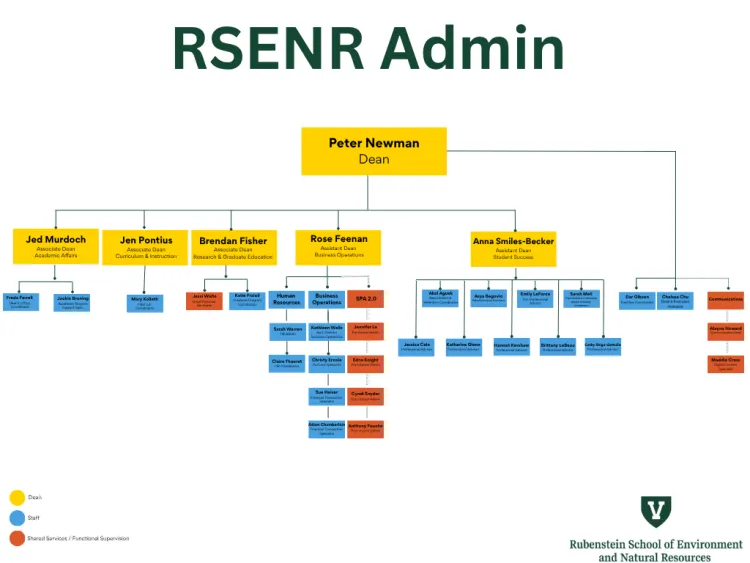
- Peter Newman, Dean
- Chelsea Chu, Dean’s Executive Assistant
- Brendan Fisher, Associate Dean of Research and Graduate Education
- Katie Fraioli, Graduate Program Coordinator
- Jessi Waite, Grant Proposal Developer
- Jed Murdoch, Associate Dean of Academic Affairs
- Jackie Bruning, Academic Program Support Staff
- Freda Farrell, Dean’s Office Coordinator
- Jennifer Pontius, Associate Dean of Curriculum and Instruction
- Mary Kolleth, Field Labs Coordinator
- Rose Feenan, Assistant Dean of Business Operations
- Sarah Warren, HR Coordinator
- Claire Theoret, HR Generalist
- Kathleen Wells, Assistant Director of Business Operations
- Adam Chamberlain, Financial Transaction Specialist
- Christy Ercole, Purcard Specialist
- Sue Heiser, Financial Transaction Specialist
- RSENR Sponsored Projects Staff
- Anthony Fouche, Post-Award Administrator
- Edna Knight, Post-Award Administrator
- Jennifer Le, Pre-Award Administrator
- Cyndi Snyder, Post-Award Administrator
- Sarah Warren, HR Coordinator
- Anna Smiles-Becker, Assistant Dean of Student Success
- Akol Aguek, Recruitment and Retention Coordinator
- Asya Begovic, Administrative Assistant
- Sarah Mell, Experiential and Community-Based Learning Coordinator
- Emily LeForce, Senior Professional Advisor
- Brittany LeBeau, Professional Advisor
- Jessica Cole, Professional Advisor
- Cathy Shiga-Gattullo, Professional Advisor
- Hannah Kershaw, Professional Advisor
- Dar Gibson, Facilities Coordinator
- Alayna Howard, Communications Lead
- Maddie Cross, Digital Communications Specialist
Our Mission Question
The School's strategic vision was designed to leverage our distinctive strengths. It asks "How can the Rubenstein School unleash empathy, passion, innovation, and creativity to heal and radically change human-environment systems in a just, equitable, and ecological direction?"
Our 20-year Strategic VisionUVM Land Acknowledgement
The campus of the University of Vermont sits within a place of gathering and exchange, shaped by water and stewarded by ongoing generations of Indigenous peoples, in particular the Western Abenaki.
Acknowledging the relations between water, land, and people is in harmony with the mission of the university. Acknowledging the serious and significant impacts of our histories on Indigenous peoples and their homelands is a part of the university’s ongoing work of teaching, research, and engagement and an essential reminder of our past and our interconnected futures for the many of us gathered on this land.
UVM respects the Indigenous knowledge interwoven in this place and commits to uplifting the Indigenous peoples and cultures present on this land and within our community.
From Our Dean
At the Rubenstein School, we pride ourselves on our dedication to experiential learning, interdisciplinary research, and environmental justice. As the environmental problems we face become more extreme and complex, we can only tackle them through collaborative, holistic approaches.
Dean's Office