Sixteen years ago, at the very northern tip of the Driftless Area of Wisconsin, Tom Manley stepped onto his new farm, Mean Acres, in Spring Valley. It was desolate; the land had been in corn the previous year and likely years before, resulting in a field of stubble and bare, exposed row-crop soil.
This isn’t an uncommon sight for farmers. Soil health is declining in areas across the U.S., like the Midwest, where farms have lost an average of two millimeters of soil per year. This is double the rate of erosion considered “sustainable” by the USDA, and fields in commodity production have seen even worse. The rate of soil degradation far outpaces that of regeneration. And yet, the soil on Tom’s farm had a memory.
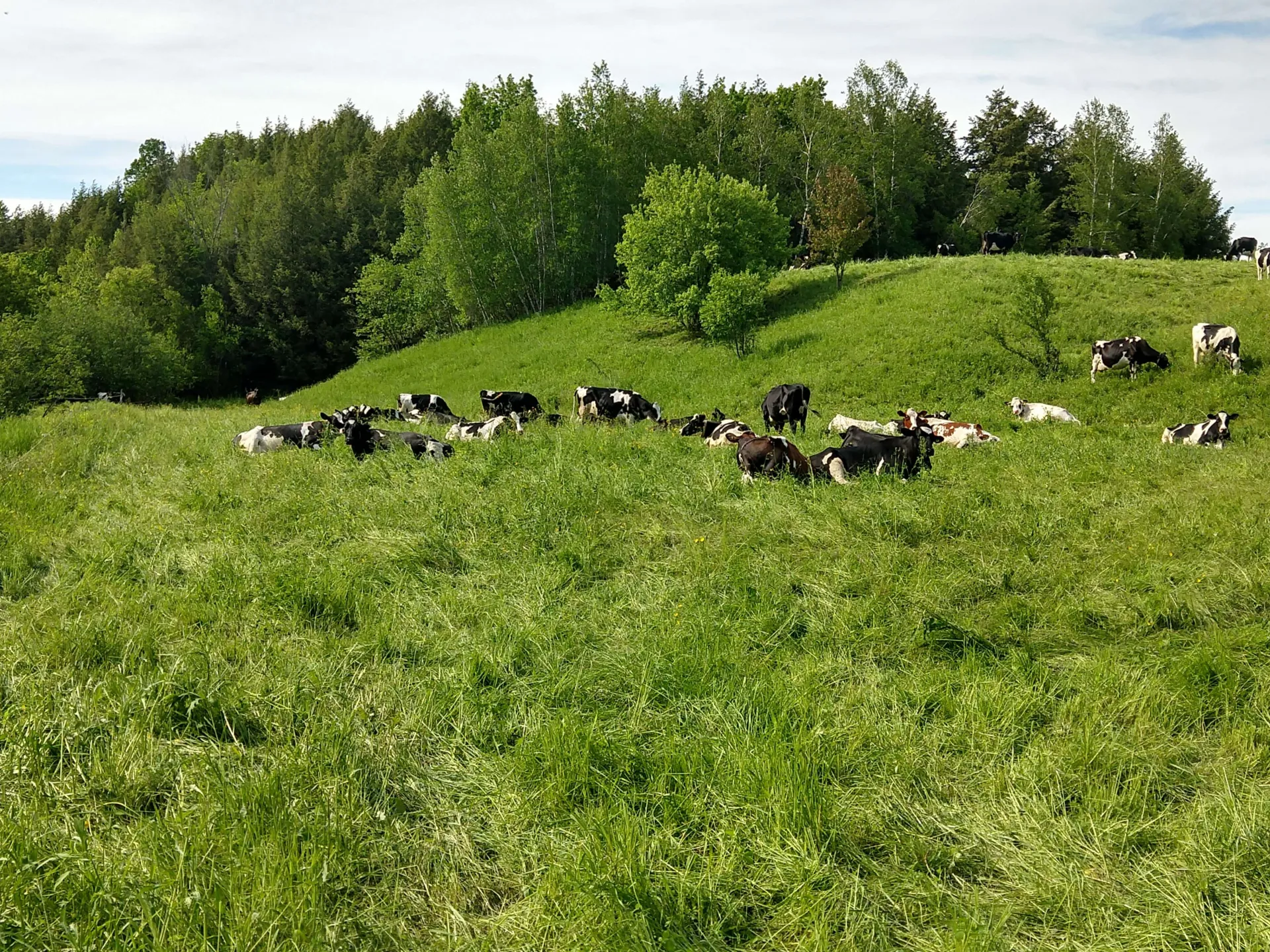
“The seed bank [in the soil] determined what was there and what was going to flourish,” he says. It began to regenerate without any input from Tom. It remembered the abundance of its past, the grasses and fungi and birds and insects it had once been a home to. “In less than a year, we had bluegrass, we had brome, we had orchard grass, we had clovers, and weeds, lots of weeds.” Over time, Tom managed this growth, both by clipping weeds and grazing cattle, to encourage the kind of pasture he wanted. He worked in tandem with natural processes.
“I'm still shocked at how desperately it wanted to turn back into grassland,” says Tom. Tom is the climate and conservation director at Marbleseed, a Midwest-based farmer-led nonprofit supporting farmers in their transition to more sustainable farming systems. In his role, he’s assisted many farms in their journey to organic production and implementing conservation practices. Today, the soil on Tom’s farm doesn't, in any way, reflect where it started.
“Soil can and does tell a story,” he continues. “It says a lot about how that soil’s been managed for decades.”
This regeneration is now a chapter in the soil’s story. As soil health assumes a central position in the fight for a better food system, viewing it as a record of memory, power, possession, knowledge, and labor becomes an invaluable tool. What about the rest of the story? What is being recorded? Whose knowledge is included? How quickly can the story change? Who’s allowed to write it?
A Movement Turned Meaningless
Since the 1980s, regenerative agriculture has been popularized as a soil rehabilitation technique. Similar to the farming practices of agroecology, regenerative embraces diversification, intercropping, crop rotation, silvopasture, cover cropping, and avoiding synthetic inputs. It aims to support the whole ecology of the land and place, not just to increase yield and profit. In this sense, both distinguish themselves from more industrial or conventional production, and, unfortunately, both face challenges of their definitions being disputed or co-opted by those who seek to maintain the industrial food system.
Farmers like Tom feel as though the movement has already been stripped of its integrity. “The word regenerative was very purposefully and deliberately hijacked by the industry,” Tom claims. “The moment your Cargills and Bayers are using the word regenerative in any of their promotion, it's meaningless.”
Corporate interests like Cargill, the largest private agribusiness in the U.S., Bayer, the world’s largest seed and pesticide company, and Perdue, one of the largest poultry producers in the U.S., have made large investments in regenerative agriculture since 2020. The current political administration, alongside the Make America Healthy Again (MAHA) campaign, has even launched a “Regenerative Agriculture Pilot Program.” Critics have repeatedly called out multinational corporations for utilizing “regenerative” as a marketing tool, or as a way to simply store carbon or look more climate friendly.
“It’s just branding. This administration's embrace of the word regenerative without any meaningful reforms or commitments behind it, (...) it's all talk and absolutely zero action,” Tom comments.
These large-scale campaigns have attracted the attention of farmers across the country. Tristan Quinn-Thibodeau, land campaigner and policy strategist at the National Family Farm Coalition (NFFC), speaks to the power dynamics NFFC’s membership has recognized in the regenerative movement.
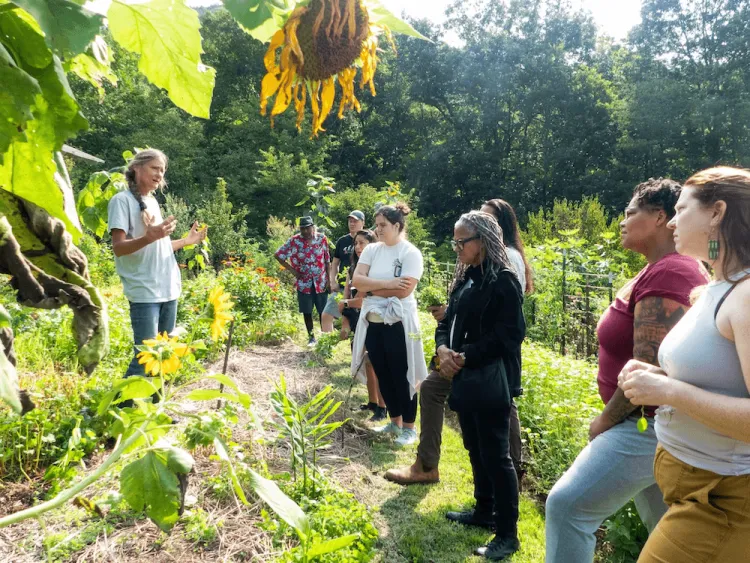
“I think a lot of our farmers are very skeptical of regenerative in particular, since it's so vague, since it can cover so many things, and since it can be very amenable to an agribusiness style of production,” Tristan says. “They’re skeptical of environmental approaches to farming that don't talk about price, that don't talk about power, and that don't talk about other things that farmers need to have in place.”
Tristan looks to the 1930s era of the New Deal as the best model of a farm policy that supports both sustainability and family-scale farming – limiting overproduction to keep crop prices fair and give farmers room to diversify, adopt sustainable practices, and conserve land. That changed in the 1970s, when the Nixon Administration, pushed by agribusiness companies eager to pay less for grain, scrapped those limits in favor of "Get Big or Get Out" farming. For NFFC's members, any environmental approach that doesn't confront overproduction and fair pricing leaves the door open to whoever has the power to define it.
Today, as U.S. agricultural industries have recognized opportunities for economic power, they’ve capitalized on the regenerative movement. The loose definition of the word “regenerative” allowed for manipulation. “They had the opportunity to tell us what it meant, and they decided it meant conventional no-till,” Tom says, “which sells a whole lot more seed and a whole lot more herbicide.”
Many early adopters of regenerative, especially those who are also coming from an organic lens, have continued their commitment to mimicking natural systems and building soil resilience. Still, the risk of co-optation ruining what these farmers have built is high.
“It's not that I think we need to come up with a new buzzword or a new way to describe what we do,” says Tom. “But we absolutely do need a collective narrative about what we are actually aiming for.”
But creating a collective narrative for a movement of land stewards, growers, and farmers, none of whom are starting on the same ground, is not a small task.
Local Ground, Local Truth
In the South and Southeast, the soil tells a different story. It raises the question of whose knowledge gets to define good practice, and where – because what counts as progress in one climate might lack meaning in another. Michelle Schroeder-Moreno, agroecology professor and director for the Center for Environmental Farming Systems at North Carolina State University, has seen this firsthand.
“The long-term benefits of building organic matter is hard to see in the South,” says Michelle. “Because of the hot temperatures, the decomposition rates are really fast.” Building healthy soils then, in the South, means playing the long game, “and that's the challenge with farming in this country, because our focus is short term gains,” she adds.
Alex Racelis, agroecology professor and Houston Endowed Chair of Science and Technology at the University of Texas Rio Grande Valley, is working on soil health research that is relevant and applicable to the unique, subtropical climate of the Rio Grande Valley.
“We’re doing research in an area where there has been a fairly significant deficit of intellectual capital, right?” says Alex. “So, we end up borrowing research from the University of Vermont or from the Rodale Institute or from other areas, where the actual interpretation of their experiments really has very little relevance for where I work.”
Both Michelle and Alex highlight cover cropping, a well-known practice for soil health, as a lauded practice that doesn’t always make sense in southern climates. For instance, Alex notes that a lot of research is done on leveraging freeze events, like winter kill, to manage cover crops. But how do farmers do that in areas that don't have winter kill?
“These legacy institutions are the ones who get the funding, so the research ends up being focused in these areas,” says Alex. “And then that becomes the prevailing school of thought and, of course, it doesn't always apply.”
This dominant paradigm of knowledge that Alex illustrates only serves “the people who the science was designed for.” Farmers outside of this group, who express a desire to transition to regenerative or agroecological ways of farming, have the odds stacked against them; their voices are rarely written into the soil record.
And, on top of that, farmers face many other barriers that force them to think twice before adopting a new practice. “Every change is an economic risk,” Michelle says. “It's hard to make those long-term commitments, especially if you’re renting land.”
“It’s incredibly hard to have any kind of land security,” Tristan agrees. “If we're talking about soil and soil health, you need that kind of security to really do the work the right way.”
Despite these challenges, Michelle feels strongly about two things: meeting farmers where they’re at and understanding their baseline for soil health. She lifts farmer-to-farmer learning as a successful pathway to widespread adoption of regenerative and agroecological practices, but also one that requires patience. “It is nuanced and yet we need to be inclusive. We have to be inviting,” she says. “I just want to get [farmers] to the table.”
Toward Shared Stories
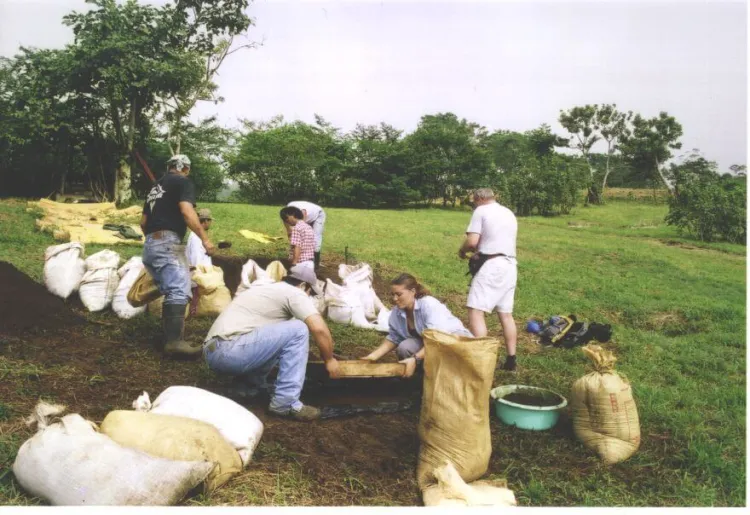
Long before Michelle was arguing for playing the long game, she watched it play out on a degraded coffee farm in Costa Rica. When she was an undergraduate, she had the opportunity to conduct research with her professor, a hummingbird canopy biologist. The goal was to revive the depleted soil that caused fragmentation of natural areas.
“It was a farm [the professor] had bought that was so degraded. It had produced coffee for a number of years in southern Costa Rica until it couldn't produce anymore,” she says. “And then they turned it over to cattle farming.”
The farm was down to bedrock – Michelle recalls planting trees in red, rocky soils. She conducted a chemical analysis that read the phosphorus level as “one part per million.” She thought she was wasting her time. Ten years later, she happened to be nearby, and her professor invited her to visit the farm.
“[The trees] were meters above my head. There was organic matter. I could dig in and see brown soil that was created. I felt carbon out of nothing,” she explains, detailing the farm’s thriving agroforestry system, and return of ruminants to graze the land. “That was my aha, this can work moment."
From Wisconsin to Costa Rica, the soils present a living history. The land remembers what’s been done to it and for it, but the record holds more. It recognizes power – who gets to define soil health and whose knowledge counts – and it recognizes labor – the risk-taking and the patience required to build soil health. These challenges amount to the argument of what will be written into the record next.
If soil health is a collective movement, then it should tell a collective story. “We need research, we need organizing, we need farmer-to-farmer training, we need local policy, state policy, we need all of that,” says Tristan. “There is a huge opportunity right now for us all to get organized and build the future we want."
“We need to keep talking about the language we're using. We need to keep talking about how we're talking about what we want,” Tom adds. “If we can't define that destination, we have no idea what path will take us there.”
A collective narrative makes all the rest easier – it informs research; it inspires organizing; it guides policy. The current food system wasn’t happenstance; it exists because of a series of deliberate decisions. “So, we have the ability to change it,” Michelle claims. “If I have to say one last thing to be optimistic about, (…) every season we get to change it. Every season, we get to do something new that can improve our soil.”