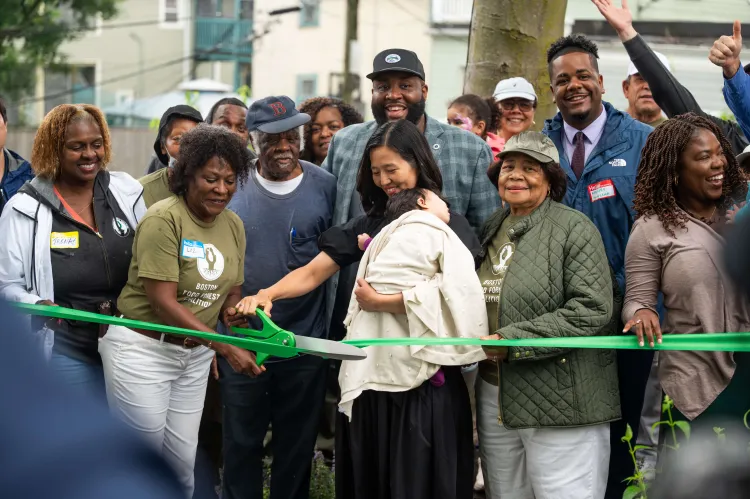
It’s the spring of 2023 and the Edgewater Food Forest in Mattapan, Mass. has been three years in the making. Today, it will open, giving the community a first-hand look at what the right to food can look like in practice.
This is the city of Boston’s 10th food forest–a term used to describe a sustainable, edible landscape designed to mimic the structure and function of a natural forest ecosystem–and Mayor Wu is present at the ribbon-cutting ceremony.
“I've lived on this street for 30 years, and I never knew my neighbors until we started this project together,” a neighbor shares with Hope Kelley, Senior Communications Manager at the Boston Food Forest Coalition, who assisted with this project from start to finish.
Throughout the process, she heard a similar sentiment from many nearby community members. To Hope, “everything else falls into place once you've met each other.” Now, in 2025, the Edgewater Food Forest provides not only fresh, healthy food for the community, but a place for fitness, education, and togetherness.

What is the Right to Food?
The United Nations defines the right to food as the right to have regular, permanent and unrestricted access to adequate, sufficient, culturally relevant food, which ensures a physical and mental, individual and collective, fulfilling and dignified life free of fear. How might this be realized in a place like the United States, which has a complex relationship with international human rights law?
The National Right to Food Community of Practice (RTF CoP)–a membership-based national coalition of advocates and organizations–is working to build a shared narrative around understanding food as a human right. They work to tackle the root causes of hunger with long-term solutions, standing firm in their stance that realizing the right to food can only happen by moving beyond short-term emergency solutions. Chelsea Marshall, Director of Special Projects at the National RTF CoP, says that central to her work is reinstating the idea that all are rightsholders as opposed to stakeholders.
“Rights-based approaches for me are really about shifting the way in which we see ourselves in relationship to the problems that we're facing,” she says.
As part of the RTF CoP, she supports various working groups to identify the ways policies and practices are supporting or constraining the realization of the right to food. For instance, governments can enact progressive policies that advance equitable access to nourishing food. Or conversely, they can adopt measures that restrict such access or enable corporations to take actions that undermine the right to food. Chelsea urges people, as rightsholders, to get involved in spaces where local and state governments are making decisions that affect the conditions needed for everyone to enjoy the right to food.
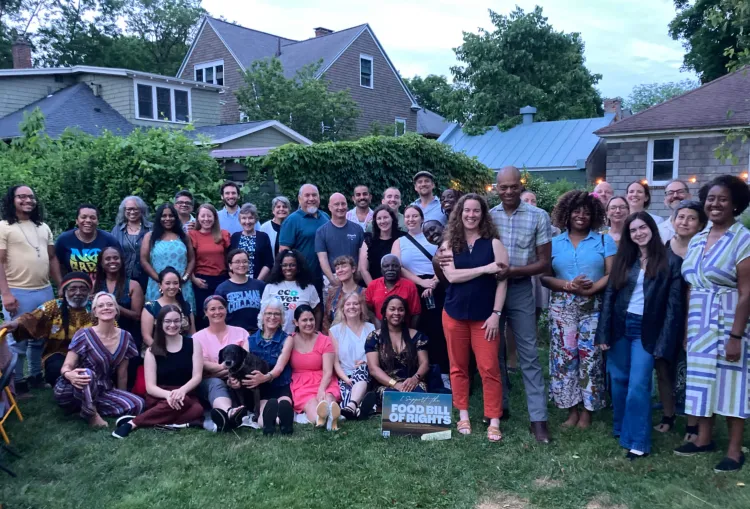
Maine, where Chelsea is located, became the first state to include the right to food as an amendment in their state constitution in 2021. This amendment was partially born out of a regulatory policy surrounding food safety and licensing rules–small-scale food producers were frustrated that they had to meet the same costly, high-capacity standards as large commercial operations. This policy constrained small-scale producers from growing and created a cliff edge in the regulatory framework, forcing small farmers to either invest funds in infrastructure they didn't need–like commercial kitchen equipment–or abandon efforts to grow or sell food locally. Here, government rules were making it harder for individuals or communities to produce food for themselves, hence the need for a rights-based approach to be enshrined in the Maine constitution. In a rights-based approach, Chelsea suggests that the government should meaningfully involve small farmers and local communities in decision making by limiting overregulation that can harm small producers and implementing policies calibrated to the size and type of production.
Food forests can be a shining example of a long-term solution that helps ensure community members and governments work together to establish “regular, permanent and unrestricted access to adequate, sufficient, culturally relevant food"–the right to food. Food forests consist of perennial crops that return year after year, creating this regular, permanent access to food, whether it be nut and fruit trees, herbs, or shrubs. They create community-controlled access and participation in food production that redistributes power and leverages investment from the government and other entities. And, they can expose gaps in our societal approach to the right to food by serving as gathering points that prompt decision-making bodies to seek local input.
Boston Food Forest Coalition
At the Boston Food Forest Coalition, land–like the Edgewater Food Forest in Mattapan, Mass.–is placed in a nonprofit community land trust that works with local leaders to design the food forest and ensures stewardship will be managed by the neighborhood in the future. The City of Boston has been central to their growth by providing funding, access to land in the city, and requiring community engagement in the development of the land.
The city releases Request for Proposals (RFPs) for parcels of land that are available for community development. Thus begins a multi-step process of securing approval from the city–applicants are required to submit a proposal packet including site plans, budgets, and “community engagement plans.” Meaning, a food forest cannot be created without a participatory process that involves community rights holders.
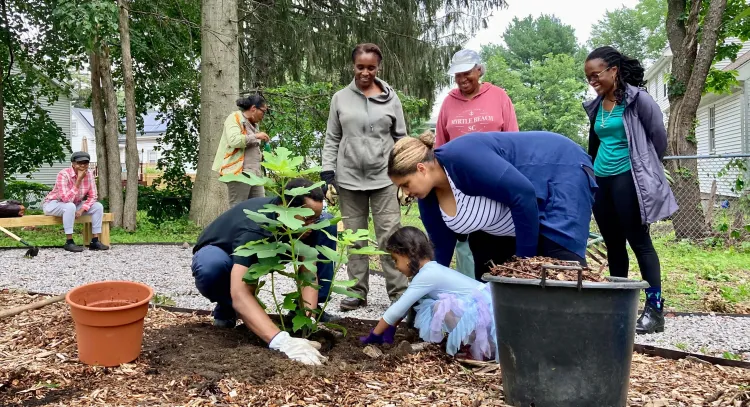
“[Boston Food Forest Coalition has] already been in conversation with neighborhood leaders or residents long before an RFP is released,” notes Hope, further explaining that many communities proactively reach out to BFFC directly because they’re familiar with BFFC’s mission and model and want to partner with them to meet their goals.
With BFFC, land stewards collaborate in determining what species are going to grow in the food forest–such as a culturally relevant plant or a plant becoming more adaptable to a New England climate. They then maintain the food forests over time with BFFC as a backbone support system.
Yet, sometimes wanting to meet community needs means stepping back from a food forest project. There have been instances during community meetings when BFFC recognized that more neighbors would rather have affordable housing built than green space.
“Not every space needs to be a food forest. There's room for all,” says Hope.
Global Village Farms
Forty miles west of Boston lies Global Village Farms in Grafton, Mass. Global Village Farms and the Pocasset Pokanoket Land Trust (PPLT), both founded and led by Indigenous leaders, recently merged organizations. Together, at the site in Grafton, they have begun the construction of an agroforestry project: a one-acre food forest.
The food forest includes 400 trees and shrubs, a riparian buffer abundant with elderberries, a nut grove with walnuts, butternuts, and chestnuts, and a denser forested part where 200 plants lie in a multi-strata system including shrub, tree, and ground cover. The construction was made possible due to their vast volunteer base that hails from Worcester, Providence, and Boston who join Global Village on Community Farm Days. According to Michelle Nikfarjam, PhD student in Food Systems at the University of Vermont studying agroforestry and an Agroecology Support Specialist at PPLT, for many volunteers, it was their first time ever planting anything. This food forest honors the microclimate of a place people love and provides healthy food to the community in return.
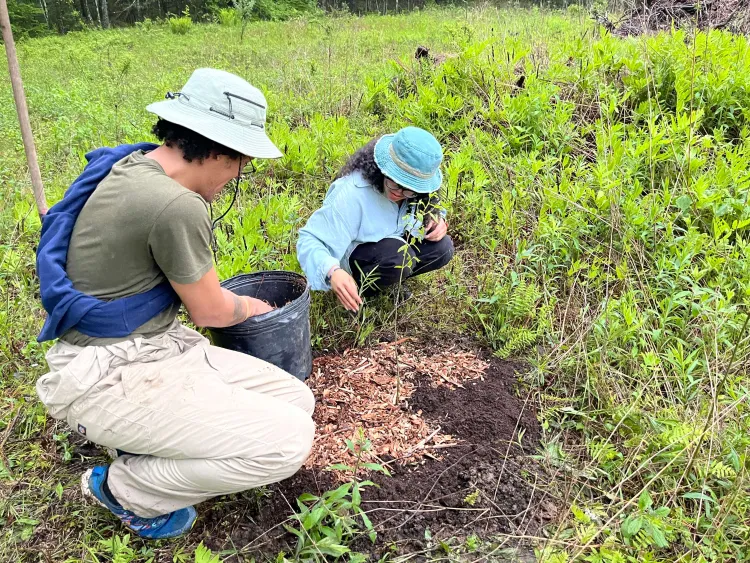
Due to the organizations’ commitment to equity, and their extensive work with black, Indigenous, and other land stewards of color, the state of Massachusetts is “coming to [PPLT]” for help in attracting more grassroots voices to weigh in on policies in the state. They have received inquiries from the Massachusetts Department of Agriculture (MDAR) and the Department of Conservation and Recreation (DCR). This kind of partnership between government entities and community organizations demonstrates how the right-to-food ethos—community action backed by government support—can transcend individual projects and influence a broader range of issue areas.
In contrast, Michelle, who has worked on many agroforestry projects throughout her role at PPLT, noted that food forests are often seen as a secondary practice due to not being “necessarily production related.” This means that they can be excluded from USDA funded programs like the Environmental Quality Incentives Program (EQIP) or the Conservation Stewardship Program (CSP) even though agroforestry, similar to food forests, is a practice that integrates trees and shrubs with crops and livestock.
To Michelle, this is a key area “to push on policy,” in hopes that the federal government adopts greater responsibility in funding food forests. Integrating food forests into public infrastructure could facilitate a shift in how people view themselves as caretakers of food systems and ecosystems, but this doesn’t happen easily.
“We really have to see ourselves in [ecosystems], and I think that edible landscapes and food forests can do that,” says Michelle.
Seeing the forest through the trees
Rights-based approaches call for prioritizing what communities need to feed themselves–land, resources, networks, autonomy–and food forests exist at that intersection. Their aim is not to simply produce fresh food but also build climate resilience, green space equity, and offer a step toward realizing the right to food, especially when properly supported by the government and other decision-making bodies.
Across Boston, Maine, and Indigenous communities in the Northeast, there are tremendous efforts underway that are realizing the right to food through food forests. Ultimately, when governments adopt enabling policies like clear processes and specific regulations while embracing alternative, agroecological approaches to food production, food forests have the potential to become critical public infrastructure in our communities. An equitable and resilient food future requires a balancing of community initiative and institutional support. Food forests are exemplary of how we can use all of the tools available to realize the right to food.