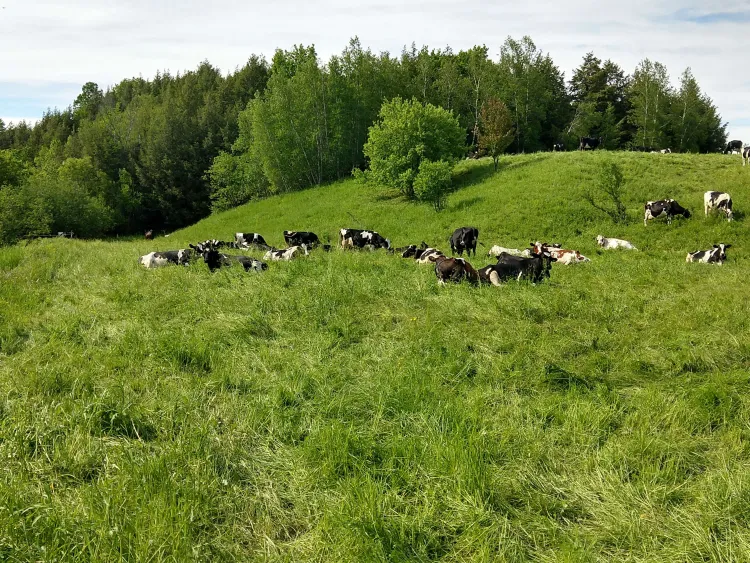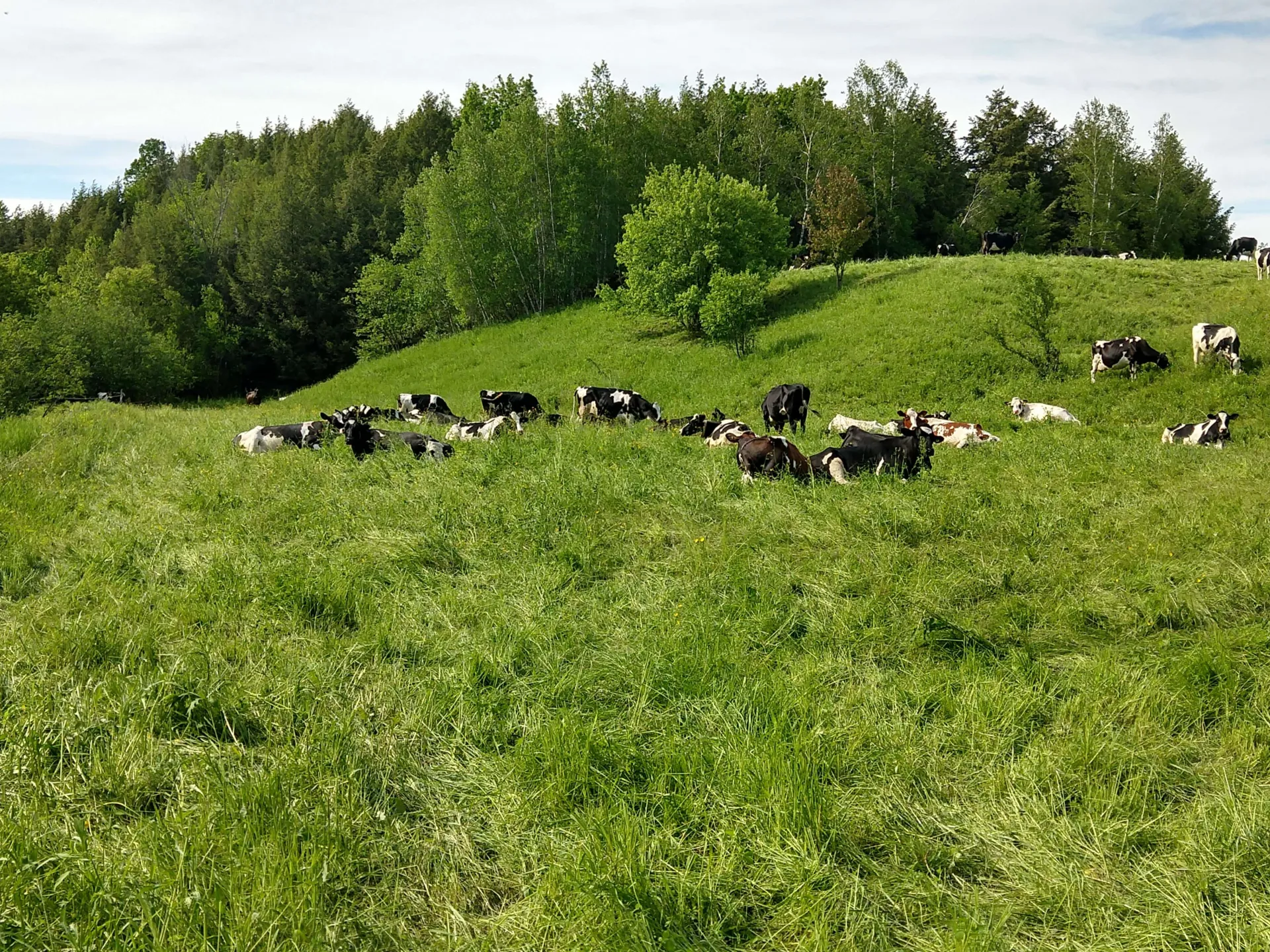
If you’ve ever been to Vermont, you’ll recognize the many hallmarks of a predominantly agricultural region, one where the rocky soils often make for better pasture than cropland. The red barns, rolling hills, and herds of dairy cows all tell a story–this one being of New England farmland.
From the late 1800s through the early 1900s, a swath of French-Canadian farmers migrated from Quebec to northern Vermont. Some were motivated by the prospect of higher prices; others, the promise of fertile land, as much of Quebec’s rich soils had deteriorated by this point. The additional perk of being right over the border allowed for frequent family visits. As the Vermont Historical Society puts it, “To the French-Canadian farmer, with depleted soil and unsettled sons, Franklin County offered fresh opportunities.”
Many present-day Vermonters share this family history, including Dairy Farmer Matt Choiniere of Choiniere Family Farm in Highgate, Vt. Choiniere represents the fourth generation of dairy farmers in the Choiniere family to steward the roughly 350 acres of land in Franklin County, just four miles from the Canadian border. The farm has evolved significantly since his great grandfather settled in 1945.
In 1997, Choiniere’s grandparents made the decision to conserve the farm with the Vermont Land Trust for economic and environmental reasons. Five years later, amidst an unstable dairy market, his parents started the transition to organic, establishing a partnership with Organic Valley. During this era of change on the Choiniere Family Farm, Franklin County-at-large was evolving as well.
“Our road used to have a lot of dairy farms,” Choiniere says, “I've seen a lot of consolidation; a lot of the smaller farms selling out, or the older ones retiring with no next generation.”
Yet, according to a 2023 New England Feeding New England (NEFNE) report, New England relies heavily on regionally produced dairy, with upwards of 50 percent of New England dairy being consumed by the region. Dairy also accounts for two-thirds of Vermont’s agricultural sales. So, why are dairy farms still struggling? Why is New England losing farmland?
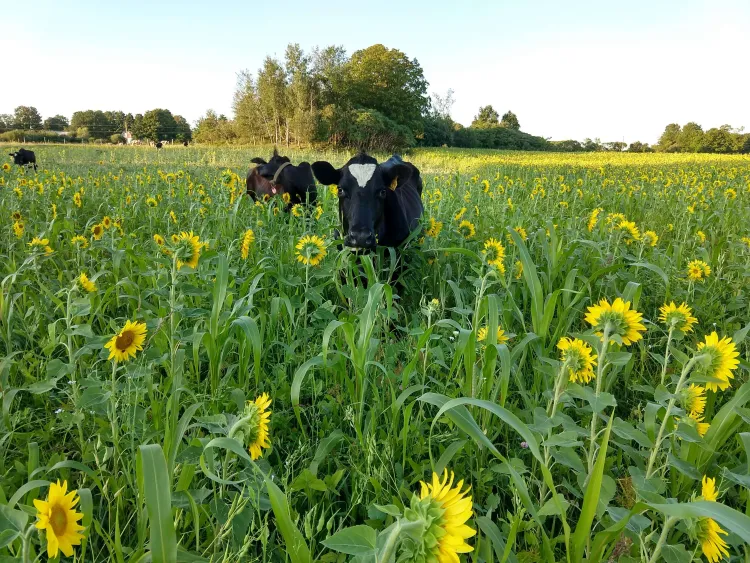
Choiniere views diversification and market expansion as key contributors to the solution. While New England relies on its own dairy, it imports large amounts of fruits, vegetables, and grains.
“That’s a huge market that our farmers can definitely fill,” Choiniere says. Still, he recognizes the market challenges, saying that “you can grow anything, but where do you sell it?”
Growing Pains
Producing more fruits and vegetables on New England soil inevitably leads to a conversation about land. The NEFNE report laid out a vision to achieve 30 percent self-reliance on regionally produced food by 2030. To reach this goal, the report calls for maximizing the use of 400,000 underutilized acres and clearing an additional 588,000 acres for production–roughly three times the size of New York City. It’s a lofty goal, one that Leah Rovner, director of the New England Food System Planners Partnership which stewards the NEFNE project, says is “a complex one, and one that we are continually navigating.” It seems this way for the report’s audience as well, where many questions exist around how, why, and where the region might achieve this goal.
It would require bringing 480,000 acres of forested land with prime farmland soils into production, a move that has historically faced backlash from individuals who advocate for ecological preservation. Alex Redfield is the policy director at Wildlands, Woodlands, Farmlands, & Communities (WWFC), a group that holds a similarly focused vision for New England that calls for the conservation of farms and forests to support a healthier planet.
“No matter what, we are going to have to feed ourselves,” says Redfield. “There are places in New England that are better at producing food for us than others, and if those places are used for other uses, it's going to jeopardize our ability to sustain ourselves.”
“How to make it profitable and how to get producers to manage their land full time, I think would be another challenge,” Choiniere says. More precisely, Redfield asks, “why would we try to bring more acres and new people into an industry that is not economically sustainable?”
Brian Donahue, longtime collaborator with WWFC and the team behind NEFNE, echoes Redfield’s remarks. To Donahue, dairy farmers are “up against an economically impossible situation,” yet he believes young farmers would be attracted to the industry if “they were being paid a decent wage with benefits.”
The question then, as Donahue puts it: “How do we, as a society, bring more support to that kind of farming, if that's the kind of farming we want to see?”
Conservation in Practice
For the Choiniere Family Farm, conservation has always played a central role in their farming philosophy. “We've enjoyed seeing eroding hillsides go from bare soil to lush riparian buffer,” Choiniere shares. While the decision to conserve their land with the Vermont Land Trust is both morally and environmentally rewarding, he says it was “initially financial.”
The conservation easement allowed his grandparents to pay off a lot of debt: a perk that he believes is the driving force behind most farmers who conserve their land. In this way, farmland conservation is rooted in the recognition of care by land stewards and provides an avenue for increased economic stability and secure farmer livelihoods.
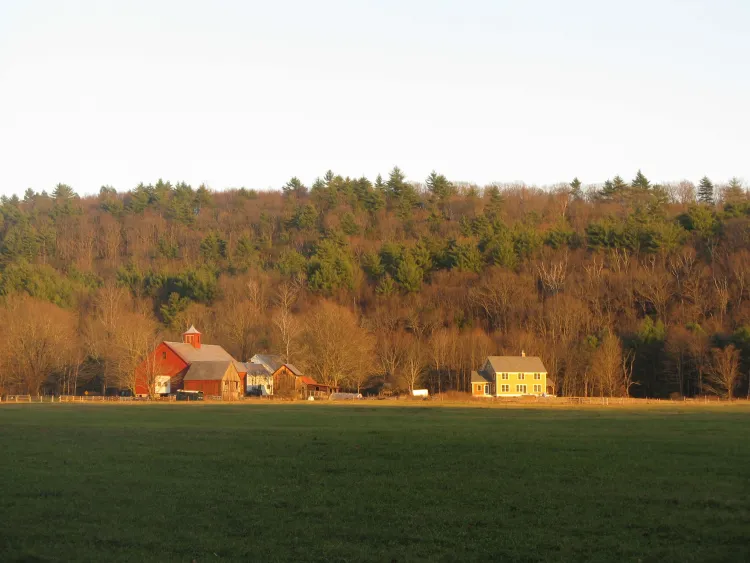
Many miles south of Choiniere Family Farm, Donahue co-owns a 170-acre farm in Western Massachusetts; where they raise beef cattle and pigs, steward a woodlot, and grow vegetables. His friends bought the existing farmhouse, and Donahue built a new farmhouse from the woodlot. “There’s three housing units where there used to be one, with a loss of almost no acreage,” he says. Donahue sees development as necessary if not inevitable. He encourages buyers of rural acreage to take a similar approach to him, ensuring the landscape stays intact, so the land is not parceled.
“You just need to convince more landowners that that's a good thing to do, which is kind of an uphill battle,” he concludes.
Still, Donahue recognizes the barriers that exist in land acquisition: “Are there ways to get people access to some of this land that don't have the wealth to acquire it?” To Alex, the answer is yes. He notes that alternative approaches to land conservation exist around the world. Most embrace the idea of redistribution – the ability of state and conservation groups to protect public lands and put them in the hands of stewards.
In Eastern Ontario, Rouge National Urban Park, managed by Parks Canada, is offering long-term, renewable agricultural leases to keep protected public land in agricultural production. This approach is designed specifically for young and new farmers to invest in a barrier-free, low-risk farming operation. In New Orleans, the Growing Green project by the New Orleans Redevelopment Authority leases out formerly unused lots to farmers and growers to spark “community development projects,” as Redfield puts it.
“The idea of using public dollars to facilitate the protection of important spaces and making it accessible in a way that's not cost prohibitive,” he muses. “It's all pretty exciting.”
Alternative models of land access offer a glimpse into how conservation might embrace equity, ensure long-term stewardship, and engage community members in its approach. Traditional conservation alone can’t be the solution. The solution must address the underlying causes that lead conservation to be a necessary action - lack of land access, market challenges, and misvalued agrarian livelihoods. Yet, existing systems often fall short in supporting these models.
The Common Ground
Redfield, who has spent several years working with refugee and immigrant farmer training programs in New England, shared that time and time again, he sees land stewards and farmers who fled political violence from their home country arrive in the U.S. without access to land. He witnesses this lack of access sever agrarian identities and interrupt the continuity of heritage and generational knowledge.
“We have set up a system where access to that land is a commodity,” says Redfield. “Our ability to connect with that part of ourselves is limited based on capital.”
Transforming this system requires looking to supply chain infrastructure. “We haven't been able to overcome the economic hurdles to how in the world you successfully farm in a market economy that rewards cheap commodity extraction,” says Donahue. “I think that was kind of the point of NEFNE, because there's a whole section on distribution; something has to be done to make this sort of food more broadly accessible to more consumers.”
A shift in infrastructure can only come from a deeper shift in values. Such a shift must recognize the inherent worth in agrarian livelihoods and care for those who feed the population. Bringing these values into focus will further show how they intersect with other issues of sustainability and justice.
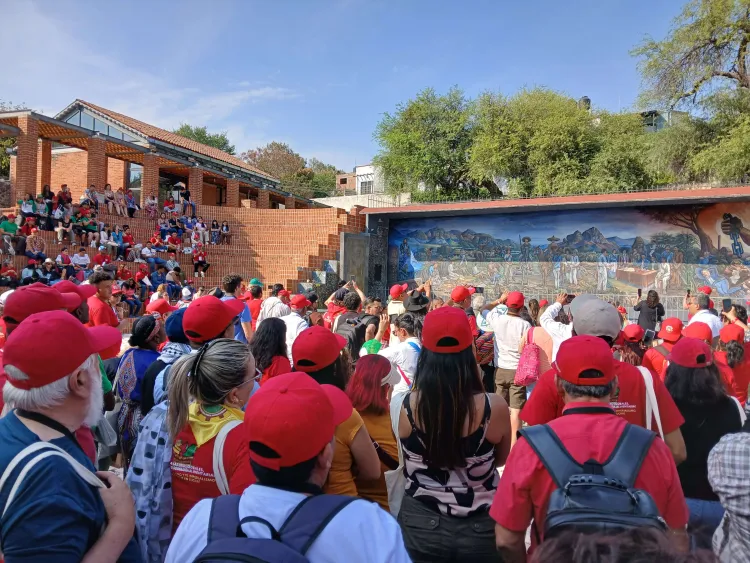
Nils McCune, research associate for the UVM Institute for Agroecology, recently attended the Second International Conference on Agrarian Reform and Rural Development (ICARRD+20) in Cartegena, Colombia. The conference reunited social movements, government officials, and scholars to envision a path forward for agrarian reform.
Informed by his recent conference attendance, McCune calls in a framework that arose to support the path of agrarian reform through four mechanisms: recognition, restitution, redistribution, and regulation. If the value in stewardship is recognized, land can be given back to those who lost it, distributed to incoming stewards, and solidified in policy. To McCune, this framework aims to support agrarian livelihoods, but it goes even further: the creation of meaningful livelihoods in rural communities causes a ripple effect that can address other stressors on sustainable systems.
Of the four R’s, McCune believes the fourth, regulation, is the most urgent for the United States. “We actually have to fight for decent public policy to accompany these four mechanisms that each have a role in conserving farmland,” he concludes.
Investing in Innovative Policy
Farmland conservation is showing up in discussions around the world as a means to achieve secure farmer livelihoods, regional food reliance, food sovereignty, and an agroecological future. Across the board, communities are fighting against development, consolidation, corporations, and market volatility–and it’s a hard fight. Despite differences among these movements, two things remain true: farmland conservation is important, and other shifts need to occur simultaneously to create a successful economic base for agrarian livelihoods.
In a world ridden with development and agricultural consolidation, support must be given to farmers who have successfully resisted external pressures, equally as to those who are trying to resist.
“Resistance has always been where innovation comes from, right?” McCune asks.
Right now, the policy landscape is limiting. Alex critiques the practice of purchasing development rights solely to increase the total acreage of conserved land, calling it a “misappropriation of public dollars.” McCune criticizes how policy decisions are simply “up for grabs by lobbyists who are able to buy out politicians.”
As an alternative, Redfield and McCune call for innovative policy. Redfield points to emerging partnerships between conservation organizations and housing organizations. He believes that more can be invested in projects that achieve multiple benefits; such as protecting a farm from development but still allowing farmworker housing to be built on the parcel of land. On the other hand, he highlights a story of restitution, one of the Niweskok Collective in Northeastern Maine, which was able to secure 245 acres of land without easements, offering full sovereignty to the Wabanaki Confederation. This was achieved through a non-traditional partnership with several conservation organizations, including the Maine Farmland Trust and Coastal Mountains Land Trust.
It’s not only about land access: it’s about markets, too. “The need is to create a clear economic path for people to survive on the land and have access to good, safe, healthy markets,” says McCune.
McCune applauds the work of the Center for an Agricultural Economy (CAE) in Hardwick, Vt. CAE has a mission of supporting local food systems by operating a food hub and providing business advising, supply chain support, and financial assistance to farmers. This is what market diversification policy might look like in practice; this is where the dairy farmers might find their produce buyer.
“[CAE] should be publicly funded,” he argues. “They're one hub, but we need 10 hubs like that in the state.”
At a basic level, McCune believes that farm and food businesses need to be made profitable, echoing the remarks of Choiniere, Redfield, and Donahue. This should encapsulate the entire food system, not just farmers: “from the composters to the haulers, to the transformers, the canners, the bottlers, the distillers,” he says.
An opportunity exists to use the public sphere – community participation, understanding, experience, and debate – to demand these changes from policymakers and ensure that innovative policies are implemented that work for farmers, stewards, workers, and eaters.
“That's the next step of innovation,” McCune concludes. “To figure out how to scale out the examples of resistance that agroecology has shown are possible.”
Fostering Agrarian Livelihoods
Conservation protects something that is irreplaceable - an agrarian identity - which isn’t just the scenery of red barns and rolling hills, but a livelihood. However, it falls short if equity and access are ignored. While conservation has allowed this people-place connection to flourish for some, an inequitable system has severed it for others.
When asked about the prospects of the Choiniere Family Farm beyond his generation, Choiniere feels hopeful; “My goal is to at least do things in a way that gives [my son] the opportunity to do what he wants.”
If collective support can be built by innovative policy and community solutions that center the diverse voices of land stewards, stories of successful generational farming could manifest in communities worldwide.