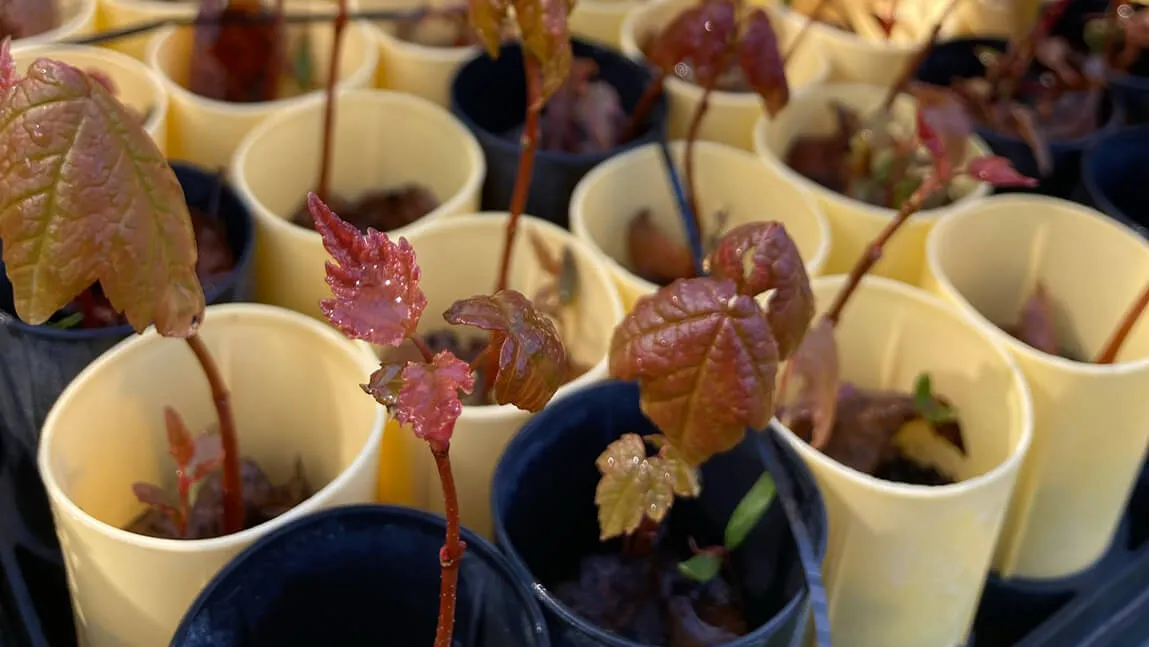
Burlington--Using locally sourced native plant material for forest restoration projects results in more successful plantings, minimizes risk of introducing invasive pests and disease pathogens and translates to economic benefits for the state and local communities. However, as a recent survey discovered, Vermont is experiencing a shortage of native tree seedlings for restoration work, and demand is expected to increase by more than half in the next 5-10 years.
To quantify the native tree seedling shortage in Vermont, restoration practitioners from Lake Champlain Sea Grant and the U.S. Fish and Wildlife Service recently conducted a survey targeting existing and aspiring native tree nursery operators specializing in native trees for riparian forest and wetland restoration projects. The survey complements earlier work (https://go.uvm.edu/plant-source) exploring plant material sourcing needs among restoration organizations like watershed groups and conservation districts.
For this latest survey, the researchers collected data on the number of units, type (e.g., bare-root, container or other type), size and species grown and/or sold annually. Nursery operators also were asked whether they are able to meet current demand, if they would expand if they had the resources and about the challenges and limitations they face that impact production.
A total of 18 individuals, representing seven existing nurseries and 11 aspiring growers, responded to the survey, conducted by Alison Adams and Annalise Carington. Adams is the watershed forestry coordinator for Lake Champlain Sea Grant and University of Vermont Extension. Carington works as a conservation specialist with the U.S. Fish and Wildlife Service and the Intervale Center in Burlington.
According to the survey, annual plant material sales for restoration projects, including from both in-state and out-of-state nurseries, totaled approximately 133,000 units this year. Around 50 percent of total sales (66,000 stems) came from stock purchased from out-of-state nurseries for resale in Vermont.
The majority (115,300 stems) of all stems sold were bare-root, the preferred plant type for restoration projects due to the lower cost and ease of transport. Of the out-of-state sales, 64,000 were bare-root stems, representing 56 percent of all bare-root material sold.
Among the limitations cited by growers were the availability of seed and cuttings for propagation, lack of knowledge about proper seed and cuttings collection protocols and handling techniques and cost of specialized equipment for seed processing and storage. All existing nurseries that responded indicated that they would expand production if they had the capital and other resources.
The survey concluded that while restoration projects help improve water quality, the ecological benefits to sourcing trees locally also are significant, including locally adapted genetics of trees and limiting risk of spreading pests and pathogens. Developing a larger in-state nursery labor force will help meet the rapidly growing demand for local native plant material and keep dollars spent on trees in Vermont.
To learn more, go to https://go.uvm.edu/tree-stock or tune into a recent podcast produced by the Watershed Forestry Partnership at https://go.uvm.edu/native-tree-shortage.