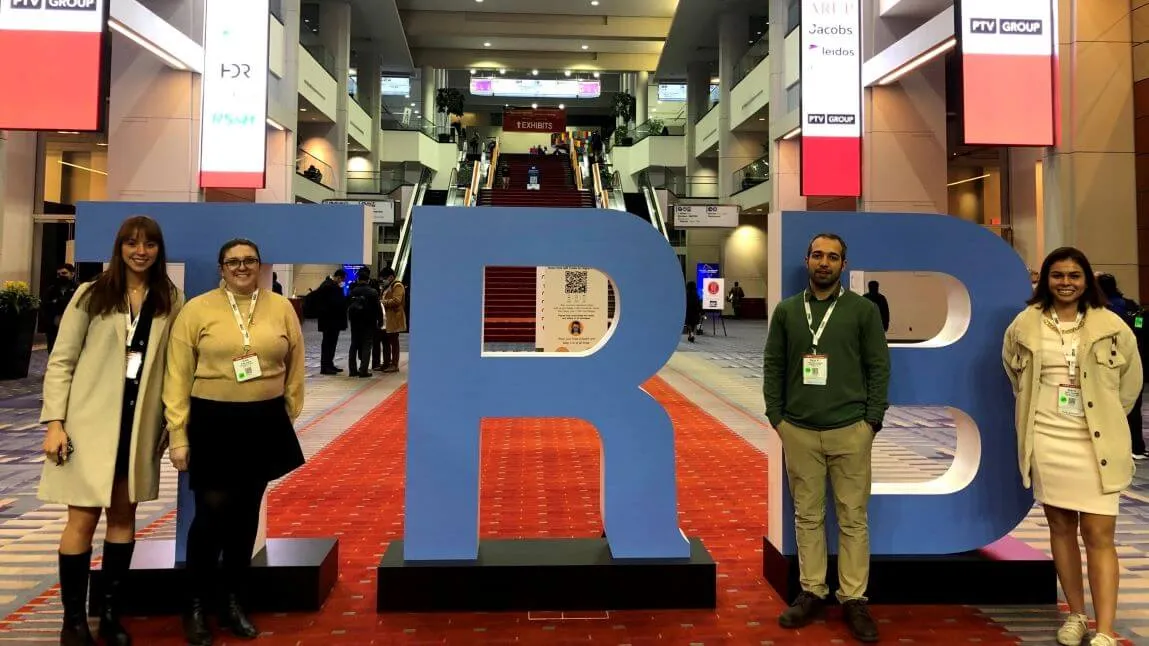
The UVM Transportation Research Center was well represented at the 101st Annual Meeting of the Transportation Research Board held in Washington, DC from January 9 – 13, 2022. Four students and three TRC faculty and staff members presented their research on rural travel issues, transit equity and infrastructure monitoring, lead conference sessions, and networked with colleagues and transportation experts from across the globe.
Erica Quallen, a Civil and Environmental Engineering Master’s student, who conducts research with the TRC, presented two posters describing her thesis research that aims to lay a new foundation for better understanding rural travel behavior. Erica found the poster sessions invaluable because she was able to talk about her work and engage in discussions with a wide variety of people who were just as excited about transportation issues as she is. Her paper, Consistently Inconsistent: An Assessment of Definitions of Rural and Travel Behavior Outcomes in Vermont, received a lot of positive recognition as a foundation piece of research furthering our understanding of rurality and how to measure travel behavior in rural areas. Erica’s experience at the TRB Annual Meeting was energizing and reinforced her resolve to continue in the field of transportation research, as “no matter what project I take on, there will always be more questions to ask, and that’s really exciting.”
Sierra Espeland won the prestigious Dwight David Eisenhower Transportation Fellowship (DDETFP) Achievement Award: 2021 Top Ranked Master’s Fellowship Fellow, for her research “Travel Burdens in Rural U.S. Households”. Sierra is a first-year Civil and Environmental Engineering Master’s student working with Dr. Dana Rowangould. She also presented preliminary results from her MS thesis research in a lectern session.
Julia Clarke, a senior Civil Engineering BS student and Barrett Scholar shared the stage in a lectern session with some of the world’s top travel behavior researchers to present her work on how the travel of Vermonters was affected by the COVID-19 pandemic. Julia’s research with the TRC offers a unique perspective on the different impacts felt by people living in urban, suburban, and rural communities.
A Summary of the research TRC faculty and students presented is provided below:
Lectern Session 1363: Advances in the Analysis and Modeling of Greenhouse Gas Mitigation Strategies and Air Quality
Led by Greg Rowangould: TRC Director
Poster Session 1196: Current Issues in Air Quality and Greenhouse Gas Mitigation
Led by Greg Rowangould: TRC Director
Title: A Comparative Analysis of Opportunities and Barriers for Changing Travel Behavior and Reducing GHG Emissions in Small and Rural Communities
Erica Quallen: Graduate Student
Greg Rowangould: TRC Director
Julia Clark: Undergraduate Student
Clare Nelson: Undergraduate Student
Abstract:
This paper examined travel attitudes in a majority rural state (VT) by speaking directly with VTers about day-to-day travel challenges, suggestions for GHG reduction, responses to fuel prices, and opinions on electric vehicles. Rural areas struggle with travelling long distances for services, while urban areas are concerned with traffic, with both rural and urban respondents being open to EV purchase if prices dropped. These interviews highlighted key questions for policy-makers to develop practical and effective policies to reduce GHG in rural areas.
Poster Session 1097: Planning for Accessible, Equitable Cities
Title: Consistently Inconsistent: An Assessment of Definitions of Rural and Travel Behavior Outcomes in Vermont
Erica Quallen: Graduate Student
Greg Rowangould: TRC Director
Abstract:
The varying definitions of rurality across state and federal departments do not allow for an accurate portrayal of community nuances and their travel behavior. VMT under multiple definitions of “rural” and “urban” were analyzed. The results suggest that different definitions of rurality conclude in differing results and the way rural areas are classified should be reevaluated in order to effectively target policies aimed at understanding the travel behavior and social characteristics of an area
Lectern Session 1322: The Depth and Breadth of Covid-19 Impacts on Travel Behavior
Title: The Impacts of COVID-19 on Travel Behavior in Small and Rural Communities
Julia Clarke: Undergraduate Student
Erica Quallen: Graduate Student
Clare Nelson: Undergraduate Student
Greg Rowangould: TRC Director
Abstract:
COVID-19 impacted how people travel, and this study conducted interviews with Vermonters to better understand this change. Differences across urban, suburban and rural communities was compared. Those living in more rural areas did not experience significant changes in travel behavior; walking increased in all communities, suggesting that walking and biking levels during the pandemic should impact public policy as it relates to travel infrastructure.
Lectern Session 1331: Evaluating Innovative Public Transportation Fare Policies: Fare Capping, Transfer Policies, and Integration with Mobility on Demand
Title: A Flexible Itinerary-Based Fare Calculator with Detailed Transfer Modeling
Mitchell Robinson: TRC Research Analyst
Abstract:
The ability to accurately estimate transit fares with a given itinerary has wide applications in equity and accessibility research, analysis of fare policy, and customer service. This paper outlines a fare calculation tool developed as part of an accessibility and equity analysis of seven major US urban areas.
Poster Session 1058: High-Value Research at State DOTs: Sweet 16
Dryver Huston: TRC Associated Faculty, Professor, Mechanical Engineering
Title: Hydraulic Inspection Vehicle Explorer (HIVE 2.0) for Culvert Upgrades
Abstract:
This project researched the design, fabrication and testing of a lightweight and low-cost inspection vehicle that enables movement through small, flooded culverts.