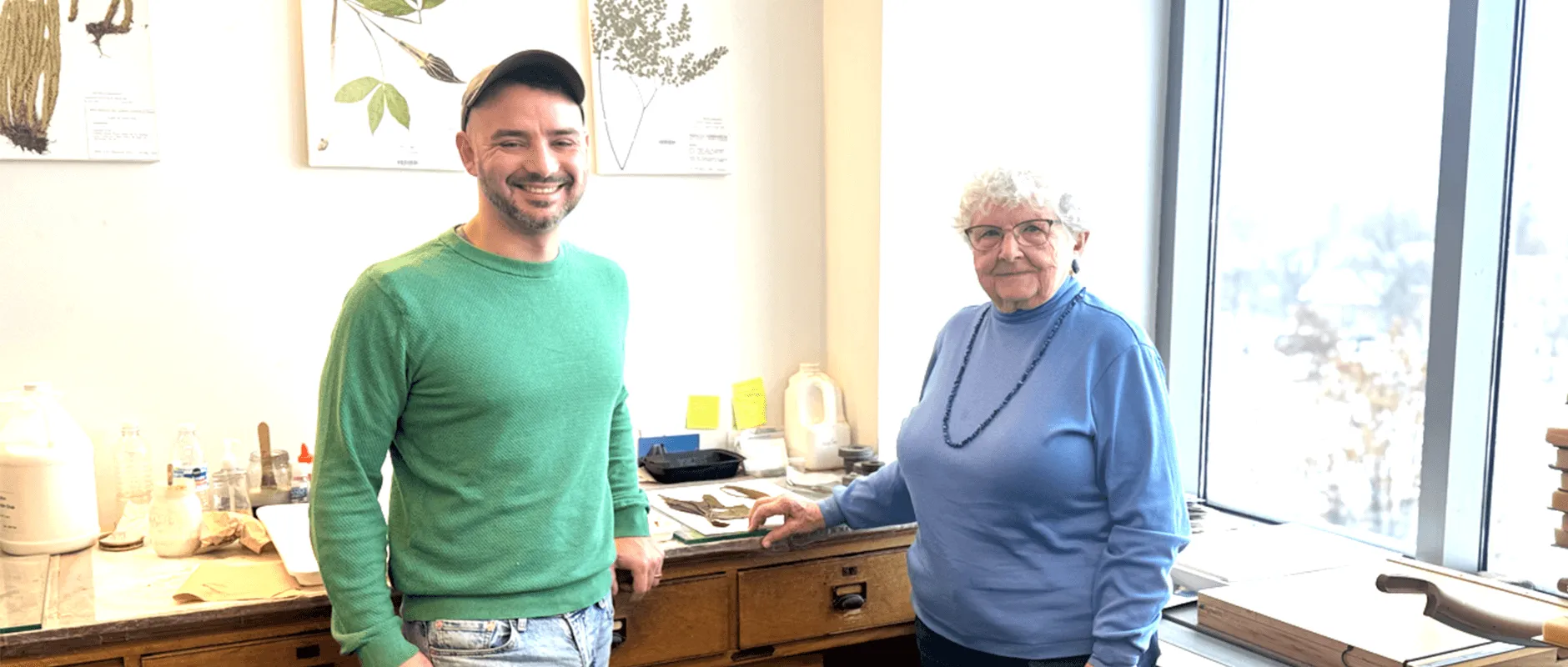
On her birthday in October, White went to the UVM Pringle Herbarium, where she has been volunteering twice a week since 1997. She was touched that Herbarium Director Weston Testo, retired Director Dave Barrington, and her fellow volunteers threw her a little party with a cake and then sang happy birthday to her.
But the big surprise was when Testo told her he had a birthday present for her. Then he showed her a specimen of a fern that he had collected during a research expedition in Colombia in 2023. Hilda had seen this large, showy plant before — she had prepared the specimen when it had arrived at the Pringle Herbarium last year. Testo explained that he and Barrington had studied the plant over the last year and had found that it was a new species of holly fern in the genus Polystichum, a large group of plants that includes the Christmas fern, a familiar member of Vermont’s flora. They were in the process of describing the new species and had decided to honor Hilda’s decades of volunteer work at the Pringle Herbarium by naming it after her.
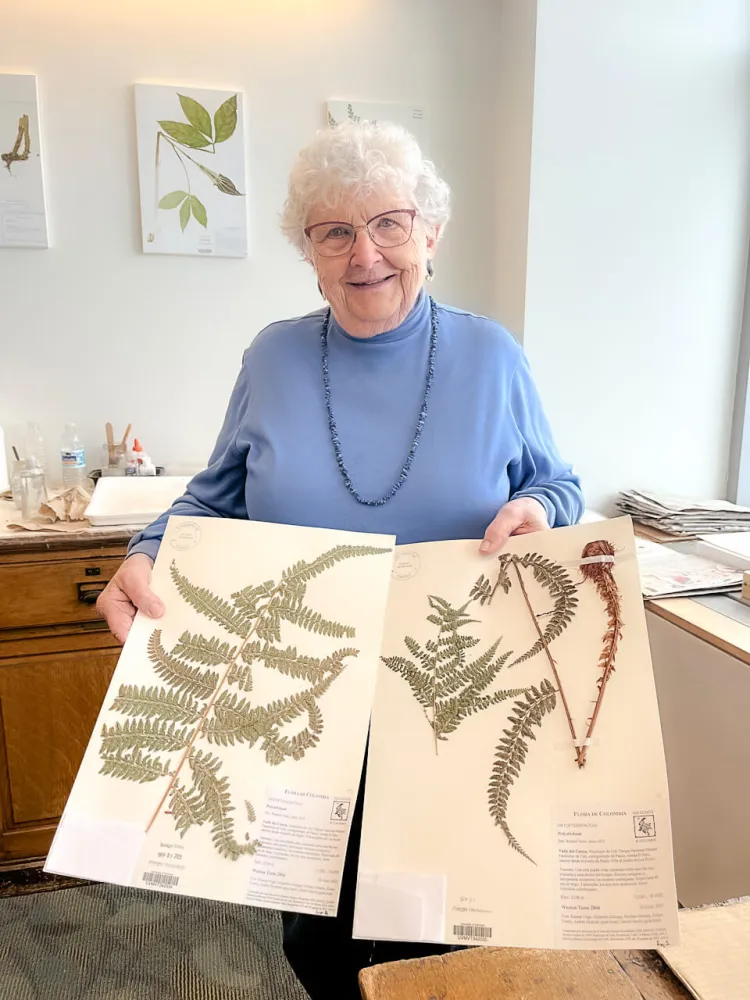
“It’s Polystichum hildae, so it's after my first name. Polystichum is the genus of the Christmas fern, and then hildae is this specific species. It was tremendously exciting. I was on a high for a whole week, I mean you can't imagine what an honor that is.”
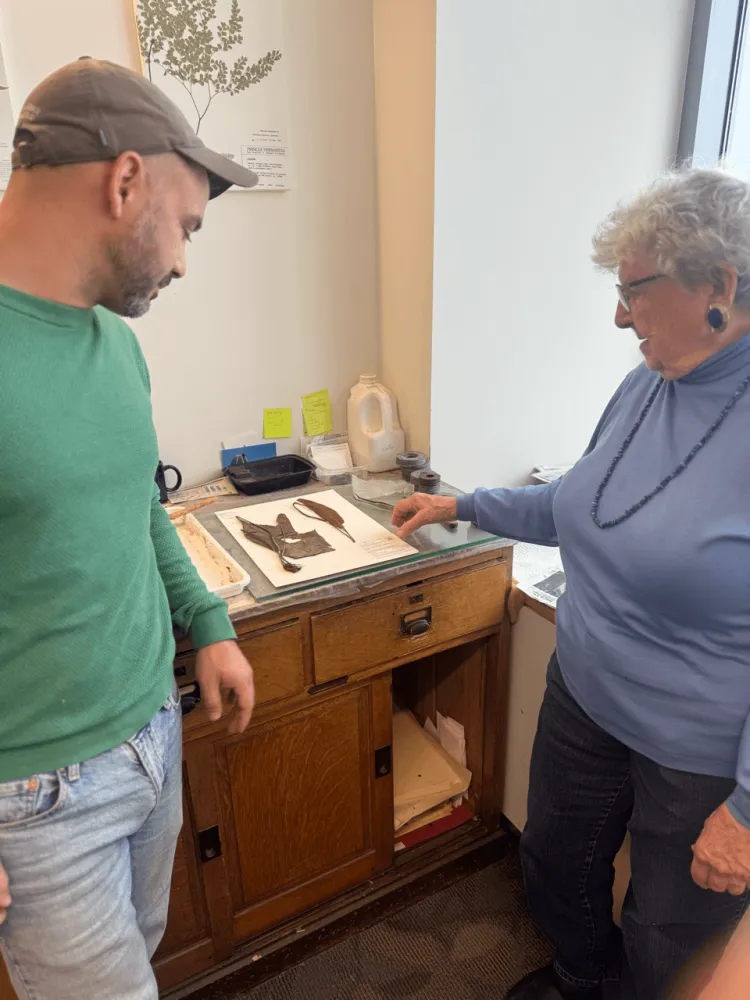
White goes on to explain that, in many cases, the Latin name refers to a plant's feature. She points to a specimen labeled Polystichum marginatum and adds that the name means there's something special about the leaves' margins. Another fern on the table in the herbarium office, Diplazium grandifolium, is so named for its large leaves.
“That's why having it named after me was so lovely. Nobody will ever be able to beat that birthday present; it was just very nice. I can't thank them enough.”
But Pringle Herbarium director, Weston Testo, says he can’t thank Hilda enough for her twenty-eight years of service to the herbarium. “She was already working here when I began as a graduate student at UVM; Hilda’s a part of the history of this collection.”
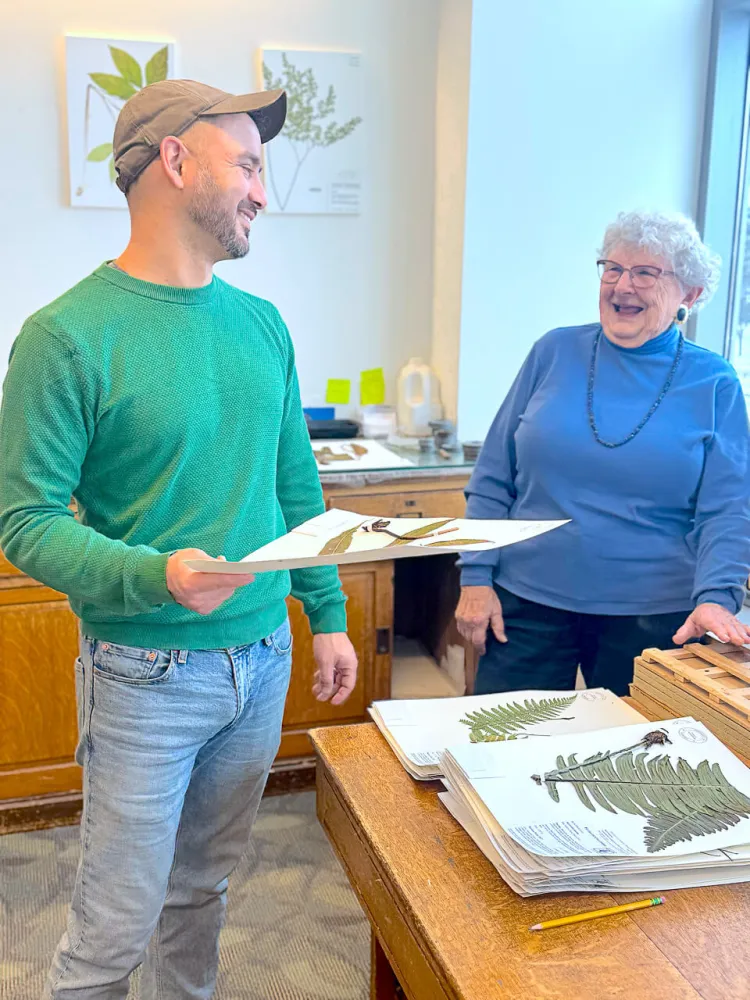
White explains how she became involved in the work. A chemist by training, she and her husband came to Vermont from Ohio in 1963 so that he could take a job as the Chair of the Department of Chemistry.
“I thought Vermont was the end of the world!”
She soon settled into her career as a chemistry lab technician and, after her retirement, took a class at UVM with Senior Lecturer Cathy Paris in Plant Systematics. Paris brought her class to the Pringle Herbarium to show them what an invaluable resource it was for botanical specimens.
“I didn’t even know what an herbarium was before then. At that time, the wall was lined with wooden cabinets, and on top of the cabinets were cardboard boxes four deep, and Cathy Paris waved her hand at those boxes and said, ‘If any of you would like to volunteer to mount those specimens…’ and I thought, I could do that.”
So, she started volunteering and realized how much she enjoyed it. “This work is appealing because you take the plant, which comes wrapped in a piece of newspaper that somebody has collected somewhere in the world, and then you have to do something with it. I find it's my only artistic outlet. I can't draw. I can't do music. But I can do this, arrange plants on the page from places all over the world. Through this work, I've met lots of interesting students, graduate students, and botanists, and I've been involved with the herbarium ever since. It's sort of a home away from home, and it’s an outlet that I really enjoy.”
Herbaria are essentially libraries that house physical plant specimens, so that researchers can compare plants from different regions or different time periods. The importance of physical examples has become even more valuable since the onset of DNA sequencing.
As Testo explains, “Our collections are useful in ways that we couldn't have imagined a century ago or 50 years ago, right? We're increasingly finding new ways to be able to leverage these collections to know more about the world around us.”
The Pringle Herbarium was started by Cyrus Pringle, an important plant collector working in the late 1800s and early 1900s. His specimens are the foundation of the UVM collection, a collection that now boasts over 350,000 mounted plant sheets, making it the second-largest herbarium in New England. It is a globally significant collection for ferns, as this has been an area of focus of the Pringle collectors for decades. There is a backlog of plant species to mount, and the Pringle collects -- and receives from other collectors -- thousands of new specimens each year. The oldest specimen that White has personally mounted was from 1836, and the oldest plant in the collection is from about 1790. Out of the 350,000 specimens, White has personally mounted around 50,000 of these sheets, and adds dozens more every week.
In 2017 the herbarium collection was almost destroyed in a catastrophic fire. Hilda describes the horror of the event, “Eunice (another long-time Pringle volunteer) and I were coming into work, and we heard sirens and I thought ‘Oh, I wonder what's going on?’ All of a sudden, we saw the flames shooting out of the top of the building! It was just awful. But the Fire Chief knew David Barrington, and he knew what was in the building, and he had the foresight to cover the cabinets with plastic so that they weren't destroyed by the water they used to put out the fire.
“What got damaged was everything that was not in the cabinets. In the basement, there were lots of old specimens that had come from Middlebury and who knows where else, and they put the ones that were salvageable into a freezer to be freeze-dried. The specimens came back after a year or so. And on some of them, you can see where there was water damage, but not so bad that they were ruined. The people in the town, the UVM students, and other herbaria were wonderful; everybody reached out to help, and the university provided temporary space for the herbarium. UVM converted a former student lounge in Jeffords Hall into the current Pringle Herbarium, but they had to place dozens of cabinets in the hallways and in the basement because there was not even close to enough space for the full collection,” explains White.
This spring, after nearly a decade, the collection will move into a new permanent location, which -- thanks to a mobile cabinet system -- will accommodate the entire collection in one space and provide space for the collection to grow for decades to come. The room will also have a spot for the herbarium library, much of which has been in storage since the fire.
White’s commitment to the Herbarium expanded in another way this year, as she decided to create an endowment that would help to ensure someone could be hired to do the work that she does once she is no longer able to contribute. However, she is quick to add that she aims to reach 100 and plans to continue at the Pringle Herbarium for all the years she has left.
So, as each of us reflects on who we’ve been in 2025 and who we want to be in 2026, let Hilda White inspire us to pursue our personal interests, give more of ourselves where we are able, and help the world become a better place because we inhabit it.