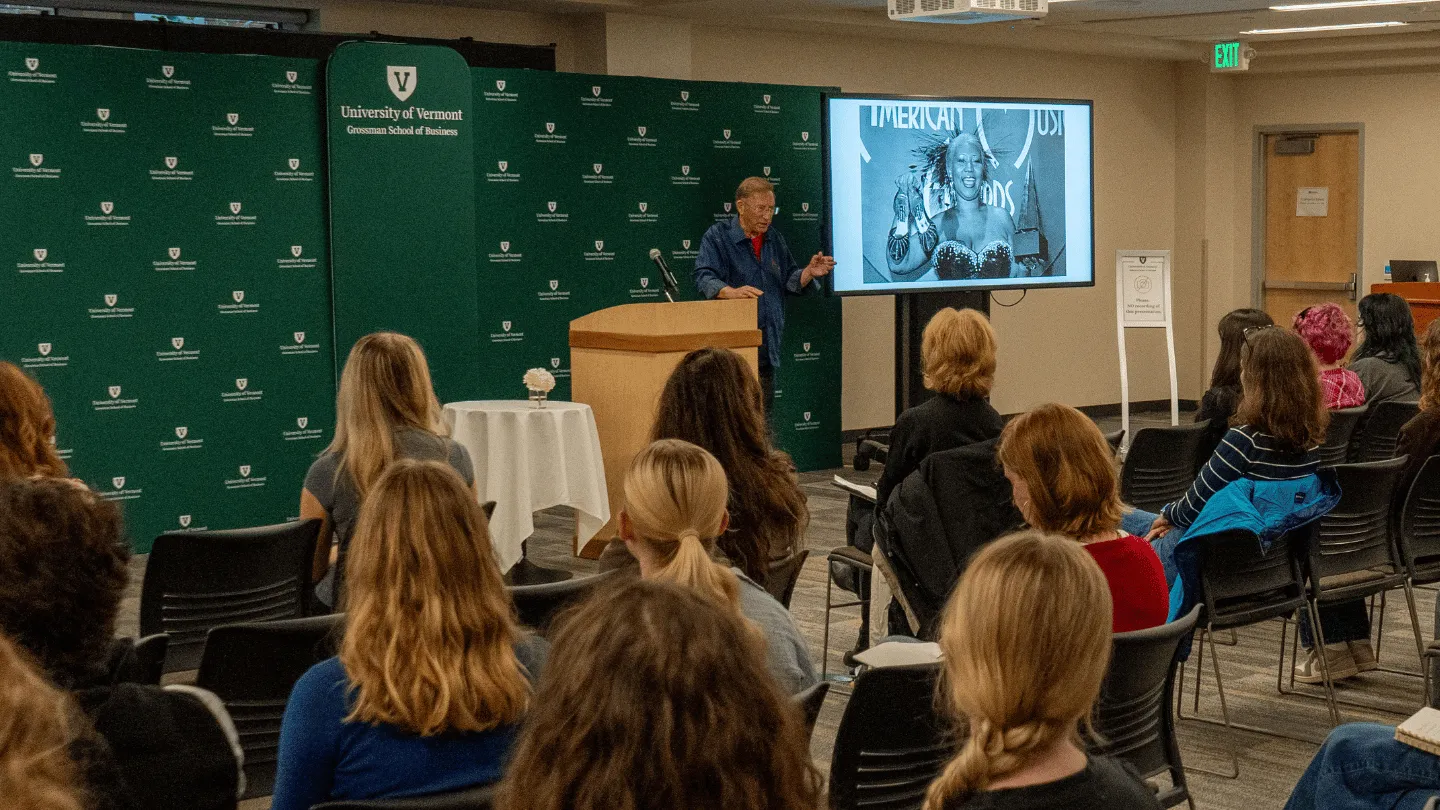
We often hear as students, “Do what you love.” This advice, usually well-intended, can feel too open-ended. Of course, you want to enjoy what you do in your future career. However, getting a response on how to do so can feel daunting and sometimes impossible. So, when walking through the familiar hallways of the Grossman School of Business and seeing a flyer broadcasting that the Stuart Weitzman was coming to speak on his journey on “the road less traveled,” my interest was piqued.
Weitzman graduated from the Wharton School at the University of Pennsylvania in 1963, the traditional Wall Street path a “no-brainer.” However, Weitzman decided to push aside his offer at Goldman Sachs to pursue something different.
“I’m, like, shoe obsessed,” he mused as he spoke about the making of his first hit campaign.
When asked if there was a defining moment in his academic journey that reinforced his choice of following a less traditional path, he shared that selling his designs to shoemakers legitimized his potential. $20 per design. “I never made that much money for an hour of my time.” Seeing how his talent and knack for shoes could lead to something bigger, he took the leap into the unknown.
That decision to step away from the expected path became the foundation for a career built around a series of lessons Weitzman now calls his “Stuisms”—guiding truisms that paved his path and contributed to his lasting success in the fashion industry. But these Stuisms served as broader guides, not just for the fashion industry but for anyone working through finding their path.
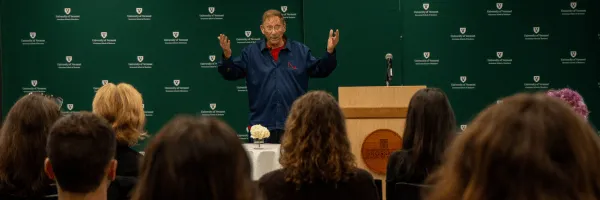
His first “Stuism,” the one that led him onto the road less traveled in the first place, was risk.
“My suggestion is absolutely work somewhere else first. Once you know a field that you really want to work in,” then you can forge your own way. Weitzman took time to learn and master his craft at a shoe company, where he worked for six years before making his own brand. During that time, he met leather suppliers, factory managers, and the best retailers in North America.
“We made a lot of mistakes. I didn't pay for one of them. They didn't cost me a nickel. But I learned from that company's mistakes, so I didn't make them again. You could be sure I made my own.”
Weitzman took many risks in his career, but they were always calculated and within his capabilities. “Always be realistic about your capabilities,” he reminded the audience as he spoke about his career.
This advice especially stood out to seniors Sophie Ball-Dolan '27 and Cecilia Barringer '27.
“Gaining experience in different environments allows us to learn from different people, better understand the industry, and build relationships with the people and partners who could become an important part of our careers in the future.” They shared.
We explored how Weitzman used adaptability and imagination to gain recognition for the work he was doing. Weitzman knew who he was up against. Major fashion houses like Gucci, Prada, and Chanel were already catching the attention of magazine viewers and consumers worldwide. Something had to be done differently if he wanted people to know about his brand.
“I didn't want to look at my competition. You look at your competition, you tend to create things that look like theirs.”
Weitzman worked alongside Allen Kay to create his shoe ad, which, funnily enough, did not feature any shoes but instead featured his Dalmatian with shoe-shaped spots. “I think too often people get stuck focusing on what they want to create that they block [out] anything unrelated, when the best inspiration can come from the opposite direction,” said Karas, a UVM junior, reflecting on their reaction to Weitzman’s Dalmatian campaign.
This campaign went on to catch the attention of so many fashion consumers worldwide that it ended up winning Weitzman a Clio Award, the first time a shoe company had ever won something of that eminence.
“What inspired him is really what shocked me. Often with designers, you hear about a big story that inspired an item…but his process was simply noticing what wasn’t there,” adds Lorelei Whalen '28.

Despite his own prestigious business background, Weitzman's approach to building his team was not centered solely on credentials. Instead, he leveraged that knowledge to take a chance on people who may have been overlooked for not having traditional training or backgrounds. Weitzman mentioned how he looked for creative people. Not those who could flash a degree that promised excellence in a field, but those who were filled with ideas, inspiration, and ambition to be part of a team. “The people who worked with me stayed forever. They became family,” he shared. There was a touching realization in Weitzman's description of his team: the importance of building relationships based on trust can make an immense difference in a career. In an industry often associated with competition and fast-paced success, his description of a team that “became family” offered a different definition of what it means to build something lasting.
“And this—it’s a different thing than going to try to figure out stocks and, and the hedge fund and merger and acquisition. That's difficult. This is emotional. And [there was] no way to give it up once you taste it.” He said this with certainty.
“Doing what you love” can feel difficult until you realize it's not necessarily about finding one perfect answer. It can be analyzing your capabilities, putting your ideas into the world and seeing how they're received, or simply paying attention to what inspires you in your everyday life. Weitzman's story suggests that finding what you love isn't necessarily about having the answer immediately. It's about being willing to explore, take calculated risks, recognize your strengths, and remain open to unconventional opportunities.