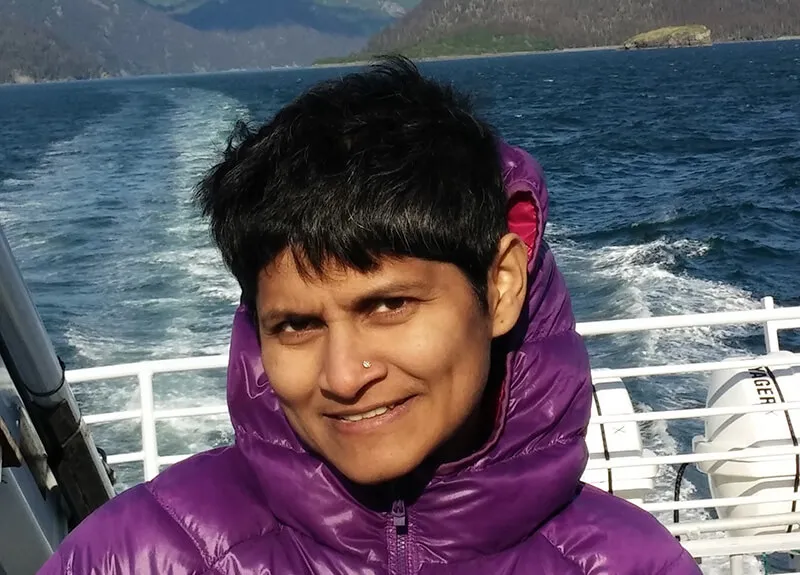
Dr. Bindu Panikkar joins the UVM Rubenstein School and Environmental Program, starting fall 2015, as an Assistant Professor with a focus on environmental health and well-being. She is receiving a UVM George Washington Henderson Fellowship, created in honor of the 1877 University of Vermont graduate and first African American student elected to the Phi Beta Kappa honor society.
The George Washington Henderson Fellowship supports promising early-career scholars at the University of Vermont and provides fellows with assistance for the development of their career. This fellowship helps to advance the university's research and teaching goals, while enhancing faculty diversity. Dr. Panikkar’s fellowship is supported by a collaboration among the Provost and Senior Vice President, David Rosowsky; the Vice President for Human Resources, Diversity and Multicultural Affairs, Wanda Heading-Grant; and the Dean of the Rubenstein School, Nancy Mathews.
Dr. Pannikar’s appointment as a tenure-track Assistant Professor marks a first for the history of the Henderson Fellowship Program. This expansion of the program has additionally contributed to the unique opportunity for a cluster hire within the Rubenstein School.
“We are delighted to welcome Dr. Panikkar to the School and to the Environmental Program,” acknowledges Dean Nancy Mathews. “She brings a unique combination of expertise and experience not only in environmental health and well-being, but also on environmental policy. Her scholarship focuses on issues related to environmental justice and will catalyze the Environmental Program's emerging research focus on global environmental equity. We are excited to integrate her Arctic research involving citizen science and community-based monitoring into the School.”
Originally from Kerala, India, Dr. Panikkar is currently a Research Associate with the Arctic Institute of North America at the University of Calgary in Alberta. Her collaborative, interdisciplinary, and community-based research combines the fields of environmental health, environmental policy, natural resource management, environmental justice, and sustainable development.
She received her Ph.D. and M.S. in Environmental Health and her M.A. in Urban and Environmental Policy and Planning from Tufts University, and her B.A. from the University of Kerala. She has held postdoctoral research positions at Northeastern University and Brown University and adjunct faculty positions at Brown University and University of Calgary.
The Henderson Fellowship was awarded to Dr. Panikkar this year to support an outstanding scholar of color who explores issues of diversity and equity. Dr. Panikkar has taught courses in: Sustainability and Human Ecology in the Circumpolar Arctic; Gender, Science and Society; Race Science and Society: Genomics and Beyond; and the Changing Arctic Environment: Science and Society.
Dr. Panikkar’s research, funded by the National Science Foundation, examines the key scientific, policy, legal and ethical debates raised by the large mine permitting process in Alaska. She is particularly focused on the environmental and health debates raised, disputed, and settled during the large mine permitting process.
“There are numerous resources that I want to explore at UVM within the intersection of natural resources, law, and policy,” she states. “The Rubenstein School is a great place for that, and it is one of the long-standing programs in the country that focuses on natural resources conservation, policy, and management.”
Dr. Panikkar will continue the research she started with the Arctic Institute on a citizen science/community-based research project in Yukon and Nunavut to monitor species diversity, wildlife health, and environmental change. She is also working to better understand the Inuit ways of dealing with sea ice changes and their use of scientific weather information in the Northwest Passage.
“The Arctic is an important region to focus on. It is a region that is rapidly changing,” explains Dr. Panikkar. “It is seen as the next frontier for development, and most countries are increasing their explorations in the remote regions throughout the North. The rapid industrialization of the Arctic comes with increased concerns of aggravating climate change, environmental degradation and pollution of pristine areas, and consequences to the health of the people and the wildlife.”
Dr. Panikkar looks forward to teaching in the Environmental Program, moving her research base to Vermont, getting more involved in the local community, and exploring the beautiful slopes of Vermont.