Each summer New England forests see an increase in recreational activity from hikers, bikers, and more. They also see a spike in research activity. The Forest Ecosystem Monitoring Cooperative (FEMC) collects and shares forest health information to help land managers and researchers understand how forests are changing.
FEMC is operated by the Rubenstein School of Environment and Natural Resources at University of Vermont in partnership with the USDA Forest Service and Northeastern State Agencies. They operate 196 forest plots across Connecticut, Rhode Island, Massachusetts, New York, Vermont, New Hampshire, and Maine.
FEMC summer field crews visit each plot annually to collect data on the same stand of trees, which generates long-range data for each location. This process has been ongoing in Vermont for over 30 years and across the entire region for four years.
“This is a really important data set that FEMC contributes,” said Alison Adams, Director of FEMC. “There are other long-term forest monitoring programs, but they don't go back to every plot every year. We're providing annual data at fixed plots across our entire service region.”
The annual monitoring data and specific plot locations are available to all, which allows land managers, students, and researchers to directly connect FEMC findings with other studies and regional projects.
Building the Field Crew
Ben Porter, FEMC Monitoring Coordinator, oversees many aspects of the program’s annual monitoring operations, including hiring twelve technicians to collect the data. College students, often from UVM’s forestry program, and recent college graduates make up much of the crew. Each year a few returning technicians are hired into leadership positions, applying their experience to crew planning and communication.
“This upcoming season, our crew is handling Connecticut, Rhode Island, Vermont, New Hampshire, Massachusetts, and Maine and we are contracting New York Department of Environmental Conservation for the New York plots,” explained Porter.
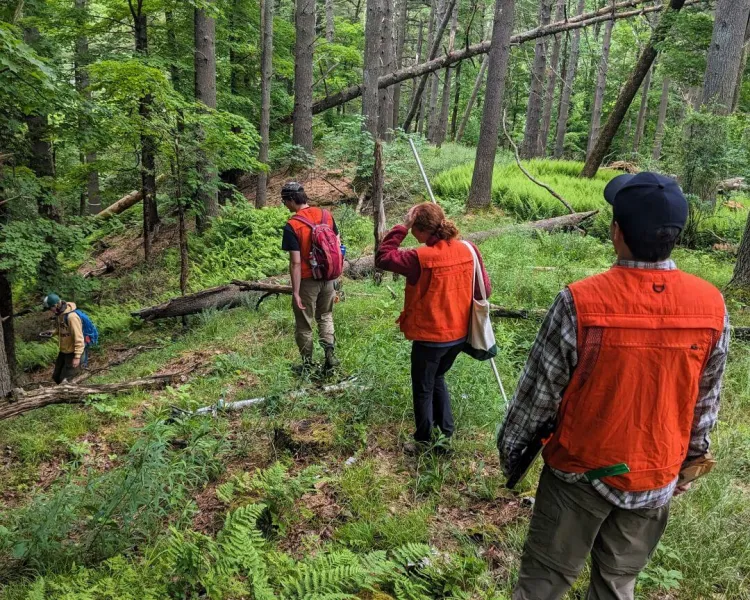
Before heading into the field in early June, technicians receive extensive training from FEMC staff and Vermont Forests, Parks, and Recreation (FPR) personnel. They are trained in the proper use of professional forestry equipment, such as diameter at breast height (DBH) tapes, hypsometers, and GPS units.
The crews are based in Burlington, Vermont, but spend most of the summer camping out for week-long stints, rotating through different regions. Each Monday during the season the crews prepare for their week in the field – gathering equipment, water, and supplies for what is often a long day of car travel.
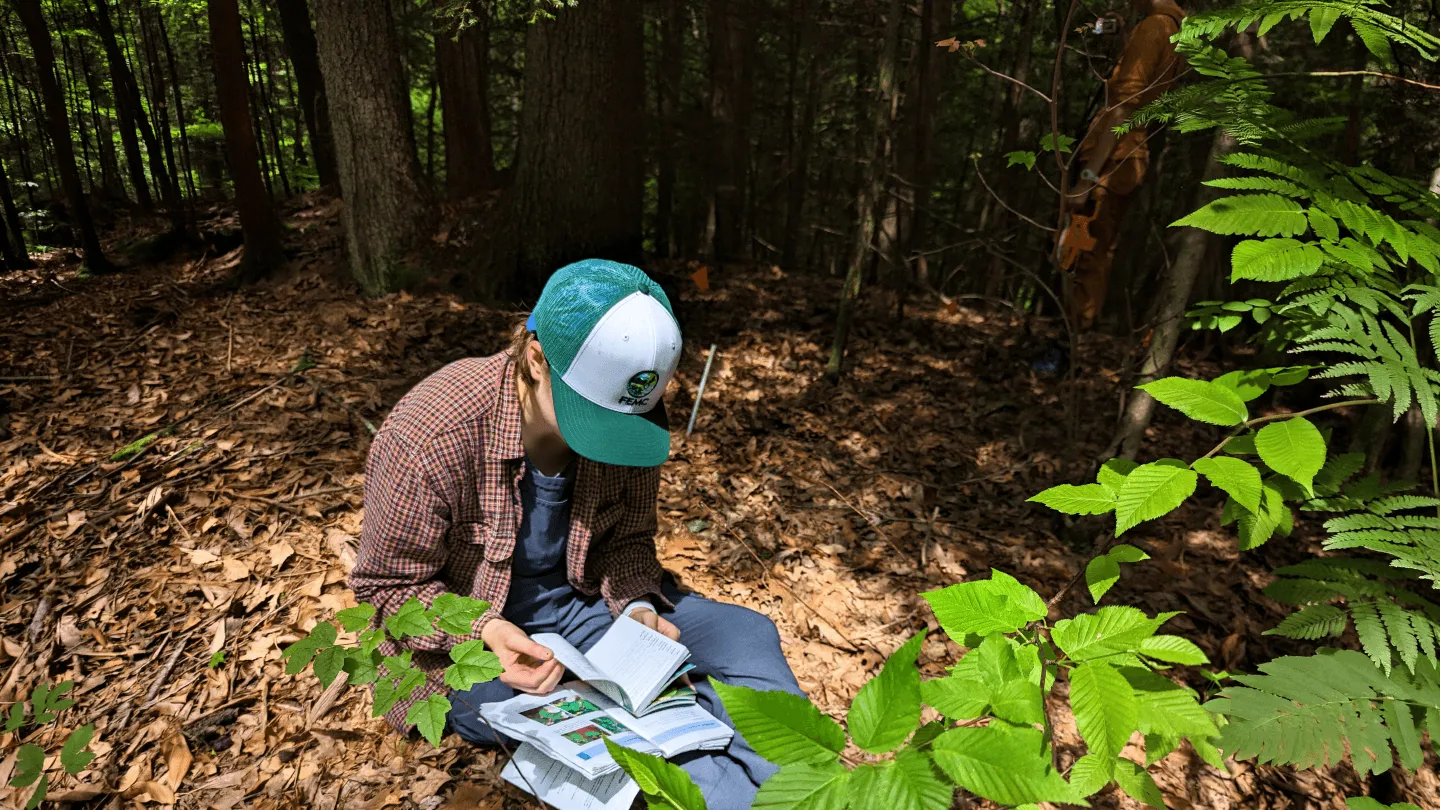
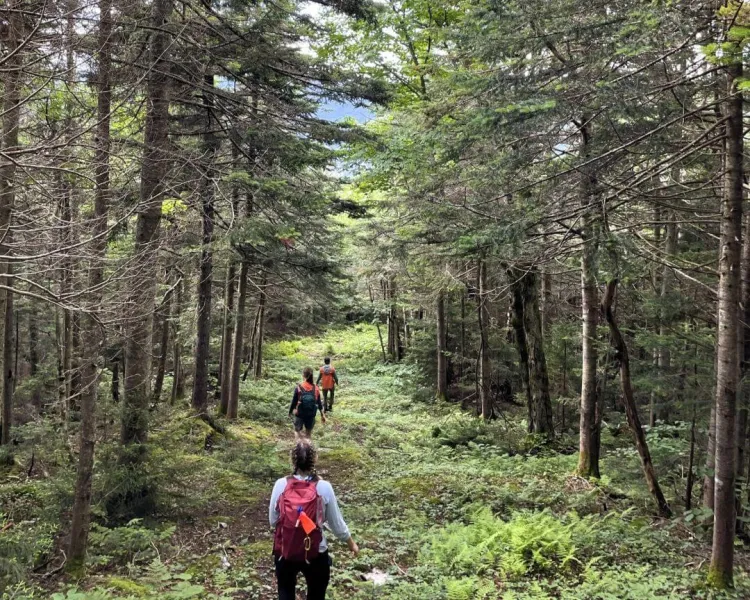
Crews locate plots, which can require multi-mile hikes and survey all marked trees in the plot. The monitoring work follows a standardized protocol, requiring them to collect comprehensive details on tree height, crown health, and species regrowth. The crew members divide tasks and report findings back to the crew lead who documents them on a tablet in the field.
Formative Summer Work
The FEMC field season can be demanding and empowering for students. “I hear that it was a formative experience a lot,” Porter said. “Gaining that responsibility, being out in the field on their own, and being trusted to make decisions, that's an area where I see growth in our technicians every year.”
Amelia Ritt ‘26, a senior forestry major from Northampton, Massachusetts, joined the crew in the summer of 2025. She described the experience as challenging and rewarding.
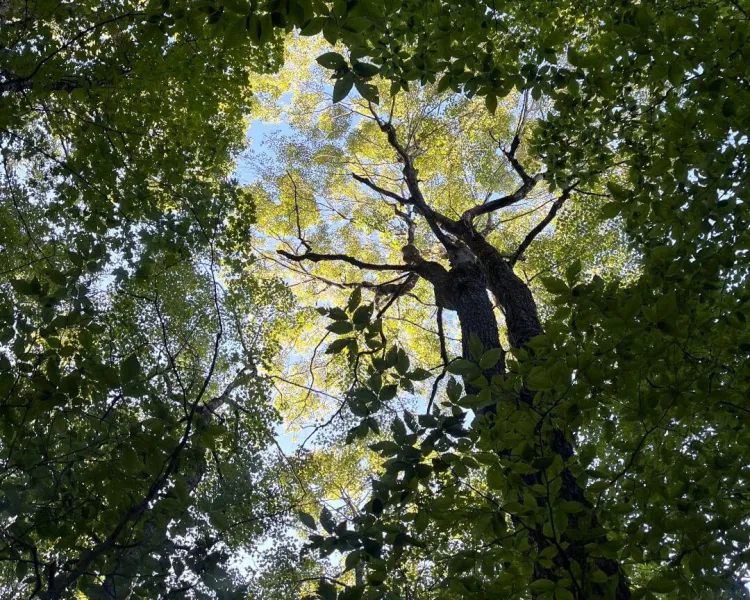
“There was a bit of a learning curve, I had measured canopy transparency in class before, but we were doing it on a specific scale,” Ritt said, “we had to determine what 25% transparency looked like versus 20%, and how that look differs on a conifer versus a deciduous tree.”
Ritt said that the long drives were one of the most challenging aspects of the job for her. “It was a lot of time in the car, but simultaneously it was a lot of time outside and I find that so fulfilling. One of my last weeks, we were in Maine, and we got to go to a swimming hole one day after field work, and it just hit me that I was getting paid to explore New England, it was so beautiful.”
Stepping into Leadership
Christian Baker ‘27, a junior forestry major with a minor in geospatial technologies, worked as a field technician between his sophomore and junior years and is returning as a Crew Lead this summer. In that role, his responsibilities will expand beyond basic technician duties to include managing data sheets and uploads from field collection, keeping track of equipment, and regularly checking-in on the crew’s time management and safety.
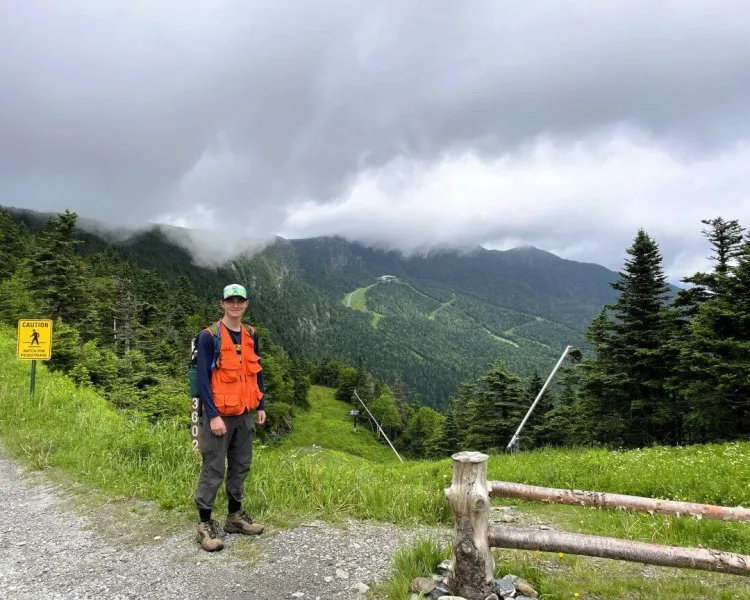
The workdays can be long, often starting at 7:00 AM and lasting ten to twelve hours. The field crews face heat, rain, bugs, ticks, and difficult terrain. “It makes you value the good weather days more,” Baker said.
For the upcoming season, Christian is excited to work with a more diverse group of technicians. Roughly half the 2026 crew will be from outside UVM. “I’m looking forward to gaining different perspectives and building new connections.”
Christian transferred into the forestry program during his sophomore year after a guest lecture by Tony D’Amato, Forestry Program Director, sparked his interest. Since then, the work with FEMC has further solidified his passion for working in the forestry field.
“I love being able to see a variety of ecosystems that I usually wouldn't have like access to,” said Baker. “I’ve been able to deepen my understanding of how forests in the Eastern U.S. work. I'm interested in overall forest health, especially disease and pest impacts and how they spread.”
Forests in Decline
After four years of regional data collection, clear and concerning trends are emerging. In the recently published Forest Health Monitoring Annual Report, FEMC outlines patterns pointing toward increased forest stress driven by climate-related factors. These include extreme wet and dry periods, pests and pathogens, and increased fire activity. The impacts are more severe for southern New England and species like beech and ash.
“We have four years of data now, which is enough for preliminary year over year trends,” Porter said. “We’re seeing pretty consistent signs of increased stress responses, including increased dieback across the board, increased transparency in the crown, and declining vigor—it looks like a pretty strong trend.”
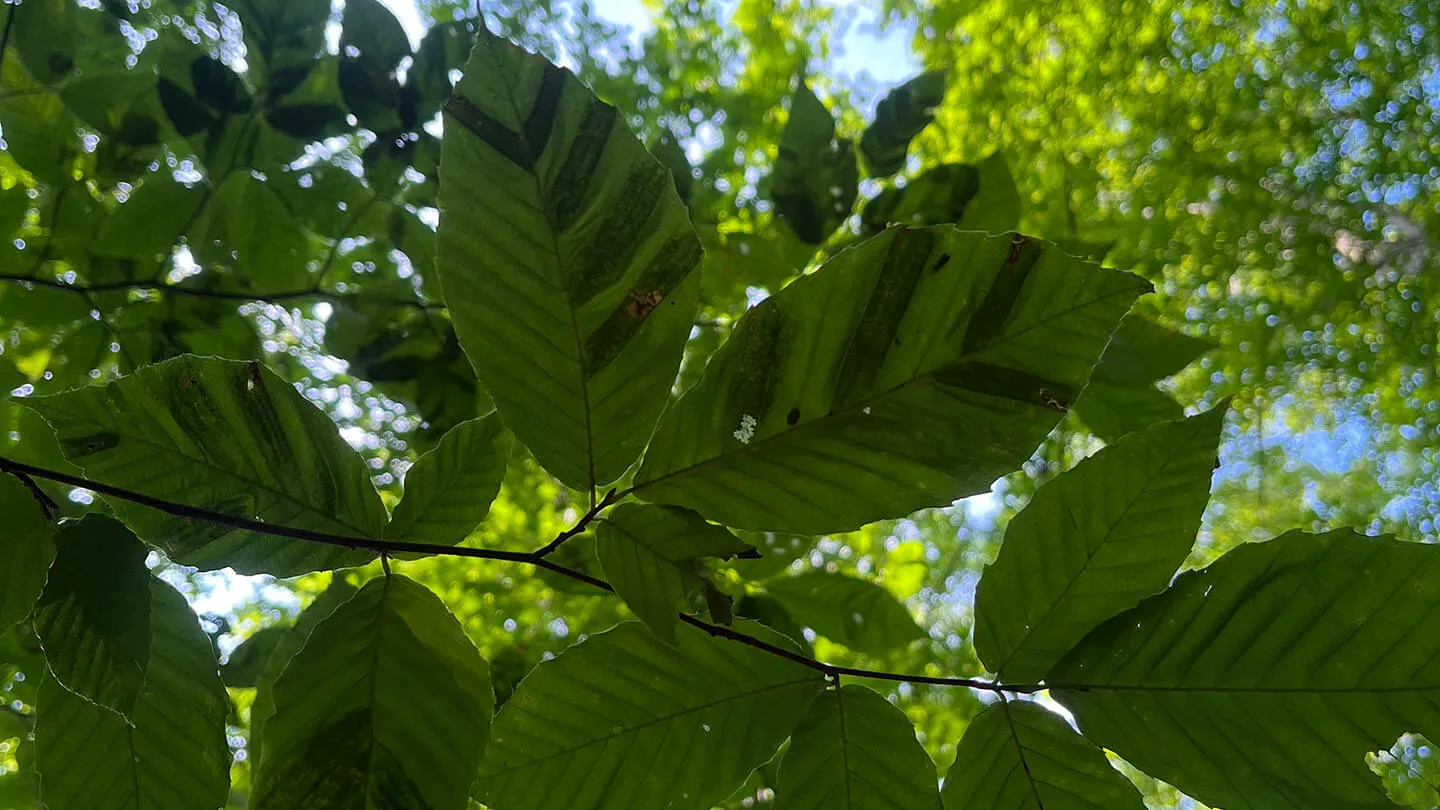
American beech, white ash, green ash, striped maple, and white oak are showing higher levels of decline. In many cases, pests and diseases such as beech leaf disease and emerald ash borer are directly responsible. These findings are consistent with research out of UVM showing that insects and disease are the new leading cause of tree mortality across the Northeastern United States.
As for regeneration, the data shows that balsam fir, American beech, red maple, sugar maple, and white pine seedlings and saplings are the most abundant. These early indicators could mean significant changes to the makeup of New England forests.
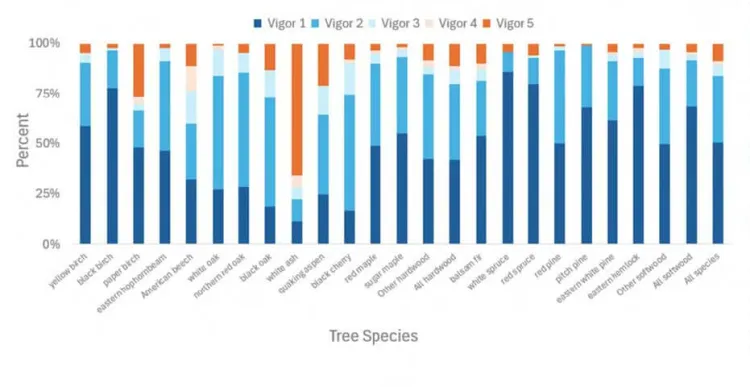
In addition to the regional analysis, the data is analyzed to provide more localized trends specific to each state.
Adams and Porter will share highlights from the 2025 Forest Health Monitoring report and answer questions during a webinar on Thursday, May 14 at 2 PM eastern. Register for the webinar.