Ethan Ducharme grew up in Marshfield, Vermont where his parents are fourth generation loggers. He and his brother spent their days in the woods, catching snakes, hunting squirrels, or fishing in nearby rivers. He developed a deep appreciation for wildlife from the many wild birds his father raised at and in their home — Canada geese, mallards, turkeys, barred owls, and a red-tailed hawk.
Ethan transferred from Texas Tech University to the Rubenstein School Wildlife and Fisheries Biology program. He benefited greatly from both the wildlife courses and his relationships with wildlife faculty Jed Murdoch and Allan Strong.
“I can't stress enough how much Jed impacted my college career; he is a truly inspirational, kind, and down-to-earth person,” acknowledges Ethan. “All of the classes I took from him were amazing and filled with incredibly applicable information for the future wildlife researcher. He was always a person I could go to anytime I was having difficulty in any class and he was always willing to help. He pointed me in the right direction when it came to finding jobs and helping with my resume.”
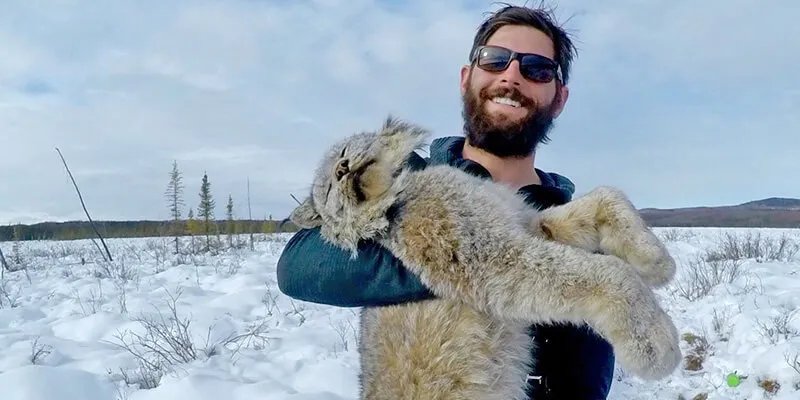
Ethan graduated in December and took a job on the U.S. Fish & Wildlife Service’s Tetlin National Wildlife Refuge in Alaska where he worked out of the office in Tok. Ethan served as a trapping technician on a Lynx research project.
“We had a remote field camp on the refuge that we could fly to for a few weeks at a time while working,” he explains. “Essentially, I operated a trap line out on the refuge in order to catch cats. Since it was the first year of the 10-year project, we didn't really know if there were Lynx where we were. Our first job was to find Lynx tracks and establish a trail via snow machine so the Lynx would start walking on our trails instead of through the deep snow. We created about a 30-mile loop where we had good signs of Lynx tracks and that became the trap line. It took forever to make the trail since it was all black spruce as thick as you can possibly imagine. Once the trail was broken (2 months after my arrival), we finally started setting the humane traps. We had about 30 sets with trap monitors, so we could hear via radio when they were tripped.”
Ethan and his team successfully captured Lynx which they sedated, photographed, processed, radio-collared, and safely released. Although no longer working in Alaska, Ethan receives regular updates from his boss on the movements of the cats.
The small Rubenstein School classes helped Ethan develop good communication skills and forced him to be able to communicate clearly and effectively in front of his peers. While in Alaska, he points out, “I would come back out of the field and present in front of 15 USFWS employees. It was critical that I could explain to them what we did and how it went in a professional manner.”
Ethan is now working for the University of Hawaii in a year-long position studying and removing Axis deer from the big island of Hawaii. In the future, he plans to attend graduate school, but for now he is eager to travel and conduct field research on animals of interest and see as much as he can while he has the opportunity.