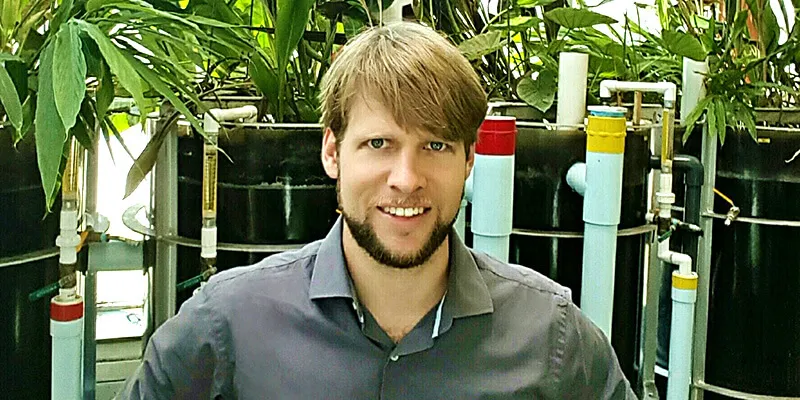
Dr. Eric Roy will join the University of Vermont Rubenstein School of Environment and Natural Resources in January 2016 as an Assistant Professor of Environmental Sciences with a focus on Ecological Design of Sustainable Systems. Dr. Roy is currently a Voss Postdoctoral Research Associate at the Institute for Environment and Society at Brown University.
He integrates techniques from engineering and ecology to study water quality, food systems, and eco-technology. Much of this work focuses on the dynamics of phosphorus and nitrogen.
“The nutrients phosphorus and nitrogen are essential for plant and animal growth, and thus underpin ecosystem function,” explains Dr. Roy. “I primarily study the transport and transformation of these nutrients in environmental systems, eco-technologies, farms, and cities. This enables me to clarify drivers of eutrophication – the most widespread water quality problem in the United States – and develop design interventions aimed at reducing pollution and increasing resource efficiency.”
"We are delighted to welcome Dr. Roy to the Rubenstein School," shares Dean Nancy Mathews. "His research and expertise in engineering, ecology, nutrient cycling, and design of ecologically sustainable systems will both excite and inspire our students, while building on the School's legacy of ecological design. The growing demand for technologies to restore aquatic ecosystems and reduce the human footprint, locally in the Lake Champlain Basin and globally, has elevated the need for the type of research conducted by Dr. Roy. He will be a tremendous asset to our School and campus."
Dr. Roy received his Ph.D. in oceanography and coastal sciences from Louisiana State University, where he focused on nutrient cycling associated with a large-scale Mississippi River flood diversion, his M.S. in food, agricultural and biological engineering from The Ohio State University, and his B.S. in mechanical engineering from Old Dominion University.
He was introduced to renowned ecological designer and Rubenstein School Professor Emeritus Dr. John Todd’s work on living machines as a Master’s student in 2006. At that point, Dr. Roy developed a passion for integrating ecological science with other disciplines to make real progress toward a more sustainable future.
“The Rubenstein School and UVM more broadly appeared on my radar, then, as a place where transdisciplinary work rooted in ecology thrived,” he recalls. “This is still the case today, and I am thrilled to have the opportunity to help uphold this legacy. From my perspective, the potential for innovative collaboration with top-notch researchers both within the School and across campus is immense. I am excited to teach ecological design and look forward to working with students that are enthusiastic about the environment and sustainability.”
At Brown University, Dr. Roy has led an interdisciplinary team examining phosphorus use and biogeochemistry in the Brazilian agro-industrial frontier. Tropical regions are expected to play a growing role in global agriculture, but some tropical soils can “fix” added phosphorus, rendering it less available to crops. Much more phosphorus must be added than is subsequently harvested in crops. Based on evidence from Brazil, the team has shown that the phosphorus cost of agricultural intensification in the tropics will likely be massive at the global scale in decades to come. This is troubling because the phosphate rock used to make inorganic phosphorus fertilizer is a finite resource without substitute.
Dr. Roy also conducted postdoctoral research at Louisiana State University where he explored key factors enabling U.S. cities to become more self-sufficient in food production. As an environmental scientist with Comite Resources, Inc. in Louisiana, he worked on wetland wastewater assimilation and coastal restoration, and as an independent consultant, he clarified potential impacts of an oil spill in coastal Louisiana. He also investigated interactions between ecosystem dynamics and phosphorus management as part of the Lake Erie Biocomplexity Project at The Ohio State University.
His vision for research in Vermont focuses primarily on ecological design to restore aquatic systems and bolster food production in local and regional contexts. He sees this as directly relevant to efforts underway in the Lake Champlain Basin, where phosphorus loading from farmlands and urban areas contributes to water quality deterioration in the Lake.
“I plan to develop technologies for nutrient recovery and recycling, work with farmers and urban planners on innovative nutrient management strategies, and collaborate routinely with others on campus to find novel paths forward in the pursuit of clean water and bountiful food systems,” he states. “I will work extensively with Research Specialist Matt Beam and utilize the Rubenstein School Eco-Machine as a model system for both teaching and research.”
He and his wife Jenny, an elementary school teacher, are excited to move to Burlington and take advantage of the outdoor opportunities that Vermont offers, including hiking, camping, trail running, and cross country skiing. They also look forward to the culture of creativity that permeates Burlington and plan to engage with the arts community.