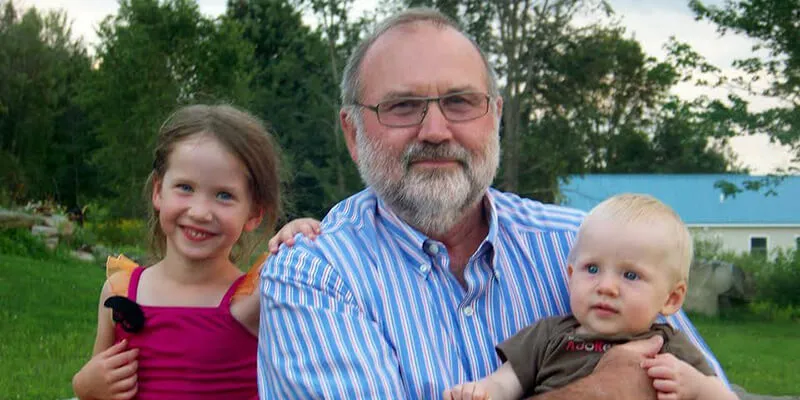
Carl Waite (FOR ’72), long-time research staff member in the Rubenstein School, is a man of few words, many talents, and a work ethic beyond compare. Carl retires this year after 42 years of dedicated service to the School, its research programs and partners, its faculty, staff, and many students.
He earned his UVM degree in forestry with a wildlife management option from the then Department of Forestry in the College of Agriculture. His long career spans the history of the School since just prior to its establishment as the School of Natural Resources in 1973.
Jack-of-all-trades, technician, senior researcher analyst – Carl’s responsibilities evolved over four decades as faculty needed research support, much of it increasingly technical and administrative. He witnessed many changes in natural resources research and in the School.
Ruffed grouse to acid rain
As a young graduate in the early 1970s, he cared for captive fisher and deer for studies on their health and food habits by former wildlife Professors Bob Fuller and Tom Hoekstra and assisted with a ruffed grouse project in Grafton, VT. Carl then switched gears to tree research, and he grew and maintained yellow birch seedlings for research by former Professor Pete Hannah. By 1978, Carl began working on forest genetics and tree improvement projects with former Professor Don DeHayes and his graduate students.
“It was a big research focus then,” explained Carl. “We collected seed range-wide – mostly birch, walnut, and fir – grew seedlings on growth frames in Hills Building’s basement, and out-planted to provenance tests. We measured and assessed growth characteristics to select seed sources adapted to growing conditions in Vermont and the Northeast.”
Carl was instrumental in the construction of the first genetics growth room and then improved upon it in the original Aiken Center completed in 1982 as the new home of the then School of Natural Resources. “We were able to grow and maintain up to 10,000 balsam fir seedlings at once under artificial lights to extend photoperiod,” he shared.
Carl worked closely with David Brynn (FOR ’76, NRP ’91) and Bill Baron (FOR ’77) of the Vermont Department of Forests, Parks and Recreation at the former Vermont State Tree Nursery in Essex where Carl and others grew thousands of seedlings which were later out-planted and maintained in research plantations in Vermont and out-of-state. Many of these seedlings were out-planted at UVM’s Wolcott Research Forest in Wolcott, VT, and Carl became the unofficial caretaker of the Forest, where he mowed and provided general maintenance for many years.
In the mid-1980s, acid rain studies took center stage in forest research. Supported by NAPAP (National Acid Precipitation Assessment Program), Carl teamed up with Don, Chip Williams (MS-FOR ’80), Gary Hawley (FOR ’78, MS-FOR ’82), and other colleagues and graduate students to study cold tolerance and genetic diversity of red spruce and balsam fir. In the Northeast, repeated winter injury to red spruce foliage, but not to balsam fir foliage, drove the researchers to investigate a potential relationship to acid precipitation.
Carl, Gary, and colleagues from the USDA Forest Service collected red spruce and balsam fir seed from the Smoky Mountains to Nova Scotia to assess genetic diversity of various geographical sources. This work, spearheaded by Don and Gary, showed that red spruce was less genetically diverse than balsam fir.
“It was an exciting time,” shared Carl. “We found only new growth of red spruce was being injured, the tree lacks the genetic diversity and cold tolerance of other montane species, acid in mountain fog reduces cold tolerance of red spruce seedlings, and nitrogen fertilization enhances cold tolerance.”
In the early 1990s, Carl investigated acid precipitation and cloud chemistry effects on leaf chemistry in forest canopies. He worked with former Research Professor Tim Scherbatskoy (MS, PhD-UVM ’80, ’89), then Research Director of the Vermont Monitoring Cooperative (VMC), a partnership of the Vermont Agency of Natural Resources, UVM, and the USDA Forest Service. The VMC serves as a clearinghouse for research collaboration and data sharing associated with the monitoring of Vermont’s forest health.
Vermont Monitoring Cooperative and mesocosm studies
Carl’s tenure with the VMC began as a meteorological site supervisor for the VMC at the UVM Proctor Maple Research Center on Mount Mansfield in Underhill Center, VT. He helped to build a 22-meter walk-up tower to access forest canopy for environmental and meteorological monitoring. Efforts by Carl, Miriam Pendleton, technician at Proctor, and others transformed the Center into a nationally recognized atmospheric monitoring site for the National Atmospheric Deposition Program (NADP/NTN, NADP/AIRMoN, NADP/MDN), USDA UV-B Monitoring Program, Atmospheric Mercury Network, and Ambient Ammonia Monitoring Network.
“When I first started doing weekend and vacation coverage at the air quality site, I was completely unfamiliar with computers,” recalled Mim. “There was a DOS machine at the tower that used to baffle me. When I called Carl for help, he would say with tremendous patience, ‘Read the screen, Mim,’ because invariably, the computer would be prompting me to do whatever was needed to move on. I don't know how many times Carl had to repeat ‘Read the screen, Mim,’ but he never made me feel inept. He has been a fantastic mentor to me.”
Since 1996, in addition to maintaining VMC meteorological stations on the east and west sides of Mount Mansfield, Carl spent time, assisted by Rubenstein School staff member Dick Furbush, former captain of the UVM research vessel Melosira, and now Captain Steve Cluett, maintaining three meteorological stations located on Lake Champlain.
Carl also continued to play a large role in the support of forest research in the School. With Professor Deane Wang, Don, Gary, Professor Jeff Hughes, and Jonathan Cumming, he handled much of the fieldwork for an intensive ecosystem study beginning in 1994 and funded by the Mellon Foundation and the McIntire-Stennis Cooperative Forestry Research Program.
“Historically, ecosystem studies, like the big Hubbard Brook Ecosystem and “Sandbox” studies in New Hampshire, used non-replicated designs with one plot per treatment,” explained Carl. “We wanted to assess interactions occurring in the early stages of ecosystem development, and we used two to three treatment replications at two different sites.”
Carl maintained sites at the then USDA Forest Service Northern Research Station on Spear Street in South Burlington and at the Wolcott Research Forest. He and others buried 49 large plastic tanks as open-topped mesocosms in which he planted tree seedlings, measured their growth, and sampled leachate, pumped from the bottoms of the tanks, for chemical analysis.
“We found even small amounts of biomass planted in over five metric tons of soil influence nutrient export in the leachate,” said Carl.
More recently, with Professor Carol Adair, Forest Service Scientist Paul Schaberg, Research Associate Gary Hawley, Deane, and graduate students, Carl resurrected the study mesocosms at the now George D. Aiken Forestry Sciences Laboratory on Spear Street to investigate the effects of climate warming on planted seedlings.
In 2008, in the absence of an executive director for VMC, Carl took over the administrative and budgetary duties for VMC activities in conjunction with former Rubenstein School Dean and Professor Larry Forcier, VMC Principal Investigator.
“Carl Waite has brought personal integrity, responsibility, and care to all of his many activities and assignments within the Rubenstein School,” stated Larry. “His organizational and field skills combined to provide remarkable opportunity for a number of faculty, staff, and student research and educational projects. He has been particularly adept at stewarding collaborative efforts, within UVM and beyond, on Vermont forest ecosystems, their sustainability and the sustainability of the Aiken Center itself. It was a true privilege for me to work with Carl and to marvel at his generous, effective, hard-working, and supportive nature.”
In 2013, upon Larry’s retirement, Carl began working with new VMC PI, Research Professor Jennifer Pontius. Together with Jen, Miriam, Judy Rosovsky, and Jim Duncan, Carl capably ensured the continued service of the VMC to the State of Vermont.
“Over more than two decades, Carl has been the ‘wind beneath the wings’ of the Vermont Monitoring Cooperative,” acknowledged Jen. “It is in large part due to his dedication, insight, and patience in pushing paperwork through multiple bureaucracies that the VMC has been able to achieve so much and remain viable over these many years. He will truly be missed.”
As the VMC Program Coordinator, Carl collaborated with Vermont Agency of Natural Resources personnel, Forest Service scientists, academic researchers, and environmental non-profits to provide Vermont with research findings, forest health monitoring, and dissemination of information and data to help in the sustainable management of the state’s forest ecosystems. Each year, Carl and his colleagues planned and hosted the annual VMC conference, a well-attended event that brings together natural resource professionals from far and wide to work collectively on forest health issues in the state and beyond. Under Carl’s tenure, Jim created a VMC website that offers searchable databases and shareable datasets covering a quarter century of research and monitoring of Vermont’s forests.
Greening of Aiken and Aiken Forestry Sciences Lab
Over more than a decade, Carl joined forces with former Professor Alan McIntosh, Don, Gary, and Deane as founding members of the Rubenstein School’s Greening of Aiken initiative and helped bring to fruition the School community’s long-time dream of a green renovated Aiken Center in 2012. Carl continued to work with the team to mentor dozens of Greening of Aiken student interns and their projects on energy efficiency and green design in an annual course now taught by Gary.
“Carl and I started working together in the late 70s,” shared Gary. “I have been amazed throughout this nearly 40-year period how he has always been dedicated and essential to many aspects of our research and particularly to the Greening of Aiken process.”
With the renovation and reconfiguration of the Aiken Center, Forest Service Northern Research Station scientists from the Laboratory on Spear Street moved their offices to Aiken, and Rubenstein School laboratories, some research staff, and VMC personnel, including Carl, relocated to the Spear Street facility. There, Carl became the facilities manager.
As a member of the School lands committee for many years, Carl helped guide management of the School’s forest properties throughout the state. And, for 14 years, he processed School course evaluations to help steer School curriculum review and revision.
For 42 years, from 6:30 am until 4:00 pm and beyond, Carl worked, often by himself, performing fieldwork at research sites around the state; growing and maintaining tree seedlings in the growth room, greenhouse, and field plots; analyzing research and monitoring data; and writing reports. He devoted his life to giving the School and its research programs, its students and faculty valuable, top-notch research, technical, and administrative support.
Deane sums up Carl’s tireless dedication to the School, "It's a Saturday, and no one else is around. Carl is finishing up something that needed to happen. It's raining, damp, and cold; the tanks need pumping, and no one else is around. Carl is out there getting the job done. There's lots to do every day, and deadlines are coming up. Carl has maxed out on untaken vacation days, still not taking a day off. Carl's work has been reliable, consistent, and critical to the functioning of the School and its research for a lot of years!"
“I would have to say I most enjoyed the field research and my time spent outdoors,” shared Carl, “but I also valued the mix of responsibilities I accumulated over the years and the relationships I developed with long-time colleagues.”
Carl and his wife Sarah, who works at a local elementary school, will continue to live in Essex Junction, VT. Carl looks forward to spending more time with his son Nathaniel, daughter-in-law, and especially his two granddaughters who live in Westford, VT and visiting his daughter Ashlee and son-in-law in western New York state.