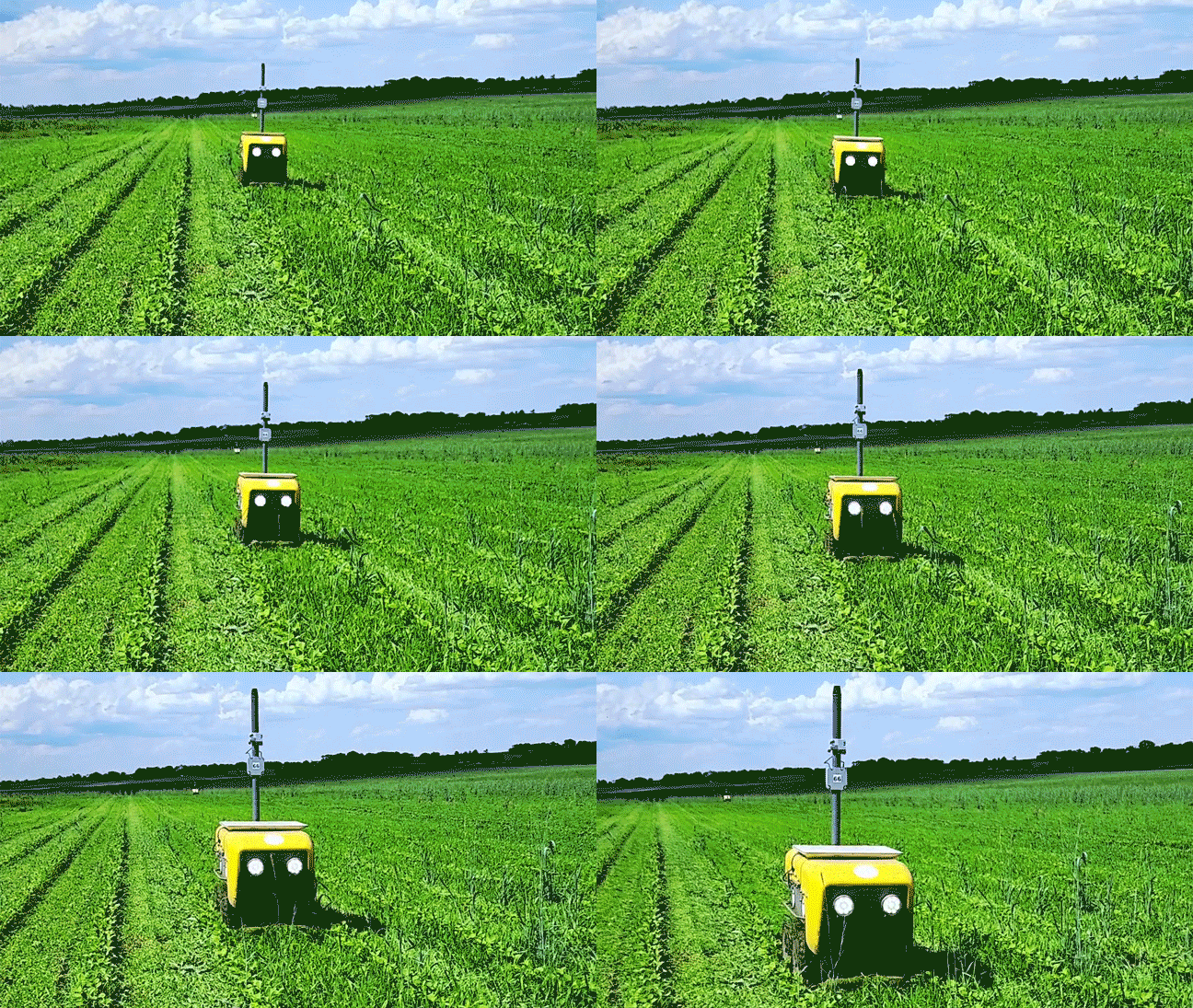
As they zip through rows of crops, completely on their own, it's hard not to compare Greenfield Robotics' BOTONY robots to the friendlier droids in Star Wars. While reminiscent of sci-fi, this is real-life technology, and it's about to arrive in Vermont for the first time.
That's thanks to $137,000 in support from the Vermont Agency of Agriculture, Food and Markets, Stonyfield Organic as well as various donations. With those funds, University of Vermont Extension has purchased six BOTONY robotic weeders to test out for the 2026 growing season.
They offer a possible new tool for organic farmers, who can't use chemicals, and in no-till agriculture, which can require additional herbicide applications to control weeds' impact on crop performance.
"The goal is to evaluate the efficacy and suitability of robotic weeders in Vermont agriculture to reduce costly inputs and enhance farm viability," said Heather Darby, Agronomic and Soils Specialist with the University of Vermont Extension's Northwest Crops and Soils Program (NWCS). "Robotics integrate drones, GPS and unmanned operations — novel methods for Vermont field crops."
The robots will soon ship to Borderview Research Farm in Alburgh. Then the NWCS team will get them set up on six farms, a mix of organic and conventional, in northern Vermont. The team will compare the weeding robots' costs and outcomes with the farms' current row crop weed management.
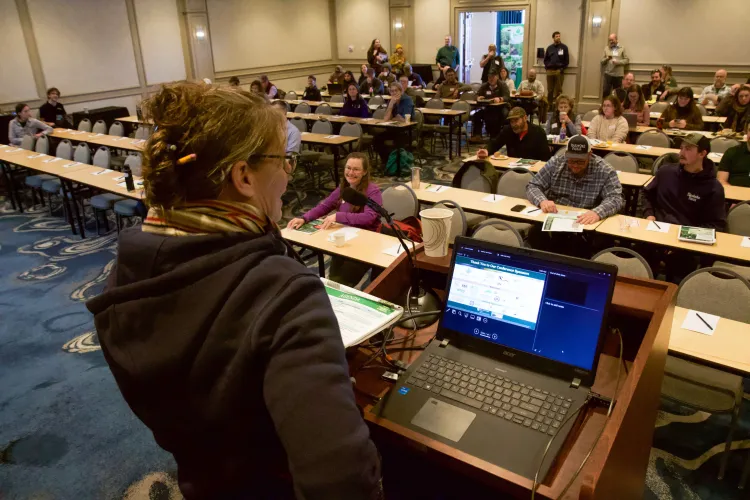
NWCS wants to experiment with the robots in different scenarios, which Agronomy Specialist Jeff Sanders listed out at this winter's 2026 No-Till and Cover Crop Conference: conventional till, no-till, corn planted into a harvested cover crop, organic corn, organic soybeans, conventional soybeans, stony ground, uneven ground.
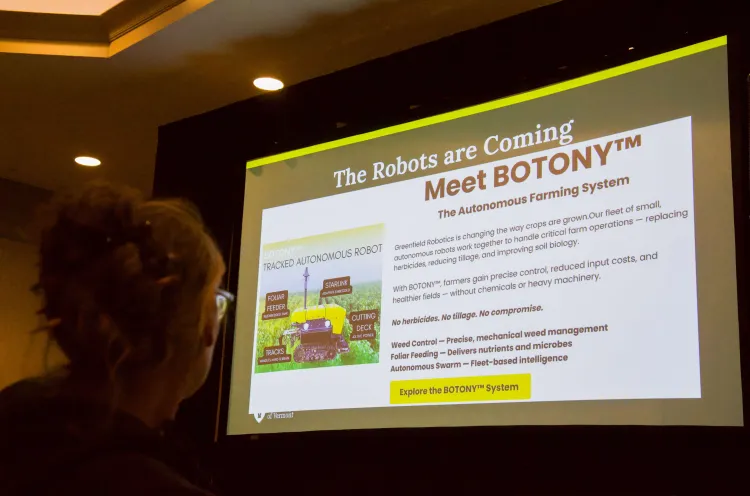
"So we're going to try it on all of it," Sanders told conference participants, "and we're going to report back to you next year at this conference on how wonderful it went and how we didn't have any problems."
The audience chuckled, because the BOTONY robots are not only brand new to the Vermont landscape — they're relatively new altogether.
The Kansas-based company Greenfield Robotics is less than a decade old. And at another recent, virtual NWCS event, sitting in front of artwork depicting a man chiseling the yellow BOTONY robot out of stone, the company's Head of Business Development, Jared Brown, said the technology is still getting plenty of updates. Like developing the ability for farmers to use voice commands for the robots, via their phones.
"We're probably 85% there," Brown said. "All of your basic functions: 'stop,' 'go,' 'return to the end row' or 'return to home.' Also commands like 'show me where you are in the field,' and it'll text you back a photo, or it'll text you back a link to pull the camera up so you can watch it."
He said Greenfield Robotics is also improving the BOTONY robots' weeding accuracy in order to not damage crops. Whenever crop damage exceeds 2.5%, Brown said the company writes a check to the farmer.
"Three seasons ago, we wrote a fair amount of checks for crop damage," he said. "Two seasons ago, we wrote two checks. Last year, we wrote one. And this past season, we didn't write any."
Greenfield Robotics has also swapped out wheels for rubber tracks to better accommodate wet conditions, and it's currently testing out object detection after operating in a Florida field where a 14-foot alligator liked to hang out. The robots follow pre-mapped routes using GPS, and in the past, they've hit anything that wasn't on the map.
"Hopefully by the time we operate for this year... it'll stop if something's in front of it," Brown said.
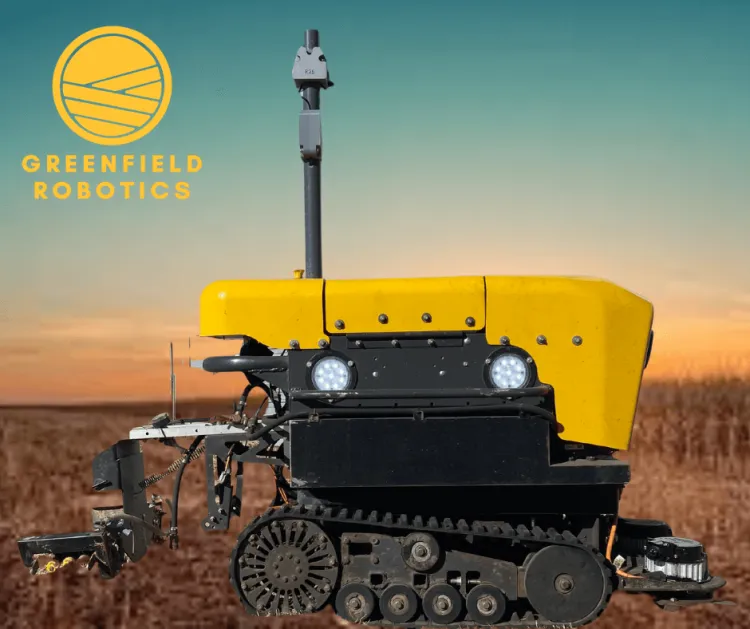
What all these smaller adjustments are aiming toward is Greenfield Robotics' larger goal: an end-to-end, fully autonomous farming system that eliminates herbicides, reduces tillage and leads to healthy food and profitable farmers.
This year, the company is expanding its reach from primarily the Midwest region to 17 states, including New York, Pennsylvania — and Vermont.
Jeff Sanders, the Agronomy Specialist with NWCS, noted at the No-Till and Cover Crop Conference that the Northeast will be a completely different setting for BOTONY robots. (Think rocks... and hills.)
"We have no idea how this thing's going to perform," Sanders said.
It's a wait-and-see situation for Richmond dairy farmer Nicholas DeGraaf. He was among the 172 attendees at the 2026 No-Till and Cover Crop Conference, and he said he took away helpful tips about corn hybrid selection and vertical vs. horizontal tillage. But with the weeding robots, DeGraaf will need a demonstration of efficiency and accuracy to be interested.
"I think it lacks the ability to truly fulfill the market, at the full commercial scale," he said. But, he added: "I think it's a cool idea."
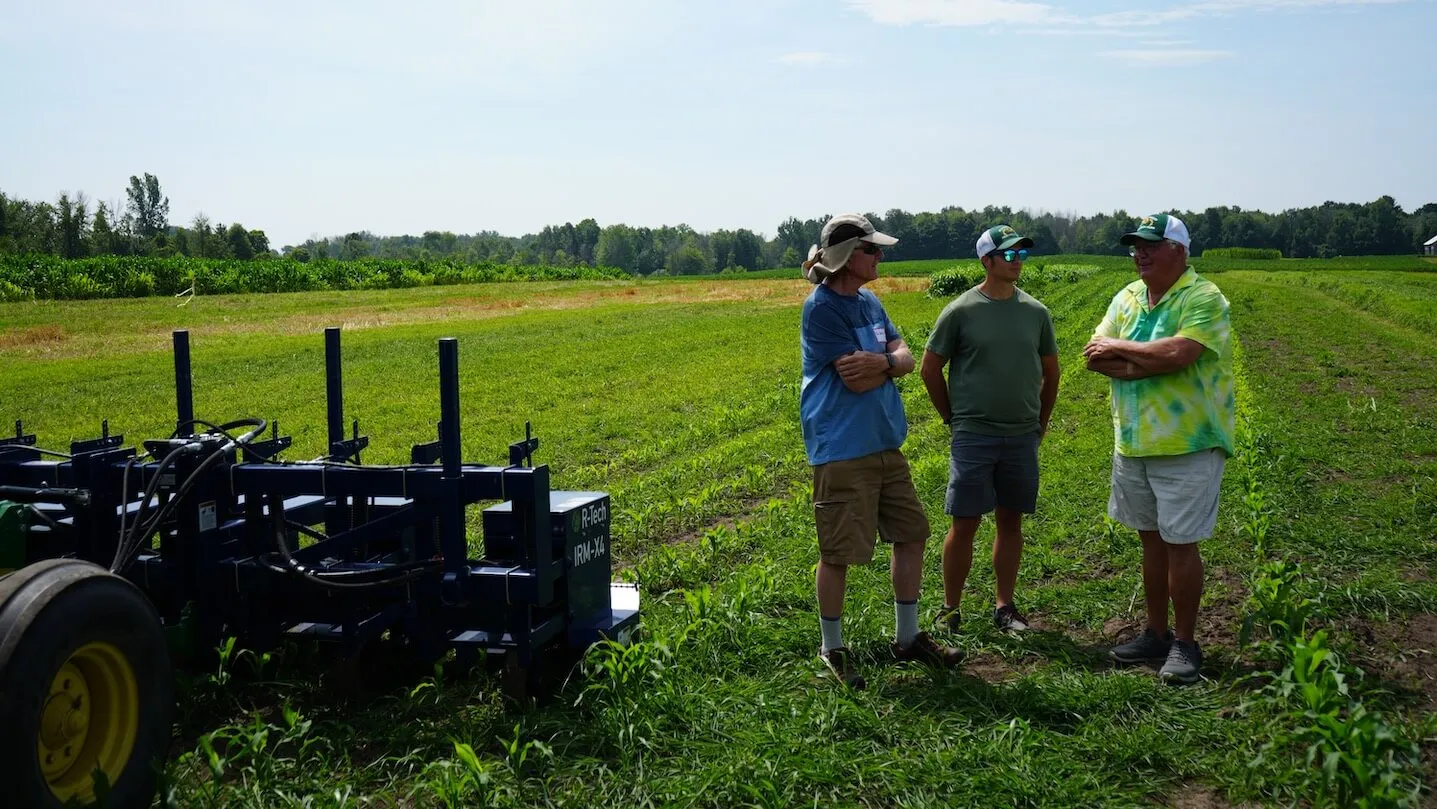
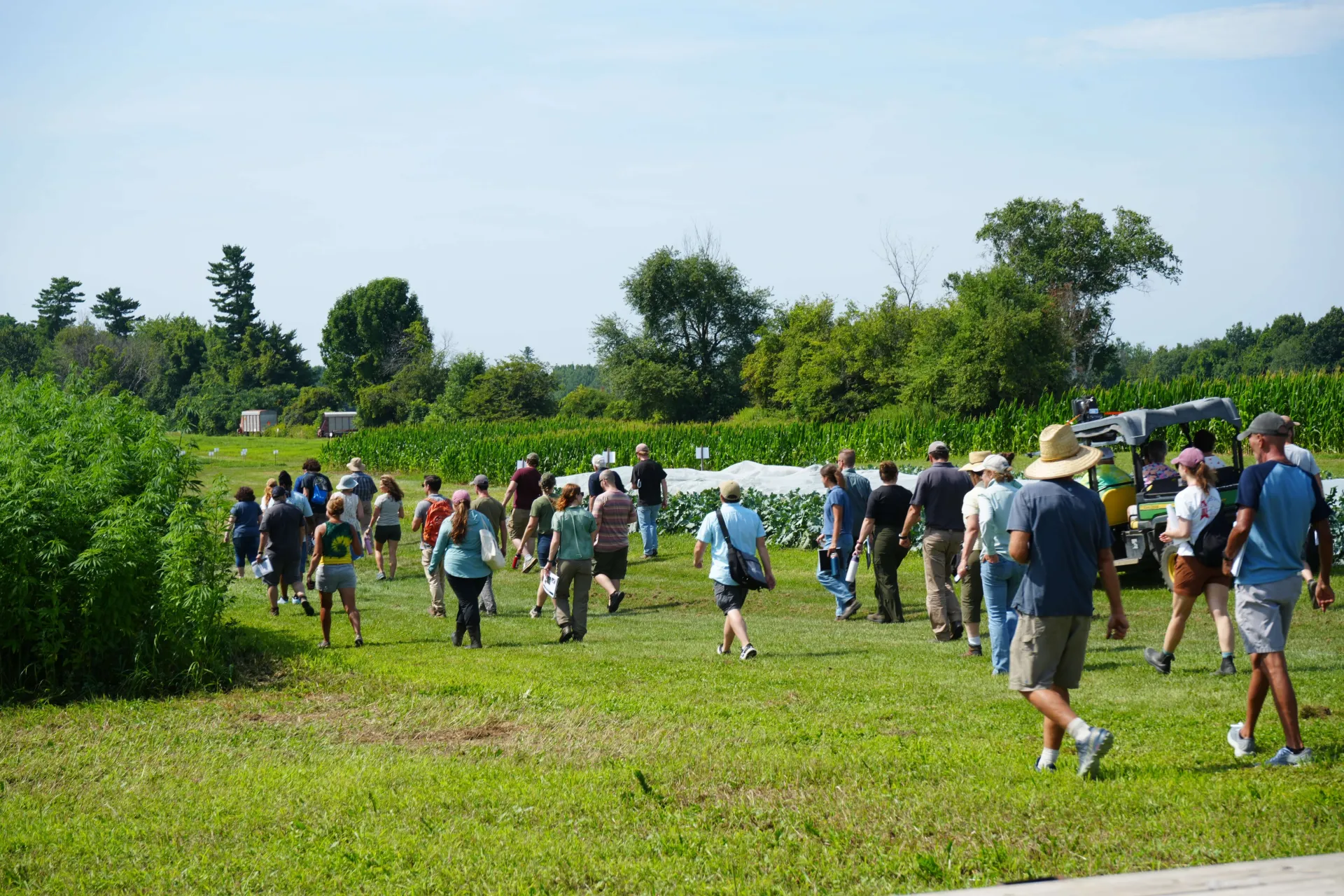
More farmers will check out the BOTONY robots for themselves this coming summer. That's according to Roger Rainville, who owns Borderview Research Farm where the robotic weeders are about to arrive, and where they'll be on display during the annual NWCS Field Day event on July 23, 2026.
"I've spoken to a number of farmers who normally don't come to our Field Day, but they're definitely coming this year," Rainville said.
For Heather Darby, the Agronomic and Soils Specialist with NWCS and also a Gund Institute for Environment fellow, the BOTONY robotic weeders offer promising innovation as farmers navigate extreme weather events, crop losses from pests and environmental regulations.
"Often technologies are too expensive for small farms, and finding Greenfield [Robotics] was a great fit," Darby said. "They are small but mighty just like us. I am so excited to be able to demonstrate and experiment with this technology in Vermont."