And there are plenty of nonprofit organizations, government agencies and community groups in Vermont working on increasing access to these necessities. But how much are they talking with each other? If they could collaborate more, would everyone be better served?
This is where the Vermont Assessment of Assets, Angles and Need, or VAAAN, wants to help. The project is led by University of Vermont Extension, with funding from the Leahy Institute for Rural Partnerships. And over the course of two years, Extension plans to create a comprehensive, up-to-date, and interactive tool showing what our communities must have to thrive (needs), who’s working to make that happen and how (assets and angles), and where people can help fill in the gaps.
The theory
The theoretical framework for VAAAN starts with a simple question, according Ike Leslie, who is a Co-Principal Investigator (Co-PI) on the project and Extension Assistant Professor of Community Development.
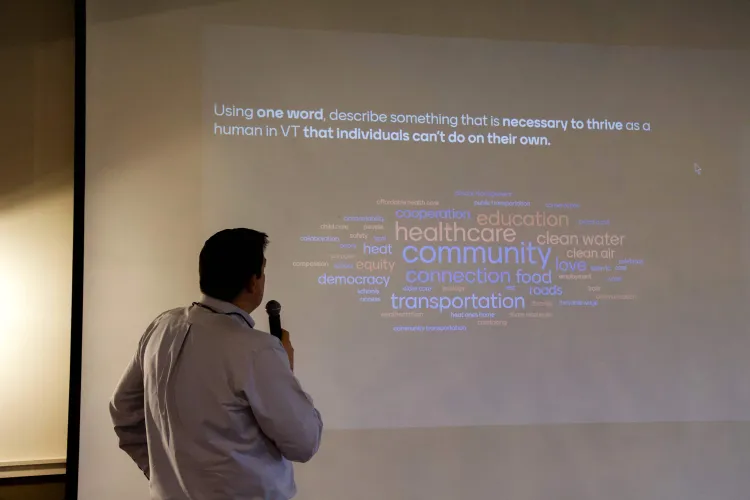
"What are things that Vermonters need to thrive that they can't accomplish as an individual?" Leslie said. "For example, education, health care, a clean environment, public safety, and the list goes on... these are core areas of social life that no individuals or households in any society can achieve on their own."
Leslie, who is an environmental sociologist specializing in justice, sustainability, and economic viability in food systems, said those core areas of social life don't change. That's what they've come to understand over time, while studying the livelihoods of small-scale farmers.
"I have several publications where I talk about key resources for farm viability," Leslie said. "Land access, housing, labor access ... They're similar to the [VAAAN] categories that I was mentioning, of course, because farmers are humans, right?"
They added that while VAAAN is starting with this basic theory, the project will rely on Vermont communities to inform the project about which core areas of social life need better support, funding and infrastructure so they can thrive.
The process
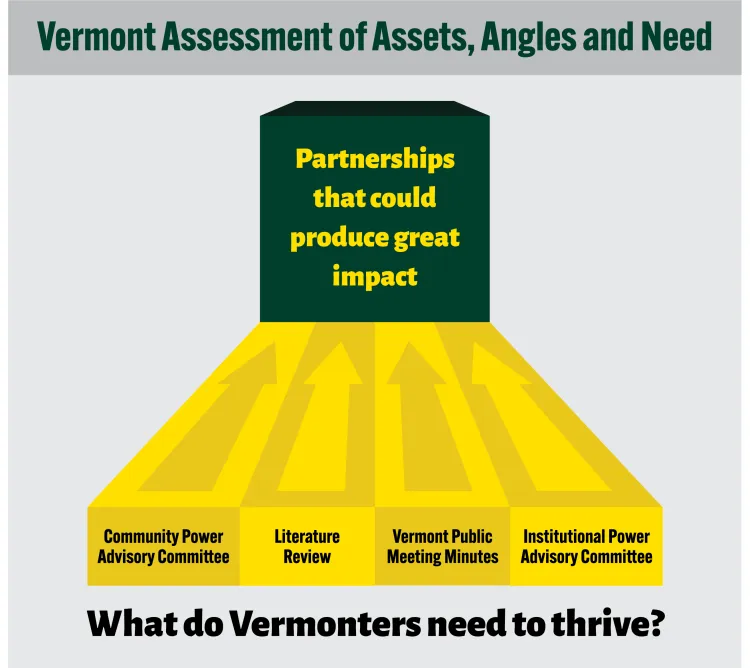
The process for Vermont communities informing the VAAAN about what they need to thrive has several, interwoven threads.
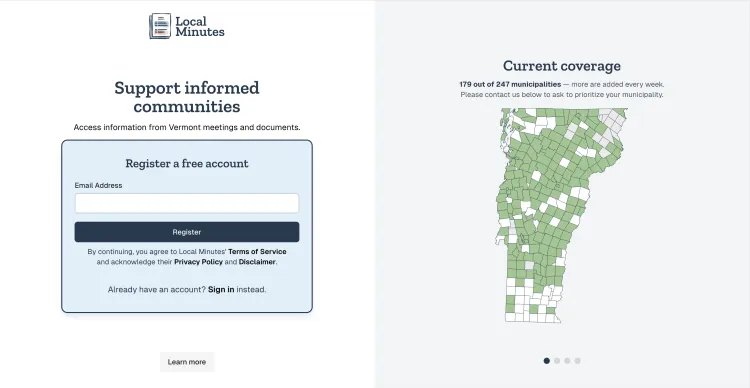
Thread No. 1: VAAAN is partnering with Local Minutes, which uses large language model (LLM) technology to gather Vermont's municipal meeting minutes and make that information searchable (and cited!) through a chat-like interface. It currently covers 179 towns and cities across the state.
Founder Duane Millar Barlow launched Local Minutes in 2025 — after joining the Essex Conservation and Trails Committee and getting assigned the role of writing minutes for the public record.
"I didn't even really know that I could find meeting minutes online, as a regular citizen who wasn't as plugged in," Barlow said. "There's actually really high-value information, and it's really hard to access it, and it really isn't accessed. And so I started thinking about, 'Well, what if we use this technology to preserve institutional knowledge, also to allow communities to learn from each other?'"
Municipal meeting minutes "are a great data source that's really grounded in real-time community conversations," said Mariya Shcheglovitova, a human geographer, Extension Assistant Professor of Community and Economic Development and VAAAN Co-PI. She and Barlow are working together on how Local Minutes can inform the VAAAN regarding Vermont communities' needs, and they're identifying steps they'll take to ground-truth that information, like a survey of subject-matter experts.
"It's a way that we can now take some of the results that we're seeing, and share them back out and say, 'Hey, are we picking up any trends that we shouldn't be that are false positives?' Or: 'Is there anything that we're missing?'" Shcheglovitova said.
She's also working on mapping the unique ways Vermont communities discuss the same core social life topic — education, for example.
"We see smaller rural populations talking about concerns over school closures and kind of this complex interaction between property taxes and local control and statewide imperatives," she said. "But then we see conversations in larger population places around education centering around things like a need for more childcare resources and a need for more educational opportunities in the trades."
Shcheglovitova added: "If we identify a single 'education' need for the whole state, we miss a lot of that nuance that we can start unpacking if we think about need as locally- and regionally-specific."
Threads No. 2 and No. 3: Simultaneous to the LLM analysis of municipal meeting minutes will be a thorough review of literature — peer-reviewed and community-generated — as well as the formation of two VAAAN advisory groups: one representing institutional power in Vermont, another representing the state's community power, at the grassroots level.
From all these sources, the VAAAN wants to understand not only what Vermont communities need, but also what it looks like when things are going well. In other words: what organizations and resources already exist as assets, and what angles or approaches are they using?
Postdoctoral Research Associate in Extension and Food Justice and VAAAN Co-PI Gianni Solórzano is overseeing the Community Power Advisory Committee. He's working on recruiting people who have experience, trust and pull within communities facing a lot of need.
"Vermont is an incredibly special place, and there are folks that care a lot, and that activate to do something about X, Y, Z that they care about," Solórzano said. "And also, sometimes that work ends up being very siloed. Sometimes work ends up being duplicated because folks aren't talking to one another."
For that reason, Solórzano is prioritizing finding community power representatives who understand their work can't happen in a vacuum — because, he said, they're most likely to actually use the online, interactive tool that the community advisory committees, literature and LLM are helping the VAAAN inform and build.
This online tool will be free and user-friendly, and it will allow people to explore Vermont’s assets, angles and needs by topic and geography. This builds on existing work by organizations like Vermont 2-1-1.
"We're still figuring out what platform we're going to use for the tool, but the goal of that tool is to be able to makes sense of the richness that is Vermont," Solórzano said. "So we're going to bridge, or triangulate those kind of various arenas of information... to give us a sense of: What are the partnerships that could produce a great impact?"
As an example: Solórzano said that once the online tool is up and running, a person interested something like improving food security in Vermont could filter by community or region to find out who's already doing food security work in their area, and whether there's work happening outside their area.
"Then they might be able to create a partnership, do some learning, do some research sharing," Solórzano said.
He added that this approach the VAAAN is taking, it has similarities to disability justice advocate Mia Mingus' pod mapping framework.
"[It's for] folks that can't look away from their needs, and have very specific needs at different times, need a very clear map of who they can go to for certain things," Solórzano said. "I think about that work and how can we be thoughtful about, if not replicating exactly, learning from those models and apply those learnings to the scale and the vision that we have with VAAAN."
The impact
The VAAAN project has gotten underway in 2026, and will last for two years. While this effort is still in its early stages, Interim Director of Extension and VAAAN PI Chris Callahan said the project is already having an impact, starting with the organization that's running it.
"Extension has, at least in my experience, been largely a group of teams that individually excel at responding to need," Callahan said. Over its more-than-100-year history, UVM Extension has done everything from helping the National Guard ship water to dairy farms during a drought to teaching municipal officials how to use the internet to conducting national research on tourism. And Extension has done its fair share of needs assessments.
But like a lot of people who care and take action based on that care in Vermont — Callahan said Extension can miss opportunities for collaboration, and perhaps more effective work.
"We're an organization that benefits from funding, public funding, and we should ensure that we are investing that wisely and ensure that we are investing that in ways that address community needs," he said. "And while we're doing that, why not bring others along with us and help them with understanding need, and addressing need in the same way, and collectively?"
Callahan credits Co-PIs Ike Leslie and Gianni Solórzano with pushing this latest Extension community needs assessment to engage with Vermont organizations, perspectives and resources already involved in addressing what Vermonters need to thrive.
He added that this approach will work in tandem with the launch of UVM's new "Green, Gold, and Bold" strategic plan.
The VAAAN's deep consultation with Vermonters will contribute to one of the strategic plan's four pillars around improving access and relationships between UVM and communities in Vermont and beyond.
And the VAAAN's identification of gaps between what Vermonters have and what they need will add to a second pillar of UVM's strategic plan, focused on understanding which research questions can produce the most impact.
"One of the key resource limitations that UVM is well-positioned to address is a gap of knowledge," Callahan said.
Linda Prokopy, Dean of the College of Agriculture and Life Sciences (which houses Extension), agrees that the VAAAN project will likely inform research, education and outreach going forward.
"I expect the outcomes of the Vermont Assessment of Assets, Angles and Need to help focus priorities across all our activities in the College," she said. "I think it will be useful across the university, and beyond."
On an interpersonal level, Callahan, the Interim Director of Extension, hopes the process of the VAAAN project makes people feel less alone.
"We're largely disconnected," Callahan said. "There's an epidemic of loneliness that former Surgeon General Murthy has identified very, very clearly. And you know, maybe in doing a project like this where we are engaging with communities in real conversations about what's needed and where their strengths are... maybe it's a little step in the right direction of getting reconnected as human beings."
He added: "I know good things come from that. When people get together and in civil discourse, good things happen."
How to get involved
Follow along with VAAAN updates on its landing page: https://www.uvm.edu/extension/vermont-assessment-assets-angles-and-need-vaaan.