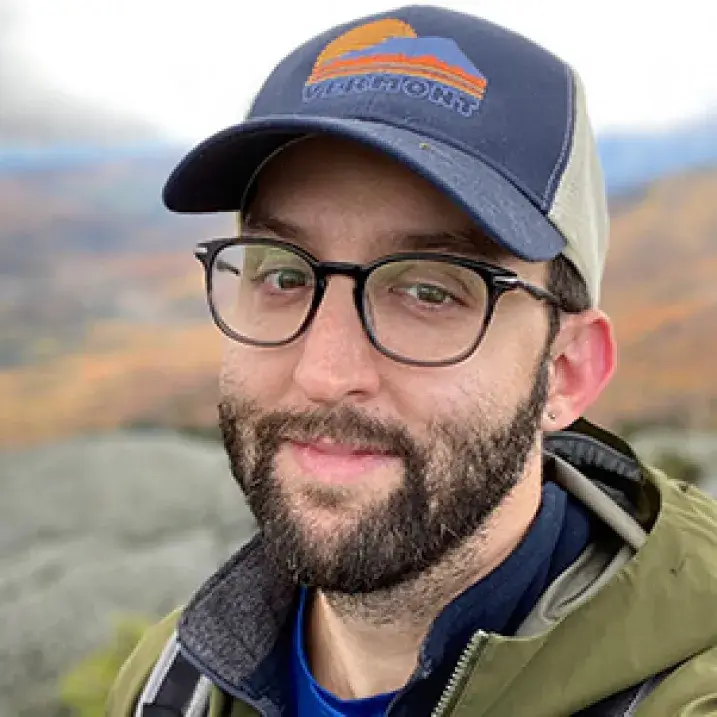
Dustin Kincaid
Post-Doc Researcher, Department of Civil and Environmental Engineering
Affiliate, Gund Institute for Environment
- Ph.D., Integrative Biology & Ecology, Evolutionary Biology & Behavior, Michigan State University, 2018
- B.S., Zoology & Biological Aspects of Conservation, University of Wisconsin - Madison, 2007
Department of Civil and Environmental Engineering
Areas of expertise
Project: Multi-scale watershed data analysis to understand ecohydrological resilience
Advisors: Scott Hamshaw, Julia Perdrial
- watershed science
- aquatic ecosystem ecology
- biogeochemistry
- sediment-water interactions
- team science
BIO
Dustin is a postdoctoral research associate with the Department of Civil and Environmental Engineering and formerly with Vermont EPSCoR's Basin Resilience to Extreme Events (BREE) project at the University of Vermont. His research broadly focuses on aquatic environments and the coupled movement of water and elements (e.g., nutrients and metals) within waterbodies and through landscapes.
Dustin studies how carbon, nutrients, and trace metals are transported from terrestrial ecosystems to headwater streams and from rivers to lakes. Dustin is particularly interested in how land use and climate change are altering these processes. Dustin studied (mucky) sediment-water interactions in shallow water bodies (i.e., small lakes, ponds, wetlands, and streams) for his PhD at Michigan State University's Kellogg Biological Station.
Bio
Dustin is a postdoctoral research associate with the Department of Civil and Environmental Engineering and formerly with Vermont EPSCoR's Basin Resilience to Extreme Events (BREE) project at the University of Vermont. His research broadly focuses on aquatic environments and the coupled movement of water and elements (e.g., nutrients and metals) within waterbodies and through landscapes.
Dustin studies how carbon, nutrients, and trace metals are transported from terrestrial ecosystems to headwater streams and from rivers to lakes. Dustin is particularly interested in how land use and climate change are altering these processes. Dustin studied (mucky) sediment-water interactions in shallow water bodies (i.e., small lakes, ponds, wetlands, and streams) for his PhD at Michigan State University's Kellogg Biological Station.