Stanna Dorn
Assistant Professor – Organic/Organometallic Methodology, Synthesis, Medicinal Chemistry

Innovation Hall E342
82 University Pl
Burlington, VT 05405
United States
- NIH K99/R00 MOSAIC and NIH NRSA F32 Postdoctoral Scholar, California Institute of Technology, Pasadena, CA, 2023-2026
- Certificate of Specialization in Leadership and Management, Harvard Business School Online, Boston, MA, 2025
- Ph.D. in Chemistry, Indiana University-Bloomington, Bloomington, IN, 2017-2022
- B.S. in Chemistry, Hope College, Holland, MI, 2013-2017
- B.A. in Music (Flute), Hope College, Holland, MI, 2013-2017
Areas of expertise
Organic chemistry, organometallic methodology, boron- and nitrogen-containing compounds, synthesis of medicinally-relevant small molecules.
BIO
Stanna was born and raised in rural northern Michigan, near Grayling. She obtained a BS in Chemistry and a BA in music at Hope College, where she performed organometallic research with Prof. Jeffrey B. Johnson. After a summer research experience in Prof. John Montgomery’s group at the University of Michigan, Stanna pursued her doctoral studies with Prof. M. Kevin Brown at Indiana University-Bloomington. Here, she developed cooperative catalysis methods for alkene carboboration, predominantly with copper and palladium. After receiving her PhD, Stanna worked as an NIH F32 and NIH K99/R00 postdoctoral fellow in Prof. Sarah Reisman’s lab at Caltech, where she gained synthetic and photochemical methodology experience. Currently, Stanna is an Assistant Professor at the University of Vermont, where she leads a research group focused on organic methodology and synthetic applications of boron- and nitrogen-containing compounds. Outside of the lab, Stanna enjoys playing the flute, participating in team sports, and finding the perfect bench for reading.
Courses
CHEM 5580 – Advanced Organic Chemistry I
Publications
Publications (from The Dorn Lab website)
Awards and Achievements
- NIH K99/R00 MOSAIC Postdoctoral Scholar, 2024-2029
- NIH NRSA F32 Postdoctoral Fellow, 2023-2024
- CAS Future Leader, 2022
- IU Chester Davis Fellowship, 2021
- IU Jack K. Crandall Award, 2021
- ACS WCC/Merck Research Award, 2021
- IU Burton L. Appleton Award, 2020
- IU Associate Instructor Award, 2018
- Hope College Southland Medal (Gerrit H. Albers Gold Medal), 2017
Bio
Stanna was born and raised in rural northern Michigan, near Grayling. She obtained a BS in Chemistry and a BA in music at Hope College, where she performed organometallic research with Prof. Jeffrey B. Johnson. After a summer research experience in Prof. John Montgomery’s group at the University of Michigan, Stanna pursued her doctoral studies with Prof. M. Kevin Brown at Indiana University-Bloomington. Here, she developed cooperative catalysis methods for alkene carboboration, predominantly with copper and palladium. After receiving her PhD, Stanna worked as an NIH F32 and NIH K99/R00 postdoctoral fellow in Prof. Sarah Reisman’s lab at Caltech, where she gained synthetic and photochemical methodology experience. Currently, Stanna is an Assistant Professor at the University of Vermont, where she leads a research group focused on organic methodology and synthetic applications of boron- and nitrogen-containing compounds. Outside of the lab, Stanna enjoys playing the flute, participating in team sports, and finding the perfect bench for reading.
Courses
CHEM 5580 – Advanced Organic Chemistry I
Publications
Awards and Achievements
- NIH K99/R00 MOSAIC Postdoctoral Scholar, 2024-2029
- NIH NRSA F32 Postdoctoral Fellow, 2023-2024
- CAS Future Leader, 2022
- IU Chester Davis Fellowship, 2021
- IU Jack K. Crandall Award, 2021
- ACS WCC/Merck Research Award, 2021
- IU Burton L. Appleton Award, 2020
- IU Associate Instructor Award, 2018
- Hope College Southland Medal (Gerrit H. Albers Gold Medal), 2017
Research and/or Creative Works
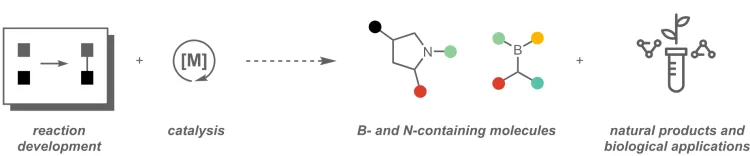
Research in the Dorn lab is focused on innovations in organic/organometallic methodology that provide new paradigms for the construction of boron- and nitrogen-containing molecules, with an eye towards translational applications. In particular, we will pursue novel reagent design, adapting traditional mechanistic paradigms for the modern era, and the development and synthesis of molecules that can interface with biology/medicinal chemistry disciplines. As part of these efforts, researchers in the Dorn lab will gain and deepen their expertise in organic methodology/synthesis, from mechanistic evaluation and organometallic synthesis to strategic synthetic planning and interdisciplinary applications.