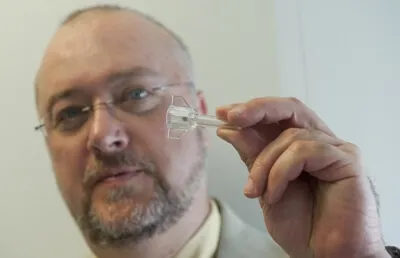
It is a simple plastic spout, no bigger than a piece of maple sugar candy. But it promises a huge impact on the maple industry and sweet dividends for many people in the State of Vermont.
A new maple tap spout innovation developed by Tim Perkins, University of Vermont Proctor Maple Research Center (PMRC) director, with funding secured by U.S. Sen. Patrick Leahy, could boost maple syrup production and increase the number of jobs and economic development in Vermont. The new spout can increase sap yields by 50 to 90 percent per tree, Sen. Leahy said during the spout's unveiling Aug. 17, 2009, at Progressive Plastics in Williamstown. Progressive Plastics manufactures this "check valve spout" for Leader Evaporator Company of Swanton, which licensed the technology from UVM and is selling it.
"The funding he secured for the maple spout development will deliver a significant return on investment in our state, at a time when Vermont needs good economic news," said Daniel Mark Fogel, UVM president.
Leader Evaporator received 1.5 million advance orders and projected sales of three million units; that would make the spout its number one selling product. Annual sales could be even higher, as the adapters will need to be replaced every year.
"It's going to add as much to syrup and sap production as vacuum tubing did," said Leader Evaporator President Gary Gaudette. "I'm confident that this is going to be the thing to use in the future." Gaudette estimates between 50 and 55 million taps in use in North America. Both Leader and Progressive Plastics report they are hiring workers despite the economic recession.
Stopping Backflow
The check valve consists of a small ball that rolls back and forth in a chamber within the spout to block the flow of sap back into the tree. All tapped sugar maple trees pull sap back into their tap holes as they try to balance the negative pressure established both by natural process and by vacuum systems now pervasive in the industry. Bacteria in the backflow cause the tree's natural defenses to plug the hole, thus ending a sugar maker's season. By allowing the sap to flow, the spout will extend the sugar-making season by 1 1/2 to 2 1/2 weeks, according to tests conducted at Proctor and confirmed by Leader's field tests. Sugaring season is typically four weeks long.
"It's 80 percent scientific, 10 percent knowledge and 10 percent black magic," Jim Johnson executive vice president of Progressive Plastics told "The Barre Montpelier Times Argus."
"Tim Perkins' maple tap innovation is one of several examples of the College of Agriculture and Life Sciences' efforts to develop new environmentally friendly products that promote agricultural viability, create jobs for Vermonters, and help the local economy," said Michael Vayda, Associate Dean of the College. "This is just the kind of outcome we had hoped for from our Ag. Innovations program: listening to our agricultural stakeholders, having our ingenious faculty develop innovative products to address their need, and working with private sector companies in Vermont to produce and market the product."
Some say the tap could even lessen the effect of global warming on the Vermont maple industry. Warming has already shortened the Vermont maple season by 10 percent over the last 40 years, according to research conducted by Perkins. "It's very gratifying to see federal dollars pay such clear dividends," Sen. Leahy said. "We all look forward to the impact this ingenious new product is going to have on the state's sugar makers and on two important Vermont companies, as well as to the economic spillover effect it will create in our state as a whole."