The U.S. Department of the Interior has renewed its support for the Northeast Climate Adaptation Science Center (NE CASC) with a five-year, $4.5 million commitment for its six-member consortium of universities, new this year to include the University of Vermont. The Northeast region ranges from Maine to Wisconsin and Maryland to Missouri, and the University of Massachusetts Amherst serves as the host campus for the center.
Scientists affiliated with the center provide federal, state, and other agencies with region-specific results of targeted research on the effects of climate change on ecosystems, wildlife, water, and other resources. These are used in resource management and planning. The new agreement continues Interior’s original seven-year, $11 million grant to the NE CASC at UMass Amherst that began in 2011. The University of Vermont joined the consortium in September 2019.
“Inclusion as a consortium member as part of the Northeast Climate Adaptation Science Center is a tremendous opportunity for UVM to further advance its commitment to developing actionable science for addressing the impacts of climate change and other stressors on critical habitats and species in the northeastern U.S.,” says Tony D’Amato, UVM principal investigator for the consortium and faculty member in the Rubenstein School of Environment and Natural Resources. “The center’s strong commitment to co-production of adaptation science with resource managers is consistent with UVM’s Land Grant mission and will enhance our ability to address the challenges facing the state and region due to an increasing frequency of climate extremes, disturbance events, and invasive species.”
The University of Vermont receives $328,450 from the grant over the next five years with opportunities for additional funds over this period for addressing priority research needs as a consortium member.
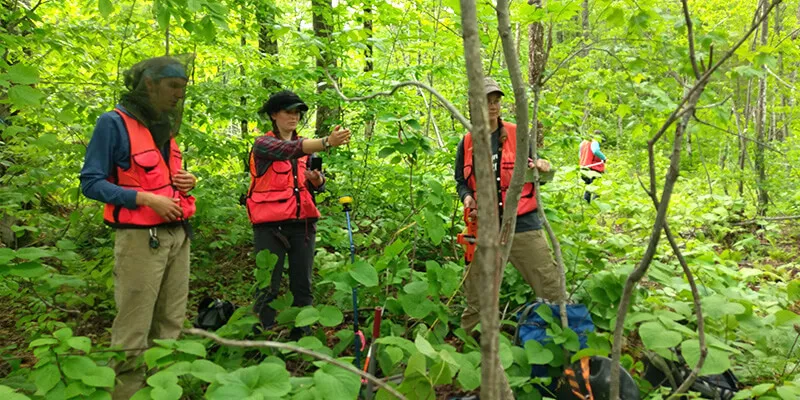
D’Amato, a former principal investigator with the original NE CASC consortium while a faculty member at the University of Minnesota, evaluates the effectiveness of forest adaptation strategies at sustaining forest habitats, ecosystem processes, and forest biodiversity across the northeastern U.S. and Lake States region. His research team uses large-scale, multidisciplinary forest adaptation experiments co-designed with land managers to test approaches for adapting forests to changing precipitation and temperature regimes and non-native insects and diseases. These experiments inform modeling and broader planning efforts for addressing climate change impacts and sustaining forested habitats across the region.
NE CASC co-director Richard Palmer at UMass Amherst says the center’s renewal means it can continue helping natural resource managers with detailed information relevant to their specific area and to the particular problems they face with climate change effects on fish and wildlife, or the effects of rising sea levels or floods. A major goal is to provide a sound foundation for decision-making and risk management.
He points out, “The NE CASC ensures that natural resource managers have access to the best available climate science to make important management decisions. We can help them to incorporate climate science in evaluating and planning for the future health of wildlife, fish, forests, and habitats.”
Other significant NE CASC accomplishments to date include:
- As part of the Regional Invasive Species and Climate Change Management Project at UMass Amherst, researchers used a new impacts assessment method to identify the highest-impact range-shifting invasive species. They will convene invasive species managers to work together to prevent these species from being introduced to the region and develop proactive management plans.
- A NE CASC project is aimed at conservation of cold-water fish. Cold-loving trout will attempt to move upstream as temperatures rise, but summer drought might result in empty stream beds. NE CASC has helped conservation groups decide how to best protect streams, maintain flow, and keep fish cool and connected.
- Through a partnership with the Commonwealth of Massachusetts, NE CASC researchers provided a standard, peer-reviewed set of projections that show how the climate is likely to change in Massachusetts through the end of this century. This is to help municipalities, industry, organizations, state agencies and others anticipate such things as temperature or precipitation change and sea level rise.
- NE CASC researchers examined ecological impacts of the emerald ash borer on black ash forests. They designed large-scale experiments and documented impacts of black ash mortality on ecosystem processes and wildlife communities and evaluated mitigation and adaptation strategies under future scenarios.
- NE CASC researchers developed a model to assess ecosystems and their capacity to sustain wildlife populations in the Northeast as it faces urban growth, climate change, sea-level rise and other stresses. This led to “Connect the Connecticut,” a tool that helps to identify priority areas for strategic habitat conservation in the Connecticut River watershed.
- NE CASC scientists have given hundreds of talks and seminars, contributed to more than 200 publications, and have created 24 web-based interactive tools that are used by dozens of wildlife ecologists, state agencies, tribes, town planning boards, and local conservation groups, It offers newsletters and webinars to circulate research news, tools, and opportunities.
The NE CASC is one of eight established by the Interior Department since 2009. In addition to UVM and host UMass Amherst, the NE CASC consortium includes the University of Missouri, University of Wisconsin, Cornell University, and the College of Menominee Nation in Keshena, Wisconsin. Also eligible for funding through NE CASC are Columbia University, Woods Hole Research Center, and Michigan State University.