Perhaps no human-environmental relationship is as fraught and complex as the one between the worldwide economy and plastics.
In SEP 1770: Plastics, Petrochemicals, & Life, students learned the biophysical and social sciences of plastics. Given their variable appearance, it can be easy to forget that plastics are petrochemicals; made from oil and natural gas. Petrochemicals also include PFAS and PFOS, BPA and other bisphenols, phthalates, vinyl chloride (the main chemical spilled in the East Palestine train derailment in 2023), formaldehyde, and thousands of additional substances. One of the goals of the course is for students to understand how plastics are inextricably linked to global fossil fuels regimes and the worldwide chemical and consumer industries.
Plastics, Petrochemicals, & Life was designed and taught by Professor and Rubenstein School Ph.D. Alumna Lucy Drummond. Dr. Drummond's Ph.D. examined environmental justices issues related to plastics and the UN Plastics treaty. Frontline communities most impacted by plastics fought hard for a comprehensive, ratified treaty, but it still has not passed. “Despite that, there’s been a global movement built around this treaty that we should treat as a success, and potentially build a form of governance around,” Drummond explained. “Most countries do want to reduce production and have a strong treaty.”
Another chapter of her Ph.D. thesis was more personal. “I wrote an auto-ethnography about what it was like being pregnant and plastics,” Drummond said. “Plastic is in everything; plastic is in breastmilk, plastic is in the human placenta. That section looked at the emotions and impact of that reality and the limited choices I felt like I had."
Explaining further, Drummond said: "It’s a peculiar mental twist, reading about how avoiding plastics and their attendant endocrine disrupting chemicals, during the time a male fetus is in the womb is one of–if not the–most important windows for preventing endocrine disruption to human anatomy. At the same time, daily plastic exposure is impossible to avoid, like at most mealtimes and even at prenatal checkups at the doctor’s office. Carrying a baby while doing this research was bizarre.”
The course draws heavily from her Ph.D. work. “I hope in sharing my experience I can help normalize how complex and fraught the environmental decisions people make every day are. But there is a lot of hope in thinking through tricky environmental problems together. I want students to walk away from the course feeling that the community we built is a solution in and of itself–we are actively working towards the movement we hope for.”
“I don’t think there’s any man-made product as ubiquitous as plastic,” Drummond reflected. “It’s been found at the top of Everest and the bottom of the Mariana Trench. It’s found in human blood, arteries, and has even crossed the blood-brain barrier. Generally, students come into the class already knowing those scary statistics. They’re aware of how ubiquitous the problem is. I really try to focus on systemic and systematic solutions.”
Drummond wants her students to become fluent in the varied and multi-scalar issues that plastics present. "Industry has focused attention on plastics as a consumption and waste issue," Drummond explained. "But in this class, students learn the reality of harm across the plastics 'lifecycle.'
Students spent the first part of the semester getting familiar with the literature and talking points around plastics and petrochemicals—they heard from guest speakers, read articles from academic, law, and medical journals, and grew more comfortable tackling the thorny topics in group discussions. “In this course, students learn that environmental issues are linked to so many other things, and they think in a more global and circular context,” Drummond said. “Plastics are the perfect lens through which to learn that environmental issues have deep societal contexts and histories that need to be understood.”
The course’s final project was a group effort focused on solutions to any of the myriad plastics problems that students learned about and wanted to pursue further. “The unlimited choices available for final project topics can be kind of overwhelming,” Drummond confessed, “but I’ve been building them up to this. They’ve had their midterm, they’ve had to explain their mastery of course content, they’ve had time in class to talk about the topics that interest them. They get to choose something that’s come up in the course that really compels them and see where it takes them. The project has to involve some kind of action—I want them to understand that they are part of the solution and they are change-makers.”
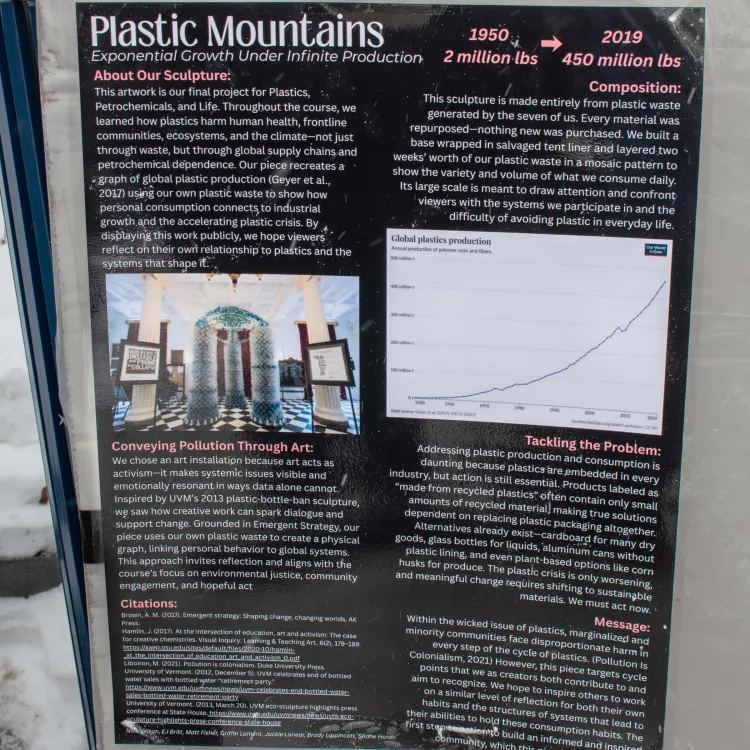
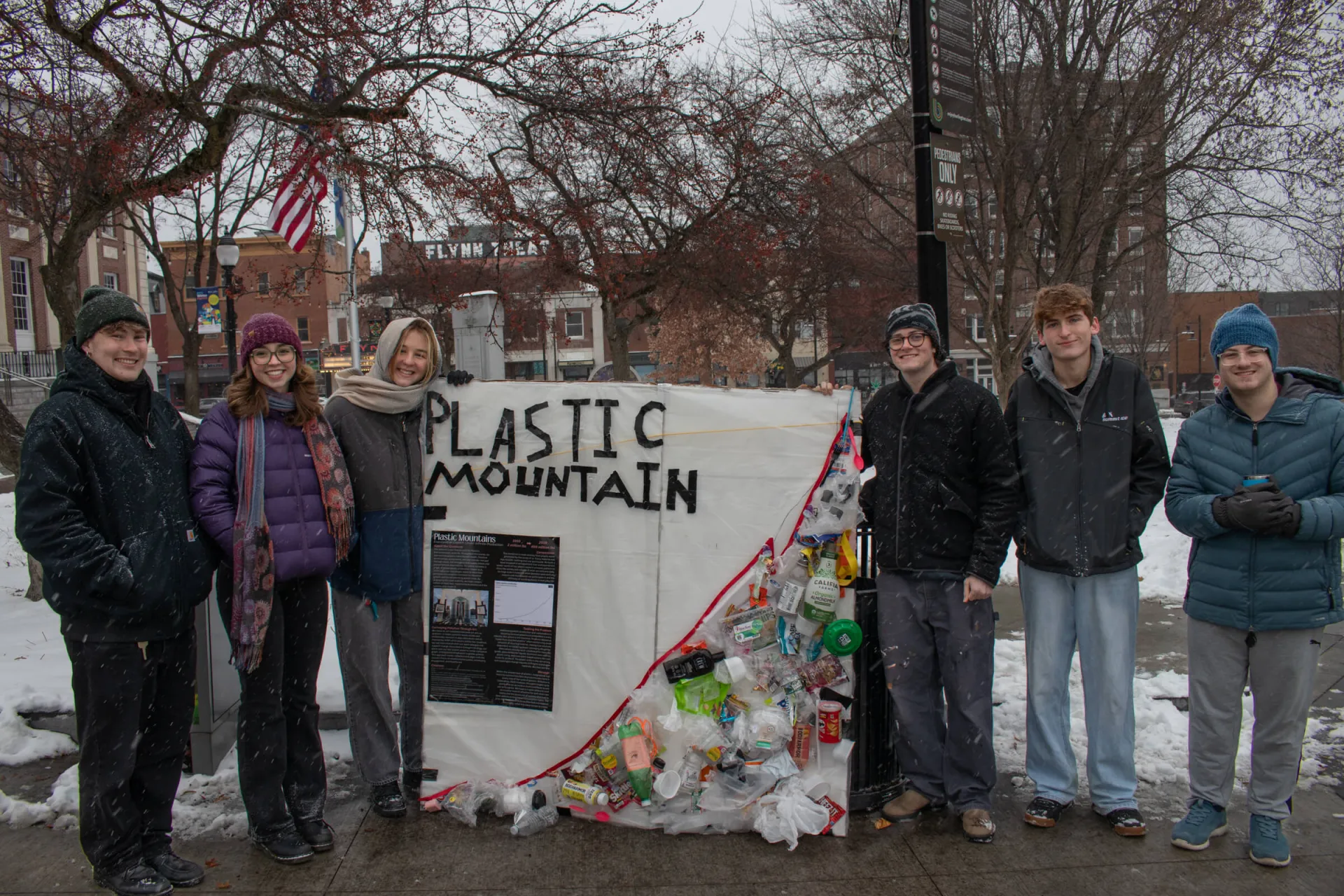
On a cold, snowy day in December, Drummond’s students took action. The students convened in City Hall Park in downtown Burlington with course deliverables such as posters and presentations, and lots of hot chocolate to share with passers-by. The goal was to educate people who walked through the park and hopefully inspire them to learn more and think deeply about the impact of plastics on their local and global communities.
“We were inspired by the 2013 Plastic Water Bottle Ban Sculpture in the Davis Center here at UVM that was built for the Plastic Water Bottle Retirement Party that students planned and threw,” EJ Britt, a sophomore studying Environmental Sciences, explained. “They added on to the plastic and added a large dome to the sculpture to preserve it and brought it to the Vermont State House, which prompted a discussion about banning plastic water bottles statewide.”
The group was inspired by the activism of those students who came before them and chose to focus their project on global plastic production and how their own behavior contributes to the crisis of unfettered plastic production. They collected all the plastic they used and would have normally disposed of in a week to create a visual representation of the waste and the difficult choices that people are forced to make about their own plastic consumption every day.
“Most of us are fairly aware of our plastic consumption thanks to this class,” EJ said. “And yet, we were collecting so much stuff—it was really scary.” The students considered themselves to be in the minority compared to other Americans regarding their plastic use: they avoid it when they can, use reusable containers, have quit using plastic straws. They wondered how an average American consumer’s weekly rate of plastic use might be much higher, and how educated most people are about the harms that plastic can cause to their health and to the ecosystem.
“One of the big things we were hoping to do with this project is spark a lot of reflection,” Jackie Lanear, a sophomore Environmental Sciences major said. “We wanted to take accountability for our own consumption and waste creation as well as recognize that we are part of a system that makes this rate of consumption possible.” The group hoped that by showing their waste and the systems that allow and encourage its accumulation to their classmates and fellow Burlingtonians, others might begin to consider how they fit into those systems.
When asked what lessons they would carry forward into their futures from the course and from the project, the students had lots to offer. “Overall, I’m taking away the knowledge that the plastics crisis is just as much of a humanitarian problem as it is an environmental problem,” Shane Horan, a sophomore SEP major offered. “We need to address it in a way that will actually effect change, rather than ways that make people feel happy and good about themselves.”