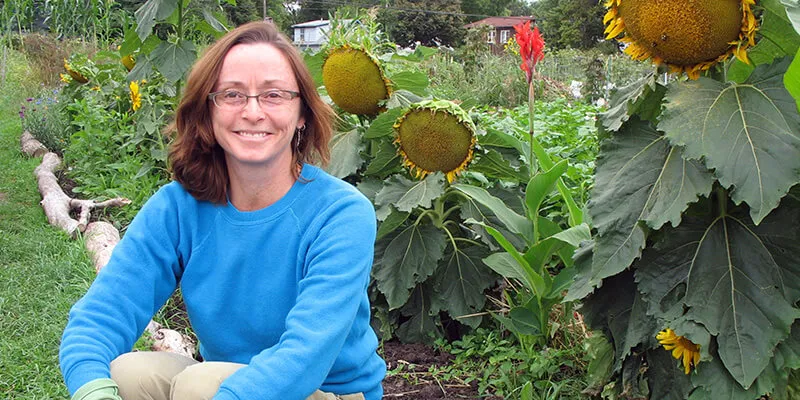
This fall semester, Dr. Trish O’Kane joins the University of Vermont Rubenstein School and Environmental Program as a Lecturer with a focus on sustainability education and communication. She comes to UVM as part of a unique faculty cluster hire in Sustainability Studies with an emphasis on Global Resource Equity.
Dr. O’Kane uses participatory research and community-based teaching methods to promote environmental and social justice. Her investigative journalism background and her research have focused on civil, environmental, and human rights. Her specializations include ornithology and urban ecology, sustainability and development, and watersheds and wetlands.
“We are excited to welcome Dr. O’Kane to the School and to the Environmental Program,” acknowledges Dean Nancy Mathews. “Her expertise and experience in environmental and social justice, investigative journalism, and sustainability education will inspire our students and catalyze new ways of working with our community. Dr. O'Kane's focus on community-based learning and participatory research will further strengthen the strong connection between the School and the Burlington community.
Dr. O’Kane recently completed her Ph.D. in Environmental Studies at the University of Wisconsin-Madison. Her dissertation grew into an action research project to help organize a community to protect a local wetland and bird habitat in one of Madison’s largest green spaces. In 213-acre Warner Park, across the street from her home, she identified 141 bird species over eight years of study. She then used ethnography and social science survey methods to assess whether knowledge of this biodiversity changes public attitudes towards urban green spaces and wildlife and how connecting with nature improves public health. Her work will be published as a how-to book for participatory researchers and community advocates in environmental justice.
Former investigative journalist turned educator, Dr. O’Kane taught creative writing at the Julia Tutwiler Prison for Women in Alabama. She taught journalism and communications at Auburn University in Alabama and Loyola University in New Orleans until Hurricane Katrina in 2005 forced her evacuation and destroyed her home. The disaster gave her a new perspective about the resiliency of the environment, in particular birds. She has more recently taught community-based courses in environmental studies and ornithology at the University of Wisconsin’s Gaylord Nelson Institute for Environmental Studies.
“My goal in teaching is to connect students with the environment around them,” she explains, “to get them to see and hear more, whether it’s seeing poverty, ecological degradation, social or environmental injustice or hearing birds in their local park for the first time.”
Dr. O’Kane created the Nelson Institute’s largest community project-based capstone course called Birding to Change the World. For the past five years, she trained undergraduates at the University of Wisconsin as mentors for middle school students from one of Madison’s poorest schools. The program gave the local students a new appreciation for Warner Park and its wildlife.
“The course became a wonderful opportunity for undergraduates to immediately apply the knowledge they learn,” she points out. “It also challenged the undergraduates’ assumptions of urban youth, as they watched their roles reverse and the middle school students become the experts as local guides. I like to turn my students upside-down and give them new ways to look at the world.”
Dr. O’Kane trained 123 undergraduates to mentor more than 250 middle school students, over half students of color. She is excited to try out the course in Burlington with new students in a new location.
“I consider myself a bridge-builder who helps universities better serve the public,” she explains. I achieve this by creating courses and outreach programs that teach critical thinking skills. By harnessing the power of passionate, knowledgeable, and energetic college students, we can help solve community problems.”
She intends to replicate another of her courses, What Does the Fox Say?, which considers how urban wildlife species survive and what lessons they teach us about living sustainably. Students learn through the use of field observation and documentation techniques. In addition to creating a “Birding to Change the World” program for UVM, Dr. O’Kane will also teach a new environmental writing course in the spring in which students will be encouraged to publish their work.
Before turning her career to teaching, Dr. O’Kane was a social science researcher and human rights investigator and journalist during the late 1980s and 90s in Central America and the southern United States. During the tail end of Nicaragua’s financial and cultural revolution, she researched and wrote articles for an economic research institute to help improve economic literacy in the country.
As part of a United Nations verification mission in Guatemala, she and dozens of other journalists investigated and documented human rights violations and massacres of the 1970s and 80s by the Guatemalan army, paramilitary groups, and guerrillas. Back in the United States at the Center for Democratic Renewal in Atlanta and the Southern Poverty Law Center in Alabama, she turned her attention to hate crimes in the South and investigated and reported on white supremacist activity to inform changes in public policy.
Dr. O’Kane earned her M.S. in Development Studies from London School of Economics, her M.A. in International Journalism from University of Southern California, and her B.A. in Spanish/Latin American Studies from University of Southern California.
She is the author of numerous newspaper and magazine articles and is published in The New York Times, The Chronicle of Higher Education, The Christian Science Monitor, San Francisco Chronicle, and Time Magazine. She is also author and editor of several books and book chapters.
She and her husband, Jim Carrier, a documentary filmmaker and book author who freelances for The New York Times, will settle in Burlington’s New North End. A ferocious knitter, a singer, ukulele player, organic gardener, cook, bike commuter, and of course, birder, she is eager to learn about the Burlington community and to build a birding program for kids.