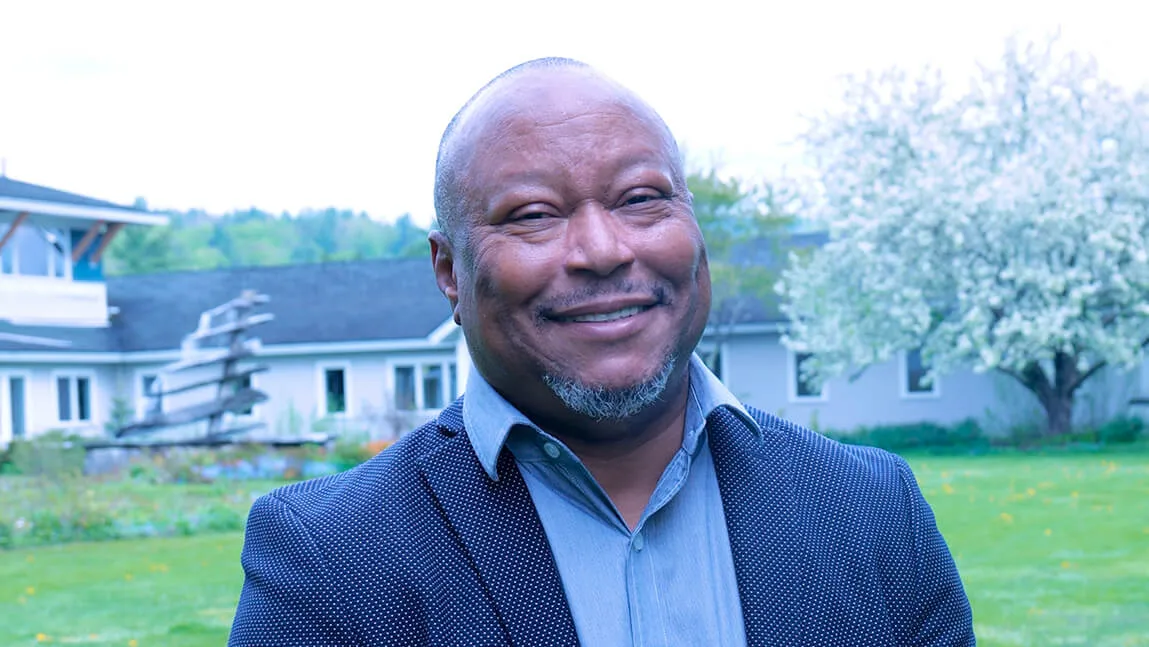
UVM Extension Director Fitzroy “Roy” Beckford embodies the University’s “for people and planet” mission -- he is passionate about the impacts of climate change and the inextricable connection between environment, health and social justice around the world. He arrived at UVM in May 2021 with an impressive portfolio: domestic experience in land-grant university (LGU) system outreach and research; a global perspective (having worked in Africa, Haiti, the British Virgin Islands, Qatar and Belize); and a commitment to making an impact in the fields of sustainable agriculture, climate change adaptation and social equity.
Beckford is the author of two books, including Poverty and Climate Change: Restoring a Global Biogeochemical Equilibrium (2019), which investigates how global biogeochemical cycles on the earth have been broken or are dangerously compromised, leading to soil degradation and depletion, ocean acidification, global warming and climate change. He points out that traditional European systems which enslaved and colonized people to further capitalism also abused land, water and air, resulting in poverty for millions. Solutions to these climate and poverty crises must first acknowledge the historic roles of both subjugated peoples and the economic beneficiaries of the environmental exploitations.
This global view of climate and social issues ties into Beckford’s current membership on the national Extension Committee on Organization and Policy (ECOP) Executive Committee and co-chair of its Climate Mitigation, Resiliency and Adaptation Program Action Team (PAT). In these roles, he is at the forefront of a national initiative which will marshal the resources of the land-grant university (LGU) system and its partners to address these critical issues, and focus on three primary goals:
- Increase inclusive and diverse collaborations and partnerships;
- Secure funding for climate-smart Extension education across all program areas (agriculture and natural resources, community development, family and consumer sciences and 4-H/youth development) and LGU’s (“1862” Morrill Act, “1890” historically Black colleges and universities; and “1994” tribal colleges); and
- Uplift the skills of Extension faculty and staff by supporting climate-related professional development offerings throughout the system.
Leveraging programmatic expertise across the entire LGU system is essential to a holistic approach because, as Beckford puts it, “Climate impacts all of those areas and we need to be as wide-sweeping as we possibly can to be successful.”
Formal collaborations began in January 2024, when Beckford and co-chair Jason Henderson (Iowa State University), brought 55 representatives from LGUs, USDA and the Extension Foundation together for the inaugural “Climate Convening.” The central question guiding the gathering was: “How can we mobilize the U.S. Cooperative Extension system to quickly and effectively contribute to climate change solutions?"
The long-term goal is a climate action plan which will guide more coordinated partnerships among LGUs, Sea Grant Extension, EDEN (Extension Disaster Education Network), the National Extension Climate Initiative, the North Central Climate Collaborative, and federal and state partners. The plan will focus on four priorities: provide climate-smart education and outreach (for policymakers) and technical assistance (to communities and land managers/stewards); build a climate-smart workforce for Extension and beyond; and advance climate-informed community health equity and well-being.
The “National Climate Change Roadmap” developed by USDA-NIFA (United States Department of Agriculture-National Institute of Food and Agriculture) underpins the initiative. It is a research framework for agriculture, forestry and working lands focused on systems-based innovation; participatory research; mitigation and adaptation through ecosystem management; climate-informed water resource management; energy-smart agriculture and technology integration; strategic, sustainable and regenerative agricultural practices; and socio-economic and policy research.
Since summer 2023, Vermont communities have experienced multiple catastrophic flooding events, and Beckford was tapped in August 2023 to co-chair the Vermont Agriculture Recovery Task Force which released its Extreme Weather Impact and Recovery Final Report in February 2024. When asked about the connection of the national climate initiative to the Task Force’s work, he quickly explained, “Local-level experiences can be used to scale to other situations. They are a microcosm of bigger, broader issues, and the lessons learned and approaches given can be applied to solve problems on a larger scale.”